

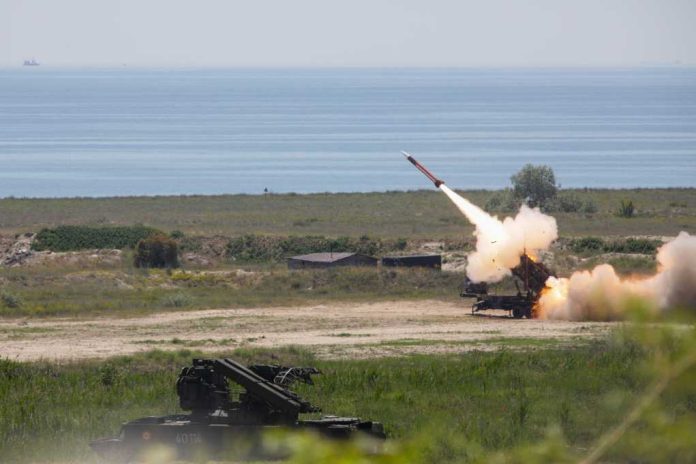
Iran fired seven ballistic missiles and launched drone swarms at Kuwait and Bahrain — and American forces were among the targets — raising urgent questions about whether the region is sliding toward a broader war despite ongoing diplomatic contacts.
Story Highlights
- U.S. Central Command confirmed Iran launched seven ballistic missiles toward Kuwait and Bahrain, with missiles aimed at Bahrain intercepted and those targeting Kuwait falling short.
- Iranian drones targeting American forces stationed in Kuwait were shot down by U.S. air defenses, marking a direct military confrontation between the two countries.
- Iran’s Islamic Revolutionary Guard Corps framed the strikes as retaliation for a U.S. attack on an Iranian oil tanker and a subsequent strike on Iranian communications facilities on Qeshm Island.
- Despite the exchanges of fire, diplomatic channels between Washington and Tehran reportedly remained open, leaving the status of any ceasefire deeply uncertain.
Missiles Over the Gulf: What Happened
U.S. Central Command confirmed that Iran launched seven ballistic missiles targeting Kuwait and Bahrain in what officials described as a serious escalation of regional hostilities. [3] Missiles directed at Bahrain were intercepted by air defense systems, while those aimed at Kuwait failed to reach their targets. [1] Separately, Iranian one-way attack drones launched toward American military personnel stationed in Kuwait were shot down before causing casualties. [3] Air raid sirens blared across both Gulf states as the strikes unfolded.
The strikes did not occur in a vacuum. According to reporting, Iran’s Islamic Revolutionary Guard Corps described the launches as direct retaliation for a U.S. strike on an Iranian oil tanker near the Strait of Hormuz and a follow-up American attack on Iranian communications infrastructure on Qeshm Island. [1] That sequence — action, counter-action, counter-counter-action — illustrates how rapidly the Gulf can spiral when military incidents go unanswered, and how difficult it becomes to identify a clear starting point once the cycle accelerates.
Iran’s Drone and Missile Strategy Is Not New
Analysts at the Center for Strategic and International Studies (CSIS) have documented Iran’s use of drones and ballistic missiles as a layered coercive tool against Gulf states and U.S. forces over an extended period. [4] Drones account for roughly 71 percent of recorded Iranian strikes in CSIS data, with targets ranging from military installations to energy infrastructure and economic centers. [4] The volume and persistence of these launches reflect a deliberate strategy rather than isolated incidents, designed to impose costs without triggering a full-scale conventional war.
What makes the current episode distinct is the direct targeting of American personnel and the involvement of two Gulf Cooperation Council member states simultaneously. [3] Prior Iranian drone and missile campaigns, while serious, were more frequently aimed at Saudi Arabia and regional proxy conflicts. Striking Kuwait and Bahrain — both of which host significant U.S. military assets — raises the threshold considerably and puts pressure on Washington to respond in ways that could either de-escalate or ignite a broader conflict. [2]
Diplomacy Hangs by a Thread
Despite the military exchanges, reporting indicates that diplomatic channels between the United States and Iran had not formally collapsed at the time of the strikes. [1] Iranian officials reportedly characterized the conflict as a cycle of action and reaction rather than a deliberate decision to end negotiations. President Trump, according to available reporting, had not publicly declared diplomacy dead. [1] That ambiguity is itself a source of instability — neither side has clearly defined what crossing which line would end talks permanently.
Videos from Bahrain show interceptor missiles streaking across the sky as air defence systems responded to a potential threat. The developments came after Iran's IRGC claimed it had launched missiles toward American military bases in the Gulf in response to recent US strikes on… pic.twitter.com/7edvuKicYg
— Srijan Pal Singh (@srijanpalsingh) June 6, 2026
For Americans watching this unfold, the stakes are straightforward: U.S. troops were targeted, allies were struck, and a volatile region just got more dangerous. Whether one believes Iran’s retaliation framing or views the launches as unprovoked aggression, the practical reality is the same. Energy markets, global shipping lanes through the Strait of Hormuz, and the safety of American service members are all in play. Early reporting in fast-moving Gulf crises frequently leaves key facts — exact damage, intercept rates, civilian harm — contested for days. [2] What is not contested is that missiles flew, drones were shot down, and the margin for miscalculation just narrowed significantly.
Sources:
[1] Web – Iran Fires Off Missiles In ‘Serious Escalation’ Toward Gulf Neighbors …
[2] YouTube – Iran Launches Drone and Missile Assault Across the Gulf | ET Now
[3] YouTube – Iran launches drone and missile strikes across Gulf countries in …
[4] YouTube – Iran Launches 7 missiles At Kuwait And Bahrain