

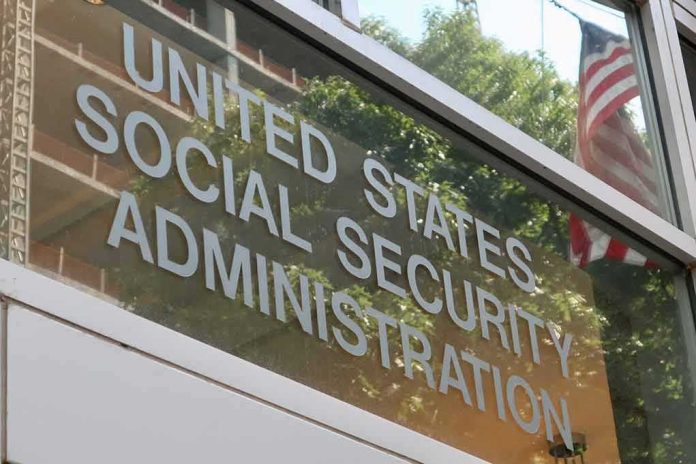
America’s main retirement safety net is now on a fixed countdown to automatic benefit cuts of about one‑fifth unless Congress finally acts.
Story Snapshot
- Social Security’s retirement trust fund is projected to run out of reserves around late 2032.
- Under current law, that would trigger automatic cuts of roughly 20%–24% in monthly benefits.
- The program would not disappear, but would pay only what payroll taxes cover, about three‑quarters of promised checks.
- Both parties know the math, but have avoided a long‑term fix for decades, feeding public anger at Washington’s gridlock.
Retirement Trust Fund Now Has a Firm Depletion Date
Social Security’s own trustees now say the Old-Age and Survivors Insurance trust fund, which pays retirement and survivor benefits, will be able to cover full scheduled payments only until the last quarter of 2032. That date is earlier than past estimates and marks when the program’s reserves will be gone. After that point, Social Security keeps running, but it can only pay benefits from yearly payroll tax income. That income is expected to fall well short of what has been promised.
The trustees and other reports explain that once the retirement trust fund is depleted, ongoing revenues will cover only about 78% of scheduled benefits. Other analyses put the post‑depletion payout between about 77% and 83% of promised checks, depending on whether they look at the retirement fund alone or combine it with the disability fund. That gap between income and promises is why many outlets summarize the impact as an automatic cut of around 20%–24% for all beneficiaries.
What a 20%–24% Cut Would Mean for Seniors
Nonpartisan budget groups warn that the legal formula is blunt: when the trust fund hits zero, benefits must be reduced across the board so total payments match annual tax income. One widely cited estimate says retirees would face about a 22% drop in benefits if lawmakers do not act before 2032. Another analysis, drawing on the 2025 trustees report, describes the cut as closer to 23%, tied to a payout level of about 77% of scheduled checks.
For a typical retiree, that kind of reduction would be painful. The Committee for a Responsible Federal Budget notes that the average Social Security beneficiary could lose more than $450 per month if the projected cut takes effect. A separate projection says many retirees may see monthly retirement and survivor payments fall by about 28%, showing how different models can produce slightly different numbers but all point to a major hit. None of these estimates rely on worst‑case politics; they simply apply current law to the financial math.
Why the System Is Sliding Toward Automatic Cuts
Social Security has run a cash shortfall since the early 2020s, drawing down a pool of surplus funds built up in past decades to keep full benefits flowing. That pool, once around $2.7 trillion across the two trust funds, is shrinking as the number of retirees grows and people live longer. Trustees have repeatedly warned that, without changes, those reserves will be exhausted in the early to mid‑2030s, with recent reports pulling the expected date forward to 2032–2034.
Once reserves are gone, Social Security will rely only on payroll taxes and a few smaller income streams. Current projections say those taxes will cover roughly four‑fifths of promised benefits, not the whole amount. Federal law does not let the program borrow to close the gap, so benefits must be cut to match income. This built‑in trigger explains why you see headlines about “insolvency” or “trust fund exhaustion”; they are shorthand for the moment when the program can no longer legally pay full scheduled checks.
Washington’s Long Pattern of Delay Feeds Public Distrust
Experts note a repeating cycle. Each new trustees report quietly shifts the depletion date a bit earlier, and media and policy groups translate that into a simple “X% cut” warning. At the same time, some voices rush to say Social Security is “not going bankrupt,” stressing that benefits will still be paid, just at a reduced level. Both messages are true, but together they can confuse people who just want to know if their check will be there and how big it will be.
For calendar year 2025 (the most recent full year with finalized data from the 2026 Trustees Report): https://t.co/ErAjHiLLJa
Combined OASI + DI Trust Funds (Social Security)Total Income: $1.45 trillionNet payroll tax contributions: ~$1.32 trillion (the vast majority)
Taxation…— Richard Belloff (@rrbelloff) July 23, 2026
This slow‑moving crisis speaks directly to a wider frustration many Americans feel. For more than a decade, Congress has known that the trust funds would be depleted in the 2030s. Yet lawmakers of both parties have avoided a full fix, choosing short‑term fights and campaign talking points instead of long‑term agreements. As the projected cut window moves to the early 2030s, millions of current workers and retirees see one more proof that Washington’s political class protects itself first and leaves ordinary people to absorb the consequences.
Sources:
theatlantic.com, ssa.gov, aarp.org, bipartisanpolicy.org, pgpf.org, finance.yahoo.com, usatoday.com, crfb.org, conduitstreet.mdcounties.org, cbsnews.com, facebook.com, thefiscaltimes.com, theconversation.com