

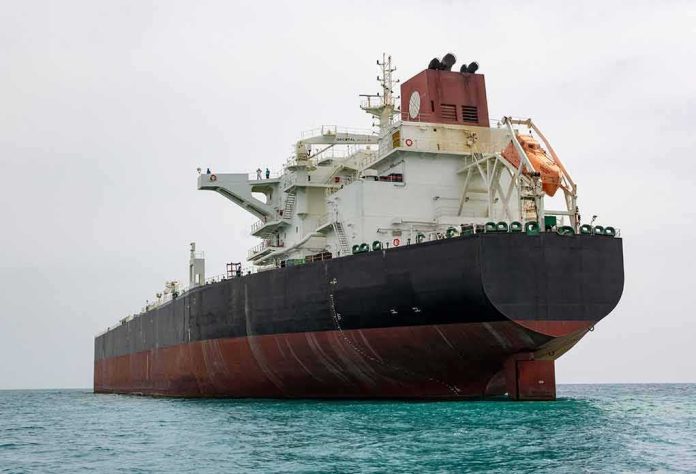
As Iran’s shadow oil fleet tests a U.S. blockade, American forces just sent a clear message in the Gulf: the rules are changing, and Washington will not let Tehran bankroll aggression with illicit crude.
Story Snapshot
- U.S. Central Command says a U.S. aircraft disabled an oil tanker that repeatedly ignored lawful blockade warnings while sailing toward an Iranian export hub.
- The tanker, reportedly tied to Iran’s sanctioned oil network, was hit with a precision strike that stopped it without causing a spill or mass casualties.
- Supporters see a necessary stand against Iran’s terror financing; critics abroad question the legality of the blockade and demand more transparency.
- The showdown highlights how energy, sanctions, and military power now intersect as the Trump administration leans on Tehran’s oil exports instead of more American blood and treasure.
U.S. Strike Halts Tanker Bound For Iran’s Oil Lifeline
U.S. Central Command reported that American forces disabled an oil tanker transiting international waters after the ship ignored repeated warnings under a U.S.-enforced maritime blockade.[2] According to Central Command, the Botswana-flagged tanker M/T Lexie was sailing toward Kharg Island, described as one of Iran’s primary oil export terminals, when it was intercepted.[2] Command officials said the crew refused to comply with multiple directives issued over roughly twenty-four hours, triggering authorization to stop the vessel short of Iranian waters.[2][4]
Central Command stated on its official channel that a U.S. aircraft ultimately disabled the tanker by firing a Hellfire missile into the ship’s engine room, preventing it from reaching Iran.[2][4] Military officials emphasized that the tanker was unladen at the time, meaning it was not carrying oil or other cargo, reducing environmental and safety risks.[2] The command framed the strike as measured enforcement of a standing blockade against ships attempting to enter or depart Iranian ports in defiance of U.S. sanctions policy.[1][3]
Blockade Enforcement, Sanctions Pressure, And Iran’s Oil Network
Central Command has described a broader campaign in nearby waters in which U.S. forces disable unladen, Iranian-linked tankers that attempt to cross a naval blockade line while heading toward Iranian ports.[1][3] Reporting notes that American aircraft and naval platforms have fired on multiple Iranian-flagged or Iran-linked tankers that tried to run the blockade, typically by targeting rudders or engine spaces rather than cargo holds.[1][5] This approach aims to stop the ship’s progress without sinking it or causing large-scale collateral damage that could inflame global markets.[1][2]
Independent tanker-tracking analysts have identified the Lexie as part of Iran’s sanctioned oil logistics network, noting it has moved tens of millions of barrels of Iranian crude since 2019 despite sanctions.[3] Central Command’s latest statement said the vessel was attempting to sail toward an Iranian port while under warning that such movement violated the declared blockade.[3][4] For supporters of a firm line on Iran, stopping a ship they view as a repeat sanctions violator aligns with the Trump administration’s pledge to squeeze Tehran’s oil revenue instead of tolerating backdoor exports that fund terror proxies and missile programs.[3]
Legal Questions, Global Optics, And Conservative Takeaways
Coverage of the incident has noted that virtually all present information on the strike comes from U.S. military and U.S.-aligned outlets, without radio transcripts, crew statements, or neutral maritime authority reports released yet.[1][3] Critics abroad argue that a self-authored Central Command narrative alone does not settle the legality of the blockade or demonstrate that every targeting decision met international standards.[3] They point to a long-running pattern where enforcing states present interdictions as limited and lawful, while opponents cast them as unlawful interference with commercial navigation.[3]
For many American conservatives, the key question is whether U.S. power is being used to protect American lives and interests while avoiding the long, open-ended ground wars that defined earlier decades. Central Command says American forces acted “deliberately and professionally” to ensure compliance with the blockade while remaining vigilant against Iranian attacks on U.S. forces in the region.[3] Supporters see disabling an empty tanker with a focused strike as a firm but restrained way to deny Iran oil cash, defend regional partners, and uphold sanctions without putting large numbers of American troops in harm’s way.[2][3]
Energy Security, Deterrence, And What Comes Next
Reporting notes that this action comes as tensions rise around Iran’s threats to U.S. forces and shipping lanes in the Strait of Hormuz, a chokepoint critical to global oil flows.[1][5] Central Command has released footage and statements highlighting its enforcement operations against tankers entering or departing Iranian ports on the Gulf of Oman, underscoring a broader effort to deter Tehran’s attempts to break sanctions at sea.[1][5] These operations signal that Washington is willing to use precise force to back up economic pressure with credible military consequences.[1][2]
US disables Iran-bound tanker, slaps new bans after Trump says talks ongoing
All Iranian attacks on US forces were unsuccessful,⁰CENTCOM says
IRGC says it struck US-linked vessel 'Panaya' after tanker attack near Strait⁰US says it intercepted Iranian missiles and drones— Arian Zare (@ArianZare3) June 3, 2026
For readers worried about energy prices at home, the fact that the Lexie and similar targets were unladen when hit matters because it minimized immediate supply shocks and avoided major spills even as the United States tightened the screws on Iran’s export capacity.[1][2][4] As more details emerge, Americans will be watching whether allies support the blockade framework and whether Iran escalates at sea or backs down in the face of firm enforcement that aims to starve its regime of oil money rather than sacrifice more American lives.[3][5]
Sources:
[1] Web – U.S. forces disabled an oil tanker headed for an Iranian port after …
[2] Web – US forces disable Iranian-flagged tankers trying to cross blockade
[3] Web – US forces disable Iranian-flagged tankers trying to cross blockade
[4] Web – U.S. Forces Disable Vessel in Gulf of Oman Attempting to Violate …
[5] YouTube – US military boards Iranian-flagged oil tanker suspected of trying to …