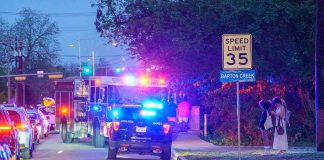
When federal agents execute a judge-approved search at a sitting lawmaker’s home, it is not political theater; it is the visible tip of a formal criminal process that requires facts sufficient to persuade a federal judge that evidence of specific offenses may be found at a particular place.
At a Glance
- Homeland Security Investigations executed a judicially authorized search warrant at Rep. Ilhan Omar’s Washington-area residence as part of an ongoing federal criminal investigation.
- Multiple outlets, citing people briefed on the matter, reported the probe involves immigration paperwork and potential false statements or fraud, alongside conspiracy theories of liability.
- Reporting describes the inquiry as yearslong and led by HSI with the Department of Justice and the U.S. Attorney’s Office in Minneapolis involved.
- The warrant’s authorization establishes probable cause to search, not proof of any offense; as of publication, no public charging document has been filed.
What Happened: The Search and the Stated Scope
The Department of Justice confirmed that Homeland Security Investigations executed a judicially authorized search warrant at a Washington, D.C.-area residence associated with Rep. Ilhan Omar and described the action as part of an ongoing federal criminal investigation. ABC News reported, based on sources briefed on the matter, that investigators are examining elements of Omar’s immigration paperwork; The New York Times likewise reported that the warrant referenced potential immigration crimes—specifically false statements and fraud in immigration filings—as well as conspiracy. Those particulars matter because they indicate a document-focused inquiry: investigators are not simply asking whether a law was broken in the abstract, but whether representations made to immigration authorities were materially false and, if so, whether others helped make or conceal them.
Search warrants of this kind are not casual measures. To secure one, federal agents submit a sworn affidavit to a magistrate judge setting out facts—documents, witness statements, data, patterns—supporting reason to believe that evidence of enumerated offenses will be found at the place to be searched. Approval signals the judiciary found that threshold met. It does not, by itself, establish that the suspected offenses occurred or that a particular person committed them; it authorizes evidence collection to answer those questions decisively.
How These Investigations Work: From Allegation to Warrant
Immigration-fraud and denaturalization cases move through well-defined stages. Investigators start with a referral—sometimes from U.S. Citizenship and Immigration Services (USCIS), sometimes from internal DHS audits, sometimes from parallel financial or identity-fraud reviews. They reconcile names, dates of birth, marital and family relationships, travel histories, and prior filings across agencies. Discrepancies that cannot be explained by translation variance or clerical error trigger deeper scrutiny: certified records from foreign custodians, school and passport files, and sworn statements from attorneys or interpreters involved at the time. If the pattern suggests possible criminal violations—such as willful false statements in immigration documents—agents seek judicially authorized access to physical or digital evidence likely to resolve the discrepancies.
According to NBC News, the matter at issue here has been characterized as a yearslong criminal investigation involving HSI, DOJ, and the U.S. Attorney’s Office in Minneapolis—an institutional footprint consistent with complex document cases that may straddle multiple jurisdictions and decades-old records. The Times’ account that the warrant enumerated potential immigration offenses and conspiracy is likewise consistent with an inquiry that contemplates whether inaccurate statements, if any, were made knowingly and whether any person assisted in their preparation or concealment.
The Legal Landscape: What “Immigration Fraud” and Denaturalization Actually Mean
Under federal law, denaturalization is possible when U.S. citizenship was “illegally procured” or obtained by “concealment of a material fact or by willful misrepresentation.” That standard is stringent, and historically, denaturalization has been rare. For decades, the United States averaged roughly a handful to a dozen civil denaturalization lawsuits annually; more recently, the Justice Department has mounted larger, coordinated filing initiatives. Public releases have detailed surges—periods when DOJ filed several dozen denaturalization cases targeting people alleged to have obtained citizenship through deception intertwined with other crimes. The consequence is severe: if a court finds fraud that goes to the heart of eligibility, it can revoke citizenship, which in turn can expose the person to removal in separate proceedings. Criminal charges for false statements or conspiracy can also arise on a parallel track, but they require proof beyond a reasonable doubt.
This context matters for interpreting the Omar probe: examining historical immigration representations is normal in such investigations; the government must ultimately show that any misstatement was both material and willful. The public record to date confirms a search warrant and the categories of suspected offenses under examination—not that the government has met the merits standard in court.
Timing, Process, and Probable Cause
The date of the search drew attention because it occurred close to an election, and several accounts noted the unusual optics of a visible step at that moment. Still, the operative legal fact is the judge’s authorization of the warrant, which necessarily reflects a finding of probable cause as to the presence of evidence at the location searched. ABC News and other outlets reported that officials emphasized the order was signed by a judge; DOJ described the warrant as judicially authorized. That procedural posture anchors the action in standard criminal process rather than discretionary “request for records” practice. The distinction is crucial: subpoenas compel production; warrants allow agents to enter and seize specific items designated by the court based on the affidavit’s showing.
Because affidavits supporting active warrants are typically sealed to protect witnesses and investigative integrity, the public cannot see the evidence agents relied on at this stage. As AP reporting underscored, the department did not provide additional details beyond confirming the search and ongoing investigation, and no charging document has been filed publicly. That information asymmetry is expected in midstream investigations, not an irregularity.
Federal investigators questioned Sahra Noor, the older sister of United States Representative Ilhan Omar, following a search of the congresswoman's Washington, D.C., home.
Noor spoke with federal authorities after agents executed a search warrant at the residence, while she was…
— Satguy 141 (@satguy01) October 21, 2026
What This Does and Doesn’t Establish Today
Three points are clear from the reliable reporting. First, federal agents executed a judge-approved search at a residence associated with Rep. Omar as part of an ongoing criminal investigation led by Homeland Security Investigations with DOJ involvement. Second, sources briefed on the matter say the focus includes immigration paperwork and possible false statements or fraud, with conspiracy also cited—hallmarks of a document-centric probe that aims to test the accuracy and materiality of statements made to the government. Third, the legal effect of the warrant is circumscribed: it supports evidence-gathering, not a conclusion on the merits, and as of now, there is no public indictment or civil complaint that delineates specific alleged misrepresentations, dates, or forms.
How to Read the Road Ahead
If investigators found relevant materials, the next procedural steps typically include forensic review of seized devices, authentication of records, witness interviews or grand jury testimony, and—if the evidence warrants—charging decisions or civil filings. In immigration-fraud matters, the government often builds a documentary chain from original foreign records through U.S. filings, cross-checking names, dates, and claimed relationships. Should the evidence support criminal counts, prosecutors decide whether to seek an indictment; if the theory is limited to civil denaturalization, DOJ files a complaint in federal court laying out the alleged material misrepresentations. Either route would move the dispute into an adversarial forum with rules of evidence, discovery, and a public docket.
Sources:
twitchy.com, npr.org, columbian.com, apnews.com, nbcnews.com, abcnews.com