When federal agents quietly mine household trash for genetic traces, they are not improvising; they are using a well-established investigative tool to answer a narrow, consequential question—identity and kinship—at the center of some of the most exacting claims in U.S. immigration and citizenship law.
The Short Version
- Justice Department officials confirmed a judicially authorized search at Rep. Ilhan Omar’s Washington residence amid a broader federal investigation; reporting describes boxes of documents removed and subpoenas to relatives.
- Multiple outlets, citing unnamed sources, say investigators collected discarded household materials in hopes of obtaining DNA from Omar and family before the raid; authorities have not confirmed DNA results or testing aims.
- Investigators are reportedly examining whether false statements or omissions in immigration paperwork—linked in part to Omar’s late father—occurred; denaturalization and related offenses require stringent proof standards.
- Omar rejects the allegations as baseless and politically driven; no charges have been announced, and key affidavits and lab records remain sealed or undisclosed.
What is firmly established—and what is still allegation
The backbone of this episode is not speculative: the Justice Department acknowledged executing a judicially authorized search at Rep. Ilhan Omar’s D.C. home as part of an ongoing criminal inquiry, and reputable reporting indicates agents removed boxes of materials during the search. The New York Times further reported that subpoenas reached at least two relatives, including Omar’s sister Sahra Noor, signaling a scope that extends beyond a single residence or subject. Separate coverage from Fox News likewise noted subpoenas to multiple family members.
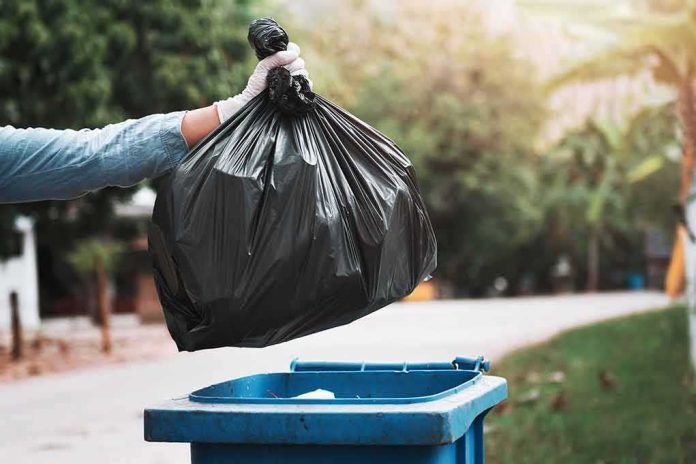
The most contested thread is genetic. NewsNation reporting, echoed by Yahoo republishing, The Hill, and others, attributes to unnamed investigative sources an effort to obtain DNA from discarded household trash in the lead-up to the search. These accounts are consistent with one another but remain uncorroborated by released affidavits, chain-of-custody documents, or laboratory reports. No official record establishes that usable DNA was recovered, much less what the testing sought to prove or whether it produced any probative result. On that point, skepticism is sensible; anonymity is not disproof, but dispositive claims require documents, not echoes.
How “dumpster DNA” fits into American evidence law
If agents did collect discarded items for DNA, the tactic sits squarely within conventional Fourth Amendment doctrine. In California v. Greenwood, the Supreme Court held that the Fourth Amendment does not prohibit warrantless searches of garbage left for collection outside a home’s curtilage; courts have since treated cigarette butts, cups, straws, or tissues as fair game once abandoned. While Greenwood concerned trash generally, its logic has been applied to biological traces left on those items; prosecutors then face separate admissibility and reliability questions at trial, but the acquisition itself typically does not require a warrant when abandonment occurs in public or at the curb.
DNA’s power is twofold: it can anchor identity and establish biological relationships—precisely the kind of facts that matter in immigration adjudications and fraud prosecutions. That potency, however, also raises civil-liberties concerns because genetic material reveals far more than a fingerprint; debates over forensic genetic genealogy and the scope of permissible searches continue to evolve, even as baseline Greenwood doctrine remains intact.
Why kinship and dates matter so much in immigration cases
The reporting nexus here is immigration paperwork connected to Omar’s family, including whether her late father omitted or misstated material facts before naturalization and how that would flow through derivative citizenship claims to a minor child. The Justice Department’s own guidance is clear: naturalization obtained “illegally” or “by concealment of a material fact or by willful misrepresentation” can be revoked, but the standard of proof for the government in denaturalization is high—clear, unequivocal, and convincing evidence of a disqualifying fact, as the Supreme Court set out in Kungys v. United States.
Materiality is not a casual threshold. A misstatement must have had a natural tendency to influence the decision to grant citizenship to qualify; errors on the margins rarely suffice, and the government generally must show intentional concealment or willful misrepresentation tied to eligibility. In parallel, some circuits have allowed denaturalization where a person gave false oral testimony under oath with the subjective intent to obtain immigration benefits, but courts still demand rigorous proof linking the falsehood to procurement of status. This is why investigators chase original forms, sworn statements, and corroborating records relentlessly—and why genetic evidence, if properly obtained and interpreted, can become decisive or irrelevant depending on the precise factual dispute.
The competing accounts and what each side has actually established
Omar’s position is categorical: she has called the allegations “baseless lies and smear campaigns,” castigating the inquiry as politically motivated targeting by the Trump administration; she has long maintained she became a U.S. citizen at 17 through her father’s naturalization. Those statements draw on well-traveled public narratives and interviews, and they carry rhetorical force. What they do not do—any more than the anonymous-source DNA claims—is resolve the specifics at issue in the investigation.
On the other side, federal actions carry more weight than leaks. A judge authorized a search at Omar’s residence, the department issued subpoenas to relatives, and agents carted away material for review; those are facts. Still, a search and subpoenas are investigative steps, not adjudications. The government has not announced charges, and the reporting that usable DNA was recovered—and what it showed—remains unconfirmed. In short: there is real smoke from validated government activity, and there are persistent flames in the anonymous-source narrative, but the evidentiary fire, if it exists, has not been shown in public.
How to read the road ahead—signals that actually matter
In investigations of this type, five milestones tend to convert speculation into substance. First, unsealing: if warrant affidavits or returns become public, they will reveal the government’s probable-cause theory, the specific items sought, and what was seized. Second, laboratory documentation: custody logs, lab submissions, and reports would confirm whether biological material was tested, methods used, and any conclusions—particularly kinship analyses. Third, grand-jury movement: target letters, immunity orders, or indictments would indicate the government believes it met statutory elements, including materiality and intent. Fourth, charging instruments: complaints or indictments will specify the alleged false statements, dates, and statutory hooks—passport fraud, immigration fraud, conspiracy, or denaturalization predicates. Fifth, defense motions: suppression or Franks challenges can expose investigative methods and, at times, the reliability of source material.
Until then, the prudent read is straightforward. The search and subpoenas are real and significant. The reported DNA collection method is legally conventional but, so far, not officially confirmed to have yielded anything probative. The substantive law governing immigration fraud and denaturalization is demanding, with the government bearing a steep evidentiary burden to show willful, material misrepresentation tied to eligibility. And the politics are inescapable: when the subject is a sitting member of Congress, anonymous-sourced narratives will be amplified through partisan filters long before primary records see daylight.
Sources:
yournews.com, yahoo.com, foxnews.com, politicalwire.com, bbc.com, thehill.com, tierneyrealnewsnetwork.substack.com, abc.net.au, criminallegalnews.org, justice.gov, eff.org, supreme.justia.com, law.cornell.edu