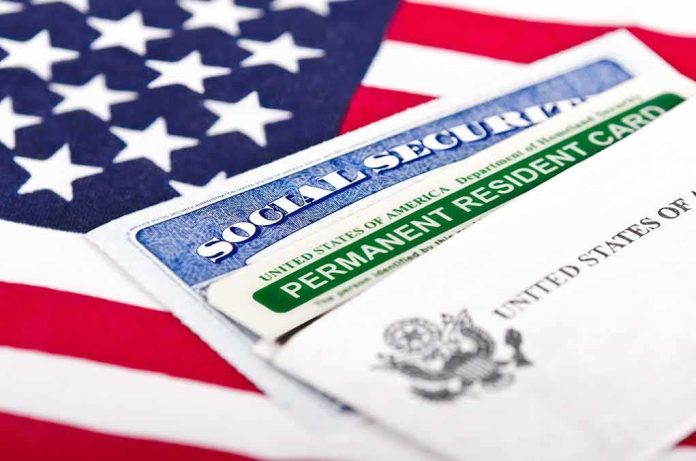
Courts do not run immigration policy day-to-day, but they do police statutory lines; the Diversity Visa injunction out of San Diego is a textbook example of a judge compelling an agency to execute a program Congress created, on a timetable that preserves the statute’s annual cadence without rewriting it.
The Short Version
- A federal court ordered the State Department to restart DV‑2027 registration, finding the government’s failure to open the lottery at odds with the Diversity Visa statute’s annual structure.
- The order sets a concrete schedule: public announcement, a defined entry window, and selection notifications, while leaving all screening and fiscal‑year limits intact.
- The Diversity Visa program is not a policy memo; it is a statutory pathway capped at roughly 50,000 immigrant visas per year for countries with historically low U.S. immigration.
- Demand dwarfs supply—more than 20.8 million qualified entries for DV‑2026—so a missed registration period affects millions, not a niche cohort.
What the court required—and what it didn’t
In Red Eagle Law LC v. Rubio, U.S. District Judge Jinsook Ohta granted preliminary relief directing the State Department to proceed with DV‑2027 registration after the administration paused the program in the wake of two high‑profile campus killings. Reporting on the order describes a near‑term schedule—public announcement by late October, a roughly 30‑day entry period opening by early November, and notification of selectees soon thereafter—designed to restart the statutory cycle in time to process through the 2027 fiscal year. The injunction does not conjure new visas or soften admissibility rules; it compels the agency to accept and process entries within the law’s ordinary constraints and through the statutory cutoff of September 30, 2027.
The State Department’s own notice aligned with that posture. Even as it deferred giving a registration start date, the Department stated the DV‑2027 visa application period would remain October 1, 2026, through September 30, 2027—the same fiscal framing the program has always used. Read together, the court’s schedule and the Department’s guidance restore the pipeline’s intake valve while leaving eligibility screening, interview staging, and annual numerical limits where Congress put them.
How the Diversity Visa program actually works
Created by Congress and codified in the Immigration and Nationality Act, the Diversity Immigrant Visa program allocates up to about 50,000 immigrant visas annually to nationals of countries with historically low rates of immigration to the United States. It is a two‑gate system. First comes registration and random selection, which functions like a queue assignment. Only if selected does an individual move to the second gate: the same document, background, medical, and inadmissibility screening that governs any immigrant visa issuance. Selection is permission to apply, not a visa in hand.
Two features shape the program’s public footprint. The first is scarcity; demand has long outstripped supply by orders of magnitude. For DV‑2026, the State Department recorded 20,822,624 qualified entries during a 37‑day window; by statute, only a fraction can ever convert to permanent residence. The second is composition; because eligibility tilts toward countries with low prior migration to the United States, the resulting cohort looks different from family‑ and employment‑based flows, which is the point of the design and a source of recurring political friction.
How the pause happened—and why litigation followed
The administration halted the DV program after officials linked the Brown University and MIT shootings to a suspect who had entered the United States years earlier on a diversity immigrant visa. Public statements framed the program as a security risk and directed a pause in processing. Those directives, however, collided with a statute that presumes an annual registration and adjudication cycle unless Congress changes the law. Plaintiffs in San Diego capitalized on that mismatch, arguing that failure to open DV‑2027 registration violated federal law’s structure and timelines; Judge Ohta’s preliminary injunction adopted their core premise and ordered the agency to restart intake on a defined clock.
A single notorious case can dominate the narrative, but it does not resolve what the law requires. Congress built security vetting into immigrant visa processing; pausing registration does not improve screening quality if the same substantive checks apply downstream. The court’s remedy preserves all vetting while ensuring the statutorily authorized cohort can move through the pipeline during the fiscal year Congress specified.
Mechanics under a compressed clock
Restarting registration on an accelerated schedule forces the Department to execute several technical tasks quickly but not for the first time. The Entrant Status Check portal must accept entries, deduplicate submissions, and generate confirmation numbers; the Kentucky Consular Center must run the draw, assign case numbers by region, and publish selection results; consular posts and USCIS must stage interviews and adjudications against the usual inadmissibility and document standards. None of those mechanics change because of litigation; the calendar does. The injunction’s terms—announce, open entry, notify, then process through September 30 or until the numerical cap is exhausted—mirror prior years’ tempo within a tighter window.
Critically, the fiscal‑year stop line remains immovable. Diversity visas are “use it or lose it” within the year; unissued numbers do not roll over, and courts have historically been reluctant to rewrite those allocation rules absent explicit statutory authority. The practical upshot is that the government must prioritize throughput and integrity in equal measure, scaling interview capacity and background checks without relaxing standards.
Where the real disagreement lies
Debate about the Diversity Visa program has always ridden on two axes: policy and law. On policy, critics argue random selection is an imprudent way to allocate permanent residence and can import risk; defenders counter that the program broadens opportunity and yields immigrant cohorts that diversify networks and skills across regions under full vetting. On law, the question is narrower: once Congress has enacted an annual selection and issuance framework, may an administration simply not open the gate? Judge Ohta’s order answers that second question in the negative at the preliminary stage, tethering the agency to the statute’s clock while leaving the policy fight to Congress.
The scale of the program sharpens the stakes. With more than 20 million qualified entries in a recent cycle, a missed registration window is not a clerical hiccup; it is the erasure of a statutory opportunity for millions worldwide. That is precisely the sort of systemic consequence federal courts look for when deciding whether to preserve the status quo ante through preliminary relief.
A United States federal judge has ordered President Donald Trump’s administration to reopen registration for the 2027 Diversity Visa (DV) lottery by November 1, 2026, following delays in the annual application process. pic.twitter.com/8ochkSQTBg
— Nairametrics (@Nairametrics) October 16, 2026
What to watch next
Three implementation markers will determine how smoothly the restart proceeds. First, timing: does the Department meet the court’s announcement and entry‑window deadlines and publish a clear, consolidated notice? Second, systems: does the intake platform handle volume without outages and maintain robust duplicate‑entry and fraud detection? Third, adjudication: do consular posts and USCIS hit the throughput necessary to allocate available numbers before the fiscal‑year ceiling without cutting corners on security vetting? The order’s architecture leaves those substantive guardrails intact; execution will test institutional muscle memory built across prior high‑volume years.
Sources:
thegatewaypundit.com, nbcnews.com, apnews.com, latintimes.com, theepochtimes.com, juricue.com