When a heritage landmark burns in the middle of a protest, two stories collide—civic memory and crowd violence—and the evidence from Limoges makes one thing plain: the town hall fire was a deliberate attack committed amid a night of wider unrest, and it left a 143-year-old symbol of municipal life largely lost.
At a Glance
- Authorities and eyewitness accounts describe masked protesters breaking into Limoges’s 19th-century town hall and setting a fire during nationwide demonstrations.
- The blaze caused catastrophic structural damage—including roof collapse—consistent with intentional arson rather than an incidental blaze.
- The incident occurred amid broader protest violence across France, with around 400 arrests reported nationally by the interior minister the same night.
- Published reporting identifies the perpetrators as rioters or masked protesters; it does not substantiate a specific ideological label.
What Happened in Limoges: A Deliberate Attack on a Civic Landmark
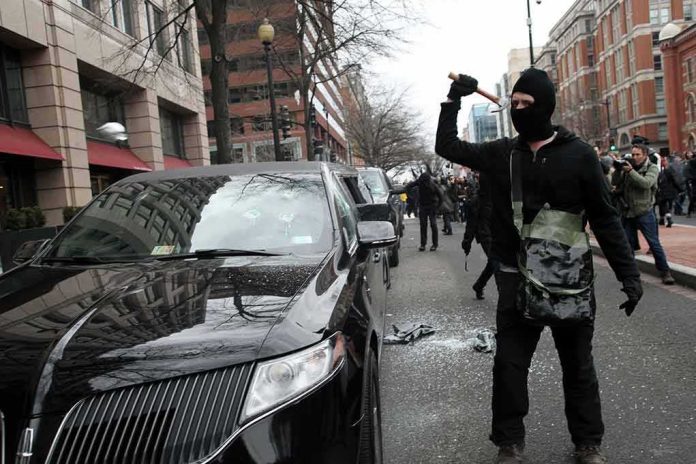
In the city of Limoges, a 19th-century town hall—an emblem of French municipal republicanism—was set ablaze during a turbulent evening of demonstrations. Contemporaneous reporting, sourced to AFP and carried by multiple outlets, describes masked protesters who had already torched a police car then breaking windows to enter the building, after which a fire took hold. The regional prefect, Maurice Barate, publicly characterized the act as deliberate. His post-incident description of the scene was stark: the roof had collapsed onto the lower floors save the west wing, and a substantial portion of the exterior envelope was already gone—a level of destruction that tracks with determined arson, not a stray ignition left to chance.
This was not an isolated scuffle accidentally gone too far. The decision to breach a public building, introduce an ignition source, and set it alight is the anatomy of intentional property crime, aggravated greatly when the target is an occupied or historically significant structure. Fire services were deployed to contain a blaze that, per witness accounts in AFP reporting, had climbed to the roofline and raced along a wing of the building. In heritage structures, such roof and attic voids—often timbered, ventilated, and difficult to access—can turn an initial set into a conflagration in minutes. The damage described is fully consistent with that mechanism.
Inside a Night of Nationwide Unrest
The Limoges arson unfolded against a broader canvas: demonstrations that tipped into violence across several French cities the same night. Reports catalogued a familiar progression—marches, then clashes, fires, looting, and targeted attacks on public buildings and municipal infrastructure. The interior minister’s running tally placed arrests at around 400 nationwide by night’s end, a figure echoed across outlets that tracked police operations in multiple localities. That national count matters for scale: the violence was not confined to one square or one city, and police postures reflected a dispersed, high-tempo response environment.
Two cautions belong here for clarity’s sake. First, the 400 arrests refer to events across France; they are not a Limoges-only figure, and the distribution by offense type—arson, burglary, assault on officers, or curfew violations—was not detailed in the same reports. Second, the specific identities of the Limoges town hall attackers were not disclosed in open sources at the time of these accounts; neither charging documents nor courtroom outcomes had yet filtered into public reporting. Those caveats do not dilute the core: the Limoges fire occurred, it was set by intruders, and it occurred in the context of broader disorder.
How an Arson at City Hall Becomes a National Rorschach
Events like Limoges commit two offenses at once: they damage irreplaceable public property, and they distort the politics of the moment. The pattern is well known in France. During periods of heightened social conflict, a single dramatic act—especially one captured on video—becomes a synecdoche for the whole, sweeping up the peaceful and the violent under one narrative umbrella. Scholarly work on the 2005 riots showed how media and political actors framed similar unrest in strikingly different ways, drawing causal lines to ideology, identity, or policing, depending on institutional vantage points. That same gravitational pull is visible here: reports bundled Limoges with nationwide arrests, looting, and municipal attacks, which is contextually accurate but can eclipse the specifics of who did what, where, and why.
Precision matters. The published accounts are strong on the act—masked intruders breached the building and set a fire—and strong on the damage—roof collapse and widespread structural loss. They are less specific on ideology; “rioters,” “masked protesters,” and “agitators” appear, but none of the reporting provides verified organizational affiliation, political banners tied to the arson scene, or statements of motive attributed to the perpetrators. Assertions that the attackers were identifiably leftist are thus not substantiated by the cited record. That is not a hedge; it is an evidentiary boundary consistent with rigorous attribution.
Mechanics of Heritage Loss in a Building Like Limoges’s Hôtel de Ville
A town hall built in the late 19th century typically marries masonry shells with significant timber or mixed roof structures. Fire introduced at lower levels can chimney upward through stairwells and voids; introduced at or near the roof, it exploits dry structural members and attics. Once the roof is involved, collapse risks rise quickly: heat weakens metal connectors, timber combusts or chars beyond load-bearing capacity, and falling elements punch through interior floors. The prefect’s summary—roof down, two-thirds of the exterior already compromised—reads like the aftermath of such a progression. Even when facades remain, smoke and water damage, warped stone, and the loss of original joinery convert a vibrant civic interior into a conservation triage case. Reconstruction may be possible, but “possible” is not “intact.”
Firefighting in heritage contexts adds difficulty. Crews must weigh aggressive interior attacks against partial collapses, unknown floor integrity, and the risk of drawing the fire into fresh air pathways. In dense historic centers, protecting exposures—adjacent buildings and streetscapes—competes with saving the primary structure. That balance, played out under riot conditions with stretched resources, lowers the odds of salvage further.
Accountability, Attribution, and the Limits of the Arrest Tally
Interior Ministry figures serve a valuable public-order function—they show the state is arresting and processing offenders at scale during unrest—but they do not, on their own, resolve responsibility for a discrete act like the Limoges arson. For that, investigators work a different checklist: scene security; origin-and-cause analysis; accelerant detection; witness canvasses; collection of CCTV and mobile video; and, crucially, the linkage evidence that puts identified individuals at the point of entry and ignition. That is slow, exacting work; when successful, it yields charges that match the act—arson, aggravated damage to a listed building, conspiracy—and courtroom evidence that stands without the noise of the broader protest.
To the extent the public debate seeks to assign ideological motive, those same evidentiary standards should apply. Banners visible in a march do not, by themselves, establish the ideology of masked individuals who separate from a crowd, force entry, and set a fire. The proper test is specific: communications seized, affiliations documented, or statements made by perpetrators that clearly tie motive to doctrine. Absent that, the responsible and accurate label remains the one grounded in behavior: rioters who committed an arson attack on a municipal building.
🔴🇫🇷🔥 BREAKING NEWS | HISTORIC BELL TOWER COLLAPSES IN LIMOGES, FRANCE
France is witnessing another shocking scene as the bell tower of Limoges City Hall has reportedly collapsed following a massive fire during violent unrest on Saturday, October 17, 2026.
🚨 WHAT WE KNOW:
🇫🇷… pic.twitter.com/yxls3iaXe3
— Mike TP Canada (@Mcolesdesign) October 17, 2026
Why This Matters Beyond One Night
Town halls are more than offices; they are the stage on which local democracy conducts its daily work. Burning one is not just vandalism—it is an assault on civic continuity, a bid to turn public space into a theater of intimidation. The Limoges arson therefore sits at the intersection of two imperatives that citizens should demand simultaneously: the firm prosecution of those who attack public institutions, and the disciplined insistence on evidence when assigning political identity to criminals. Both protect the republic’s health. Both are achievable, even in a season of anger.
Sources:
humanevents.com, en.haberler.com, en.royanews.tv