

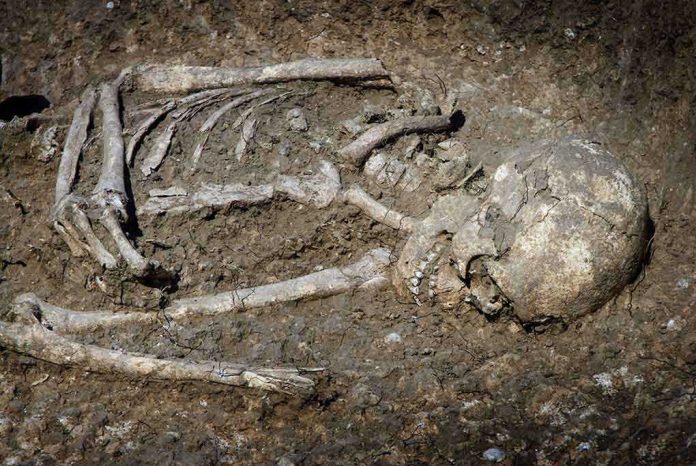
The controversy over whether Homo naledi deliberately buried its dead is not a morality tale about hype or heroics; it is a hard test of what counts as evidence for mortuary behavior when the record is fragmentary and the mechanisms of caves are subtle. The strongest claims rest on specific taphonomic patterns; the strongest counterclaims dismantle the sedimentary case. Between them lies the actual question: has the burial threshold been met?
At a Glance
- Proponents identify discrete subsurface disturbances, articulated skeleton regions, and repeated contexts deep in Rising Star cave as most compatible with cultural burial.
- Critics argue that sediment chemistry does not distinguish putative graves from background deposits and that natural processes remain viable alternatives.
- The core dispute is evidential: do disrupted stratigraphy and articulation demonstrate purposeful digging, or can gravity, slumping, and post-depositional movement explain them?
- Resolution depends on rigorous replication: independent micromorphology, complete geochemical audit, and high-resolution taphonomic mapping across multiple cave locales.
The claim on the table: repeated, minimal cultural burial
The Rising Star team has framed its case carefully. They do not claim pageantry or symbolism; they argue a minimal hypothesis of cultural burial—placing bodies in shallow dug features and covering them with sediment—best fits the observed pattern in multiple deep-cave contexts. In their reports from the Dinaledi Chamber and Hill Antechamber, they describe discrete features that disrupt local stratigraphy, with parts of skeletons preserved in articulation and supported by encasing matrix—signatures they interpret as rapid covering prior to soft-tissue decay. The emphasis on repeated occurrences across more than one chamber is central: if comparable features recur in separated spaces, the interpretation shifts from an anomalous deposit toward patterned behavior.
Mechanistically, the argument proceeds in layers. First, bodies entered these hard-to-access spaces. Second, skeletal elements remained in partial anatomical order instead of dispersing as they would under prolonged surface exposure or transport. Third, surrounding sediments look disturbed relative to adjacent cave deposits. On this reading, gravity-driven settling, slow aggradation, or slumps do not reproduce the combined articulation-plus-disturbance signal, particularly when the pattern appears in more than one area of the system.
The counter-case: sedimentology and alternative formation pathways
The most substantive critique targets the proposed sedimentary distinction itself. An independent team led by Foecke reports that when they reanalyzed the available data—supplementing missing parameters with standard protocols—the samples associated with the supposed features overlapped entirely with background cave sediments. In their view, neither X-ray emission nor particle-size measurements separated “feature” from “non-feature,” so no geochemical evidence of deliberate excavation emerges from the dataset. That isn’t a quibble about tone; it strikes at the diagnostic heart of the burial claim.
Other researchers argue that natural processes have not been excluded. Papers led by Martínon‑Torres and colleagues maintain that death traps, water transport of bodies or parts, carnivore activity, and post-depositional shifts can yield clustered accumulations with partial articulation; they contend the present documentation is insufficient to demonstrate intentional excavation and refilling of pits by H. naledi. This line of critique does not need to provide a single replacement mechanism; it only needs to show that more than one natural pathway remains plausible at the current evidentiary resolution, thereby lowering the posterior probability of burial below a justifiable threshold.
Where the evidence is strongest—and where it is not
Two elements of the proponents’ case carry genuine weight. First, the articulation and matrix-supported blocks argue against long intervals of exposure or high-energy transport within the chambers. Second, the recurrence of similar deposits in multiple deep-cave contexts raises the likelihood of patterned behavior rather than a one-off taphonomic oddity. Those points constrain any naturalistic scenario; a viable alternative must reproduce intactness, placement, and sediment relationships without invoking purposeful digging.
Yet the counterweight is equally clear. The campaign’s strongest proposed discriminator—sedimentary differentiation consistent with cut-and-fill—has not been independently reproduced. The replication team’s conclusion that sample groups fully overlap in composition undermines the claim that geochemistry separates grave fills from surrounding cave deposits. Add to this the critics’ insistence that basic natural agents have not been exhaustively ruled out, and the balance tilts away from a decisive burial verdict at present.
How paleoanthropology adjudicates “burial”
Intentional burial in deep time is almost never caught in the act; it is inferred from converging lines: an identifiable grave cut with discernible boundaries, a consistent body position, a rapid sedimentary seal, a chronological step between grave fill and enclosing strata, and the exclusion of natural formation mechanisms. The H. naledi debate sits in the same evidentiary neighborhood that has long divided scholars over Neanderthal interments: when articulations, depressions, and fill textures imply agency to some, others can still model gravity, slumping, or slow deposition into hollows as sufficient causes. The bar rises with the extraordinariness of the behavioral claim; “minimal cultural burial” is less extraordinary than full ritual symbolism, but it still demands clear diagnostics that separate human action from cave physics.
Methodologically, that means micromorphology—thin sections through feature margins that reveal cut boundaries or infilled laminae—paired with complete and auditable geochemical workflows, precise three-dimensional mapping of skeletal articulation and sediment encasement, and stratigraphic dating that resolves whether covering was rapid and discrete rather than gradual. Those are not box‑checking exercises; they are the instruments that turn plausible narratives into reproducible findings.
What would settle it: a roadmap for resolution
Three steps would move this question from debate to decision. First, independent re-excavation and micromorphology of still-preserved margins in each proposed feature—documented with full stratigraphic profiles, thin sections, and blind comparisons to undisturbed cave sediments—could confirm or refute cut-and-fill structures. If present, these features should display sharp boundaries, contrasting fabric, or intrusive clasts distinct from the host deposit. If absent, the minimal burial hypothesis loses its stratigraphic pillar.
Second, a fully auditable geochemical replication—public release of sample coordinates, laboratory settings, raw spectra, calibration and drift logs, chain-of-custody, and code—followed by preregistered analysis across multiple laboratories would address the present contradiction head-on. The Foecke team’s inability to discriminate fills from background sediments is, at the moment, the most forceful empirical obstacle to acceptance; a transparent, replicated workflow is the appropriate rejoinder.
Implications either way
If repeated, well-documented cut-and-fill features with articulated bodies are demonstrated in multiple deep-cave contexts, then small-brained hominins engaged in simple mortuary practice—a result that would broaden our understanding of how cognition and culture scale with brain size. If, instead, features resolve into natural hollows, slumps, or undifferentiated sediments, the naledi record still enriches paleoanthropology: it becomes a case study in how deep cave systems sort remains, how articulation can persist without agency, and how rigorous standards prevent over-reading ambiguous signals. Either outcome elevates method over myth.
Bottom line
On current evidence, deliberate burial by Homo naledi remains an intriguing, constrained hypothesis—not yet a demonstrated fact. The articulation patterns and repeated deep-cave contexts keep the question very much alive; the unresolved, contested sedimentology keeps it from closure. The next phase is not another round of essays; it is transparent, independently replicated field and laboratory work that either reveals the unambiguous anatomy of a grave or shows that cave dynamics and time suffice.
Sources:
deephistory.substack.com, elifesciences.org, biorxiv.org, gmu.edu, bereanarchive.org, sciencealert.com, wisconsin.edu