

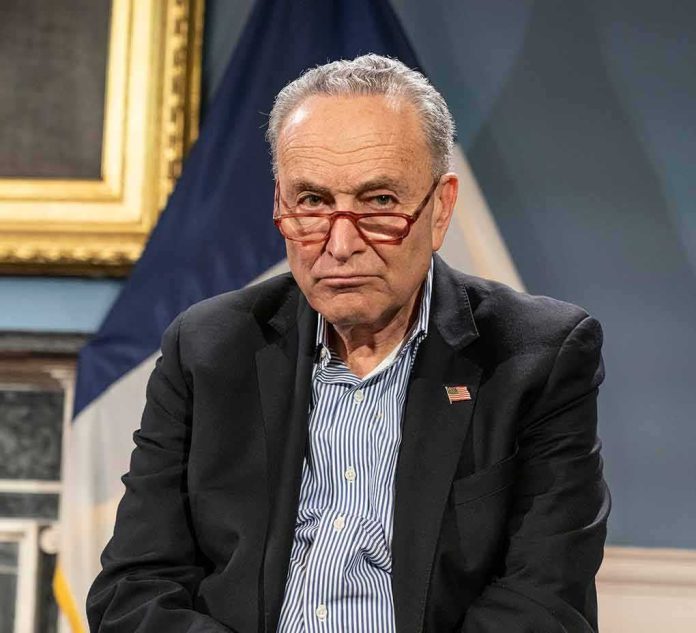
In Senate leadership contests, the visible argument is rarely the real one; what looks like a simple vote is in fact a stress test of the caucus’s internal market for loyalty, access, and procedural control — and Chris Van Hollen’s challenge to Chuck Schumer brought that machinery into public view.
At a Glance
- Van Hollen’s bid created a real alternative to Schumer, transforming private grumbling into a formal leadership contest.
- He claimed double-digit caucus support and alleged intimidation by Schumer’s team; Schumer said he welcomed discussion and had the votes.
- The dispute centered not just on numbers but on process — including whether allies would accelerate the election window.
- Closed-door caucus rules and incumbency advantages make verification difficult and tend to favor the sitting leader.
What Van Hollen’s Challenge Actually Did
Most leadership discontent in the Senate dies in the private rooms where it’s born. Van Hollen upended that pattern by formally entering the race to lead Senate Democrats, forcing colleagues to treat dissatisfaction as a choice rather than a mood. He announced his run after Democrats secured a majority, positioning the contest as a debate over how to govern rather than whether to oppose — a significant escalation from hints or exploratory chatter. Public reports fix the start line with clarity: he declared, he filed, and he began counting votes, not merely venting.
From the start he framed viability with a number: more than ten senators, out of roughly fifty-five Democratic votes, were with him. That figure matters because it signaled a bloc large enough to make the race non-theoretical while conceding underdog status. It also crystallized the verification problem endemic to caucus elections: members rarely volunteer their positions publicly in advance, and ballots, when cast, are secret. Van Hollen’s number therefore anchored the coverage while remaining untestable in real time, which, strategically, is both feature and bug.
The Counter from the Incumbent: Continuity, Credit, and Counting Heads
Schumer answered in the language of incumbency: celebrate the majority, promise to lead it, and assert a decisive tally. “I have the votes,” he said — not just a rebuttal to Van Hollen’s momentum claim but a message to fence-sitters that the safe harbor remains the existing order. He paired that with a nod to openness — welcoming discussion about the caucus’s future — which simultaneously rejects the need for a change while insulating against charges of closing ranks. In practical terms, this is the classic inside game: count privately, project inevitability publicly, and let the status quo do the rest.
The public case for continuity leaned on performance validation — winning and holding the majority — which is the currency most likely to resonate with senators whose committee prerogatives and legislative ambitions depend on a steady hand. That logic often prevails because leadership is less about charisma than about predictable delivery: floor time, member protection on tough votes, and a functioning relationship with the White House. Schumer’s record since taking over in 2017 gave him the default legitimacy advantage that most challengers must puncture to win.
Process Is Power: Why the Timetable Fight Mattered
Van Hollen’s sharpest allegation was not about ideology but about process — that Schumer-aligned actors sought to deter dissent by instilling fear and, potentially, by accelerating the leadership vote to compress debate. He cast any move to advance the election date as a maneuver to lock in the status quo before support for change could consolidate. Reporting confirmed discussions among Democrats about an earlier vote and made clear such a shift would require a caucus-rules waiver — in other words, a choice, not an inevitability. That distinction matters: the mechanism to hurry the decision exists; whether to use it is a political calculation.
The retaliation claim, by contrast, arrived as a direct but largely uncorroborated accusation: fear, pressure, potential consequences. No senators were publicly named as targets; no committee assignments or funding threats were documented in the record. In a chamber where careers turn on trust and discretion, that evidentiary gap is not surprising — and it is precisely why process fights loom so large. It is easier to observe a rushed calendar than a quiet phone call. On the record, Schumer’s answer to the intimidation frame was to emphasize welcome debate and vote strength, not to litigate internal enforcement in detail.
How Caucus Elections Really Work
To understand why these claims were hard to adjudicate from the outside, you have to understand the structure of Senate party organization. Leaders are chosen by their caucus, not the public; votes are typically private; and the transactional memory of the institution — who protected whom, who delivered appointments, who suppressed a vulnerable amendment — is long. Comparative and congressional scholarship consistently finds that control over committee assignments and agenda access functions as a loyalty mechanism: members who align with leadership are more likely to receive prestigious or electorally valuable posts, and that dynamic weakens when the leader who conferred benefits exits.
None of this implies automatic wrongdoing; it describes an incentive system. Leaders are expected to reward reliability because it builds capacity to pass the party program. The flip side is equally structural: dissent can be costly, even without overt threats, because every scarce good in the Senate — staff resources, floor time, prime committee seats — is rationed. That is why leadership challenges are rare once a network stabilizes, and why, when they do occur, they hinge on whether a challenger can credibly promise equal or better protection for colleagues’ interests inside the same incentive lattice.
🚨🇺🇸 Win the Senate and fire the leader? Chris Van Hollen is coming for Chuck Schumer’s job after the Democrats’ biggest night in decades
Only in Washington does the winning team hold the mutiny.
Tom Bevan of RealClearPolitics says the challenge began as a long shot and has… pic.twitter.com/kqPb9oMeQ0
— Mario Nawfal (@MarioNawfal) November 17, 2026
What Was Proven, What Wasn’t, and Why That Distinction Matters
The record decisively establishes three things. First, Van Hollen mounted a formal challenge and claimed tangible, if minority, support. Second, he alleged a climate of fear tied to Schumer’s team and criticized potential efforts to shorten the campaign window. Third, Schumer asserted he had the votes, welcomed discussion, and was favored to continue. What the record does not provide is documentary corroboration of retaliation or a public whip list that would let observers independently verify either camp’s numbers before the vote. The absence of such proof does not negate the claims; it reflects the design of caucus elections, which privilege privacy and incumbency.
Implications for Future Leadership Contests
The episode sketches a playbook relevant beyond this race. Challengers who want to overcome the structural tilt toward incumbents need three assets: a process foothold that guarantees time for argument (guarding against accelerated calendars), a publicly confirmable coalition that grows rather than stalls, and a credible alternative patronage network — committee pathways, campaign infrastructure, and legislative sequencing — that reassures risk-averse colleagues. Incumbents, for their part, can usually win by maintaining a perception of inevitability and demonstrating that continuity yields material benefits for members. Both understand the meta-rule: in a secret ballot shaped by long relationships, the story is not the speech; it is the ledger.
Sources:
redstate.com, apnews.com, cnbc.com, inquirer.com, edition.cnn.com, abcnews.com, politico.com, recordonline.com, pbs.org, usatoday.com