

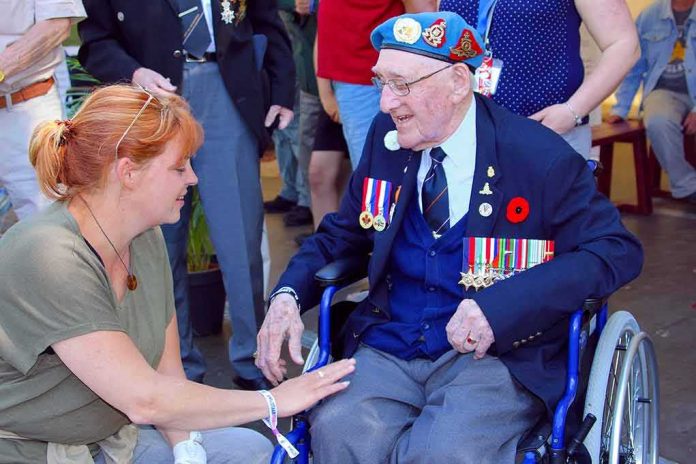
The core problem is not whether Canadian veterans ever heard Medical Assistance in Dying mentioned—some did—but whether an institution charged with supporting injured soldiers tolerated conversations that even risk nudging vulnerable clients toward death rather than treatment; that boundary, and how it’s enforced, is what matters now in court and policy.
At a Glance
- Parliamentary testimony describes unsolicited MAiD offers to veterans by a Veterans Affairs Canada (VAC) caseworker, with alleged recordings, apology calls, and written case notes.
- VAC’s official investigation acknowledged four inappropriate conversations tied to a single employee and says comprehensive file reviews found no systemic practice.
- Advocates claim many more veterans possess documentary proof; if produced and authenticated, that evidence could test VAC’s conclusion and methods.
- The litigation push will turn on documentation, causation (care denied vs. conversation), and whether safeguards and oversight inside VAC were adequate.
What is firmly established—and what remains contested
Two things can be true at once. First, a veteran told Parliament that a VAC caseworker offered MAiD without solicitation and pressed the option even after refusal; the witness referenced contemporaneous recordings, two apology calls from a VAC manager, and entries in the veteran’s VAC account documenting the interaction. Second, VAC’s own inquiry concluded there were four inappropriate MAiD-related conversations, all linked to one employee who has since left the department; after reviewing that employee’s 2,153 files and running searches across approximately 402,000 files, the department says it found no broader pattern and deemed later named allegations unfounded.
Those two truths define the dispute. The first anchors the claim that specific veterans were inappropriately offered death when they sought help. The second undercuts the argument that such conduct was normalized inside VAC. The courts—and any credible public reckoning—will turn on documents and audio, not rhetoric: what is on tape, what appears in case notes, who said what and when, and whether the language crossed from acknowledging a legal regime to recommending it.
How MAiD is supposed to intersect with veterans’ care
Under Canada’s framework, MAiD decisions sit with provincial and territorial health systems and are administered by physicians or nurse practitioners under federal criminal-law safeguards. VAC does not deliver MAiD, and its staff are not MAiD assessors; the department’s written position is unambiguous that providing advice on MAiD is not a VAC service, employees have no mandate to raise or recommend it, and any veteran seeking advice should be referred back to a primary-care provider. Staff who encounter a veteran-initiated MAiD discussion are instructed to document the facts and report the conversation through management channels.
That design reflects a larger clinical safeguard: voluntariness. National guidance to MAiD practitioners emphasizes that a request must be made freely, without undue influence—by family, providers, or others—and that assessors must be satisfied about capacity, irremediability, and the absence of coercion. The line between an autonomous request and a suggestion from an authority figure is not semantic; it is the safeguard itself.
What the official review concluded—and why skeptics question it
After complaints surfaced, VAC says it apologized to at least one veteran, launched a department-wide review, and implemented training and directives to prevent recurrence. The published report states the review analyzed the implicated employee’s 2,153 files, queried all 402,000 files in VAC databases, canvassed front-line staff and managers, reviewed incoming communications, and monitored training feedback. Its conclusion: four inappropriate conversations, one former employee, no evidence of a systemic issue, and subsequent allegations investigated and found unfounded.
Critics accept the four incidents as real but challenge the leap from “no hits in our search” to “no broader problem.” Their case hinges on producing the underlying materials Parliament heard about—original audio files and metadata, the apology-call records, complete MyVAC account notes—and on assembling additional veterans with comparable documentation. A committee session record references claims that more than 20 veterans have written proof or recordings; if that registry solidifies into authenticated case files, the center of gravity could shift from anecdote to corpus, and the department’s search methodology will come under scrutiny.
The litigation questions that actually matter
Courts will sort allegations from atmospherics with a few exacting tests:
Documentation and authenticity. Audio files, call logs, device metadata, internal case-note audit trails, and correspondence chains will determine what was said, by whom, and with what authority. Parliamentary testimony is a start; evidence under oath, preserved and forensically sound, is the currency that counts in court.
Mandate and training. VAC’s written directives are clear; employees were told not to offer or advise on MAiD and to refer veteran-initiated queries to clinicians. If the record shows deviations, the next question is whether those were truly isolated or reflected gaps in supervision, clarity, or enforcement before directives were reinforced. That is where an internal “four cases only” finding can be tested against external discovery.
Causation and harm. Being exposed to an inappropriate conversation is not identical to being denied care. Plaintiffs will need to show that a suggestion displaced, delayed, or chilled access to entitled treatment or benefits. That requires synchronized timelines: what care was requested, what VAC decided and when, and whether the MAiD exchange plausibly altered that trajectory. Without causation, the legal stakes narrow to dignity harm and administrative breach; with it, they broaden to negligence or Charter-adjacent claims.
Why veterans are a uniquely sensitive population for MAiD conversations
Veterans as a group carry elevated, well-documented risks around suicidality and complex comorbidity—operational stress injuries, chronic pain, and trauma—making the voluntariness analysis harder, not easier. Expert panels convened by Health Canada have wrestled with the confounding overlap between suicidal ideation and an apparently reasoned request for MAiD, emphasizing structural vulnerability and the need for rigorous, case-by-case assessment. That is precisely why front-line administrative staff are walled off from initiating MAiD discussions; even subtle authority cues can be coercive when the listener depends on you for access to treatment and income support.
For policy-makers, that sensitivity argues for redundant safeguards: bright-line prohibitions on employee-initiated MAiD talk, mandatory reporting and documentation when veterans raise it, periodic audits of call recordings and case-note fields, and arm’s-length oversight to verify that guidance is practiced, not just posted. The goal is not to impede lawful access to MAiD, but to insulate it from institutional influence within a benefits agency.
Canadian veterans prepare to sue government for offering them MAiD
Nov 12, 2026https://t.co/H70R7f0M9Q
— 🦋EmergencyHousing.ca 🏘️ 🇨🇦 (@EmergencyAgent) November 12, 2026
The path forward: evidence, not escalation
Where does this leave the lawsuits now forming? With homework. If advocates can file a coherent docket—named cases, dates, staff identities, verbatim language, recordings, and VAC account entries—then the question becomes whether the department’s search protocols were fit for purpose and whether supervision failed. If they can also demonstrate delays or substitutions in care linked to those conversations, liability becomes a live issue. If, by contrast, the evidentiary record never matures beyond a handful of confirmed incidents and generalized suspicion, VAC’s position—that it confronted and contained an isolated breach—will stand largely intact.
Veterans deserve two things at once: unimpeded access to every benefit and treatment they have earned, and a clean separation between that support system and any suggestion about ending one’s life. Canada’s laws already demand the latter. The work now is to prove—in documents rather than declarations—whether that standard was met, and when it was not, whether the failure was aberration or architecture.
Sources:
lifesitenews.com, veterans.gc.ca, publications.gc.ca, openparliament.ca, theepochtimes.com, suicideinfo.ca