

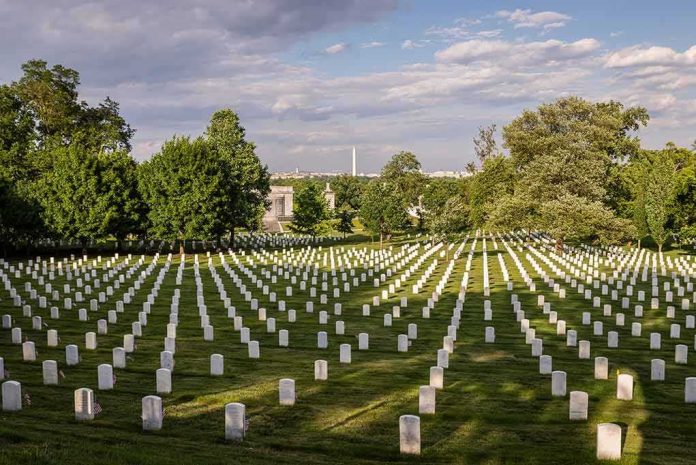
The Tomb of the Unknown Soldier demands shared discipline: rank, office, and entourage do not suspend the obligation every visitor carries to preserve silence and respect. That is why a sentinel’s clear, status-neutral correction to Pete Hegseth’s group on Veterans Day was not an aberration but the system working exactly as designed.
At a Glance
- A Tomb sentinel audibly instructed Hegseth’s group: “All visitors will maintain an atmosphere of silence and respect at all times.”
- Arlington’s published guidance and federal standards require quiet decorum at the Tomb and throughout the cemetery.
- Video and reporting describe audible talking, photography, and laughter preceding the admonition.
- The Pentagon backed the sentinel’s action as “correct and respectful,” underscoring that rules apply to all visitors.
What happened at the Tomb
During a Veterans Day visit to Arlington National Cemetery, a sentinel guarding the Tomb of the Unknown Soldier addressed a cluster of VIP visitors in front of the mat—the 63-foot walkway on which guards pace their exacting vigil—with a crisp instruction: “All visitors will maintain an atmosphere of silence and respect at all times.” Multiple outlets carried video capturing the call-out to the group that included Defense Secretary Pete Hegseth, his wife, and aides; audible conversation, laughter, and picture-taking in the immediate vicinity preceded the sentinel’s intervention. The guard’s wording mattered: “All visitors” affirmed a core principle at Arlington—protocol governs the space, not the person occupying it.
Arlington’s own visitor guidance is not ornamental prose. It asks people to speak quietly and to avoid disturbing others, including by using headphones when listening to audio, precisely because reverence is a collective act at a living cemetery with active funerals, grieving families, and continuous ceremony. The Tomb, a national shrine within the grounds, is patrolled by sentinels whose role includes keeping order around the mat; verbal corrections are one of the lightest tools they use to restore decorum before the need for sterner measures arises.
Why the sentinel spoke—and why it was appropriate
Reporters on scene and in pool coverage identified conversation, photography, and audible laughter near the Tomb as the proximate triggers. Those behaviors are not uncommon in tourist settings; at Arlington, however, they collide with the cemetery’s codified standards. Federal rules governing Army national military cemeteries characterize Arlington as a “national shrine to the honored dead,” and require visitors to observe proper standards of “decorum and decency”; in practice that means minimizing noise, avoiding boisterous conduct, and refraining from anything that distracts from the solemnity of the site. On this point, the Pentagon did not equivocate. Its chief spokesperson stated the sentinel “correctly and respectfully reminded everyone to maintain decorum,” validating both the content and the tone of the intervention.
This is also routine. Former Tomb guards have explained that verbal reminders occur daily—often two or three times—because many visitors simply do not realize how their voices carry in the amphitheater-like space or how a casual chuckle can break the soundscape that the ceremony intends to maintain. In other words, the incident does not prove malice or special entitlement; it illustrates why these sentinels exist and how they manage a sacred space opened to the public.
The rules, the ritual, and how we got here
The Tomb’s modern expectations did not emerge from pedantry but from hard-earned experience. In the 1920s, when the grave was unguarded, visitors treated it like an overlook—sitting on the sarcophagus or picnicking beside it—until a civilian guard was posted in 1925 and a military guard in 1926. The 24-hour vigil began in 1937; since 1948, the 3rd U.S. Infantry Regiment—the Old Guard—has held the duty. The choreography the public sees today—the twenty-one steps, the turns, the measured pauses—derives from the twenty-one-gun salute, the military’s highest ceremonial honor, designed to signal that every moment at the Tomb is a rite, not a spectacle.
Against that history, the cemetery’s published guidance reads as pragmatic, not precious: speak softly, use headphones, do not distract other visitors. These rules protect more than aesthetics. The Tomb area is an acoustic instrument; the click of a guard’s heels and the hiss of the steel on the rifle’s sling are not incidental sounds, they are the ceremony. An outburst—or a string of casual asides—breaks that instrument for everyone present.
What the evidence establishes—and what it doesn’t change
There is wide reporting consensus on the core facts: the sentinel issued a loud, status-neutral instruction for silence; the group included Secretary Hegseth; conversation and audible laughter were recorded close to the mat; and the Pentagon endorsed the guard’s action. Some details remain granular—who said precisely what, which voice laughed, or how loud any single utterance was—but those specifics do not alter the rule or the appropriateness of a sentinel exercising his duty to enforce it. The correction itself is not a public censure; it is the minimum intervention the Old Guard uses, delivered for everyone’s benefit.
There is a temptation in public life to treat decorum as performative, something you “do” for the camera. The Tomb flips that logic. The presence of cameras raises the bar. Photography is allowed almost everywhere at Arlington, but discretion is the price of admission to a cemetery that still holds burials and welcomes Gold Star families daily. You can document a moment without becoming the moment. The sentinel’s admonition restored that boundary.
A Tomb Guard from the U.S. Army’s 3rd Infantry Regiment, “The Old Guard” was forced to verbally reprimand Secretary of Defense Pete Hegseth and a group of his senior advisers Wednesday after some in the group laughed and loudly talked in front of the Tomb of the Unknown Soldier…
— Dr Charlie ward (@Charliewardt6) November 12, 2026
The larger lesson: shared norms in public sacred space
The Tomb’s rules endure because they scale. They do not assume visitors will arrive flawlessly briefed or immune to the social gravity of a VIP cluster. They assume human noise happens—and they invest a trained sentinel with the authority and poise to stop it quickly. That investment pays off only if the instruction carries the same weight whether it is directed at a student group, a tourist with a selfie stick, or the Secretary of Defense. By addressing “all visitors,” the guard did more than quiet a corner of the plaza; he affirmed the idea that the Unknowns belong to everyone, which is why everyone bears the same duty of respect.
Sources:
cbsnews.com, arlingtoncemetery.mil, nbcnews.com, stripes.com, themirror.com, washingtontimes.com, armytimes.com, washingtonpost.com