
The core risk in the “overseas police stations” debate is not a storefront with a misleading sign; it is the fusion of community-facing services with state-directed leverage over a diaspora—an overlap that obscures where consular help ends and coercive reach begins.
At a Glance
- Sustained, multi-source reporting alleges a Canada-based network of PRC-linked “police service” sites; RCMP opened investigations rather than dismissing the claims.
- Evidence is largely open-source and NGO-driven; Canadian authorities have not publicly produced a charge sheet tying specific sites to criminal policing functions.
- Two Montreal-area community organizations identified in coverage deny the allegations and have sued the RCMP, underscoring unresolved factual disputes.
- Beijing categorically denies operating overseas police stations, framing any “service centers” as volunteer-run administrative help during COVID-19.
What the strongest evidence says—and what it doesn’t
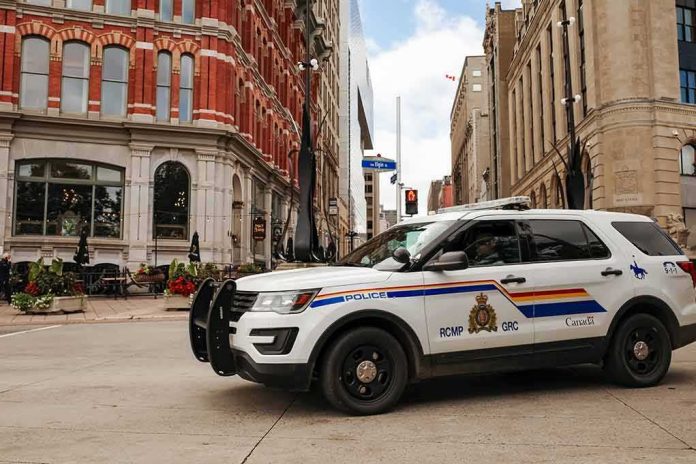
The most durable claims about alleged PRC-affiliated “police service” sites in Canada come from a pair of Safeguard Defenders reports and derivative analyses that mapped a broader global infrastructure attributed to Chinese public-security bureaus. Canadian officials treated those claims as serious. An official parliamentary briefing records that the RCMP announced an investigation on October 27, 2022 into possible criminal activity linked to alleged stations in the Greater Toronto Area and later examined two Montreal-area organizations; those were identifiable entities with street addresses, not abstractions. The same briefing anchors the public record that authorities investigated specific locations tied to community associations, not merely rumors circulating online.
Safeguard Defenders’ core contention is that these ostensibly benign “service centers” can function as nodes for monitoring, pressure, and the orchestration of “involuntary returns” to the PRC—conduct consistent with Beijing’s broader transnational repression playbook. A Foreign Interference Commission exhibit summarizes that allegation and references prior cases documenting coerced returns involving individuals in Canada, situating the Canadian claims within a known pattern rather than as a novel theory.
Counting sites: why the numbers vary
Much of the public friction concerns the headline figure: five alleged Canadian stations in earlier reporting versus later claims of at least 18. The parliamentary and commission records preserve the early floor—at least five—while later media coverage attributes the higher tally to subsequent NGO work. The divergence matters. It tells us less about a proven expansion than about method: evolving open-source collection, broader inclusion criteria, and potential duplication can all move the count without demonstrating that each site performed policing functions, operated simultaneously, or met a uniform evidentiary threshold. Treat the number, therefore, as a signal to investigate—not as proof in itself.
That caution is not an exoneration; it is a reminder about how open-source allegations should mature. A defensible map ties each site to documentary links, personnel, tasking, and activities that cross from consular-adjacent assistance into prohibited policing. The public record in Canada has not been filled in at that level for every address named; the RCMP has confirmed inquiries but not published the predicate intelligence, warrants, or surveillance product that would convert suspicion into a prosecutable case.
Where community service and state leverage can blur
Alleged stations have been described as co-located within legitimate associations—settlement support, cultural programming, language services. The RCMP has itself acknowledged that elements under investigation took place at locations that also provide bona fide services to Chinese-Canadian residents. That overlap complicates both attribution and public understanding: activity that looks like administrative help can also create choke points—document handling, problem-solving “liaison,” or dispute mediation—through which state influence is applied informally but effectively.
Witness testimony before the Foreign Interference Commission adds texture on effects, if not always on command chains. Community leaders have described intimidation aimed at critics of CCP policy—pressure that functions even without an arrest power, because family ties, business exposure in China, and social networks can be leveraged to silence speech abroad. The commission record captures that chilling environment, which is relevant when assessing whether “service centers” might serve more than clerical purposes.
The counter-case: categorical denials and contested labels
Beijing’s position is unambiguous: “there is simply no such thing as so-called Chinese overseas police stations.” Embassy statements further argue that overseas “service stations” were volunteer-staffed and created to help with administrative tasks—particularly driver’s licence renewals—during pandemic travel restrictions, not to conduct criminal investigations or policing. Within Canada, the two Montreal organizations publicly deny operating clandestine police posts. They emphasize cooperation with law enforcement and the presumption of innocence; they have sued the RCMP for defamation, arguing the force associated them with foreign interference without a proper basis. The litigation underscores that, on the facts of those sites, the dispute is active and unresolved in court rather than adjudicated in the press.
Those denials must be weighed against two realities. First, Canadian authorities deemed the allegations credible enough to investigate, which is not simply routine; it signals threshold plausibility even if it is not proof beyond a reasonable doubt. Second, investigations to date have not yielded publicly reported criminal charges against the named Montreal organizations—an outcome consistent with either exoneration or with evidence that remains classified, insufficient, or misaligned with available offences. The point is not to force a conclusion but to keep the lanes straight: credible allegation, real investigation, and an absence—so far—of public charges.
3) The video resurfaced prominently around November 15–17, 2026 (coinciding with Prime Minister Mark Carney’s visit to China for the APEC summit in Shenzhen). Human rights advocates and Falun Gong representatives described it as an example of transnational repression, creating…
— Bird X (@TheBandBirdX) November 18, 2026
How to separate allegation from actionable fact
For readers tracking this issue over time, the decisive tests are concrete and replicable. At the investigative level: obtain the RCMP’s predicate evidence for each location—warrants, interview notes, surveillance logs—and the rationale for closing or continuing inquiries. At the organizational level: map finances, governance, and communications between Canadian associations and PRC public-security or United Front entities; charters, leases, grant files, and event records can establish institutional direction or its absence. At the incident level: tie specific threats, harassment, or coerced returns to named individuals, dates, communications metadata, and—critically—the physical premises or personnel at issue. That chain of custody differentiates a climate of intimidation from a site-enabled operation.
Until such a record emerges publicly, responsible analysis rests on what is solid: a documented global pattern of PRC transnational repression that provides a plausible mechanism; NGO reporting and open-source clues that identify testable Canadian locations; an RCMP posture that treats the matter as serious; categorical embassy denials and active civil litigation by two named organizations; and an unresolved evidentiary gap between suspicion and charge.
Why this matters beyond any single storefront
Canada’s problem set is structural. Liberal democracies tolerate, even encourage, diaspora self-organization; authoritarian states exploit that openness to maintain leverage abroad. The boundary between service and surveillance is therefore not a philosophical line—it is a compliance and accountability regime. Clear standards on foreign direction and funding disclosure, routine due diligence on community partners that interact with consulates or hometown bureaus in China, and rapid pathways for victims to report and obtain protection are not anti-diaspora measures; they are the baseline safeguards that let legitimate services flourish without becoming vectors of coercion.
If future disclosures validate that particular Canadian sites crossed into policing functions, enforcement and transparency should be unflinching. If, conversely, specific groups are cleared, public exoneration is essential to repairing reputations. Either outcome depends on evidence that can withstand courtroom scrutiny, not just headlines. The path from allegation to adjudicated fact runs through meticulous documentation, disciplined attribution, and an insistence on distinguishing community support from state power by the only standard that endures: proof.
Sources:
lifesitenews.com, foreigninterferencecommission.ca, cbc.ca, globalnews.ca