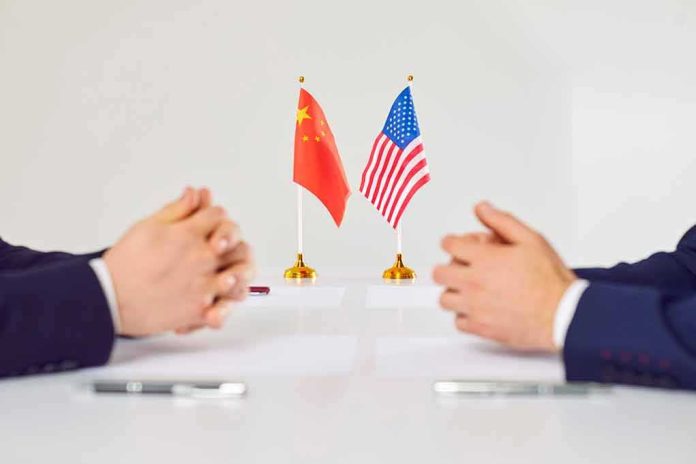
When the leaders of the United States, China, and Russia sit down together, the point is not ceremony; it is signaling—of priorities, red lines, and whether the world’s three largest nuclear powers can still use statecraft to manage rivalry without courting catastrophe.
At a Glance
- Beijing publicly confirmed a first-of-its-kind Xi–Trump–Putin meeting in Shenzhen, with White House and Kremlin concurrence.
- China framed the agenda around “safeguarding world peace” and “strategic stability,” while U.S. briefings highlighted nuclear risks.
- The trilateral occurs alongside APEC, using the summit’s margins to stage great-power diplomacy.
- Expectations focus on opening channels—especially on nuclear danger—rather than announcing immediate, detailed agreements.
What is confirmed: a trilateral at the center of global power
China’s Foreign Ministry announced that President Xi Jinping would host a heads-of-state meeting with President Trump and President Vladimir Putin in Shenzhen on November 19, confirming both the participants and the venue. Beijing’s statement characterized the discussion as an in-depth exchange on “safeguarding world peace” and promoting “strategic stability.” The White House first flagged the plan, and the Kremlin, along with China, confirmed it, putting the gathering on the record from all three capitals. The meeting is staged on the sidelines of the APEC summit, which Shenzhen is hosting, a familiar move that leverages a multilateral backdrop to convene a more sensitive conversation among great powers.
Two features make this meeting consequential. First, it is the leaders’ inaugural face-to-face in a trilateral format, breaking decades of a U.S.–Russia dyad on strategic stability and acknowledging China’s centrality to any future nuclear risk framework. Second, it takes place after the collapse or suspension of legacy arms control scaffolding—most notably the U.S.–Russia New START framework—leaving no operative cap on deployed strategic arsenals for the first time in years, and elevating the premium on new channels and norms.
What “strategic stability” means in practice
Strategic stability, in professional usage, is not a slogan; it is a bundle of conditions that make accidental war or coercive nuclear brinkmanship less likely. Historically, stability rested on verifiable limits, transparency measures, and crisis-communication tools—hotlines, notifications, and inspections—paired with tacit understandings about red lines. In the U.S.–Soviet era, summits seeded mechanisms such as dedicated strategic stability dialogues and arms-limitation frameworks. Even when documents were thin, the process reset expectations and empowered technical negotiators to grind through verification and counting rules over months, sometimes years.
Applying that template to a trilateral is harder. China’s arsenal remains smaller than those of the U.S. and Russia but is growing, and Beijing has not habitually participated in formal limitation regimes. That asymmetry complicates the “parity logic” that underwrote past bilateral treaties. It steers early conversations toward risk-reduction—deconfliction channels, transparency about exercises, space and cyber-nuclear entanglement—rather than immediate, symmetric force limits. U.S. officials have accordingly emphasized nuclear danger reduction and a restart of sustained expert-level talks as practical first steps.
Why convene at APEC—and why Shenzhen
APEC’s loose, consensus-based design makes it a convenient convening cover. Leaders arrive with large delegations; advance teams can arrange side rooms with rigorous security; and the host has narrative control of public framing. Shenzhen, China’s flagship innovation hub, underscores Beijing’s message that economic gravity and geopolitical stewardship now coexist in the same Chinese city. That symbolism is not incidental. In summit diplomacy, location broadcasts intent: economic openness and growth paired with an assertion that peacemaking—or at least risk management—runs through Chinese-led forums as much as Western ones.
Using a multilateral setting also lowers the bar for concrete deliverables. Not every high-stakes conversation should end with a treaty; experience from Geneva 1955 to more recent leader-level encounters shows that resetting channels can be the deliverable, and its value is often realized in the months that follow, not in the post-meeting communiqué.
What each side is aiming to get
The United States has sketched a focus on nuclear nonproliferation and strategic risks—reflecting both the absence of current treaty constraints with Russia and the need to integrate China into any serious future architecture. Washington also points to adjacent security issues, from Iran’s nuclear trajectory to constraints on destabilizing uses of advanced technologies, areas where trilateral signaling can complement regional diplomacy.
For Beijing, the stated priority is “world peace” and “major-power strategic stability,” language that signals responsibility and positions China as an indispensable convenor. That framing also gives China running room to calibrate how explicitly it engages on nuclear force sizing versus narrower risk-reduction measures, a distinction with real consequences for what expert working groups will tackle next. Moscow arrives intent on normalizing Russia’s role at top tables and exploring pathways that ease strategic pressure without conceding unilateral limits—while using deepening Sino–Russian economic ties as ballast. The Kremlin’s confirmation of the meeting aligns with that positioning.
The deliverable problem, and why it need not be fatal
China’s preview avoided itemized negotiating tracks, and none of the parties released a jointly endorsed agenda in advance. That is typical rather than suspect at this stage; complex arms and risk issues begin with scoping and sequencing. The most credible near-term outcome is not an instant cap on warheads but a commitment to sustained strategic stability talks among experts, plus specific risk-reduction steps—formalized crisis hotlines, advance-notice norms for large exercises, or guardrails around cyber operations that touch nuclear command-and-control—measures that have proven stabilizing across previous eras of tension.
History’s base rate cautions against fetishizing the photo call or the absence thereof. Breakthroughs like the Reagan–Gorbachev track did not materialize ex nihilo; they were built atop repeated leader engagements that legitimated detailed, technical negotiations. Conversely, summits that produced little text sometimes still cooled tempers and clarified each side’s appetite for constraint—useful intelligence for policymakers designing the next move.
How to read outcomes: a practical scorecard
An expert’s rubric for judging progress after Shenzhen looks for three things. First, institutionalization: did the leaders charge deputies to launch a named, continuing strategic stability dialogue with a timetable and working-level leads? That is the pipeline through which real verification, transparency, and risk-reduction mechanisms are built. Second, specificity: even absent a treaty, did they announce discrete, verifiable steps—hotline protocols, notification regimes, or incident-prevention formats for air, sea, space, or cyber? Third, linkage management: did the parties successfully firewall nuclear risk conversations from other disputes so that talks do not collapse under the weight of unrelated grievances? On that last point, APEC’s economic frame can help, by giving each side parallel lanes for trade, technology, and security.
If those pieces fall into place, Shenzhen will have done the quiet work that serious summits do: convert a moment on the calendar into a structure that reduces the chance of the worst day in modern history. If they do not, the absence of structure will be the story—and the world will continue to run higher nuclear and crisis-escalation risks by default.
🇨🇳 𝐀𝐥𝐥 𝐄𝐲𝐞𝐬 𝐨𝐧 𝐒𝐡𝐞𝐧𝐳𝐡𝐞𝐧 𝐚𝐬 𝐓𝐫𝐮𝐦𝐩, 𝐗𝐢 𝐚𝐧𝐝 𝐏𝐮𝐭𝐢𝐧 𝐆𝐚𝐭𝐡𝐞𝐫
APEC opens in China, with the first-ever three-way summit expected on the Iran war and nuclear arms.— Warwatch (@warwatchh) November 18, 2026
Bottom line
All three governments have confirmed an unprecedented Xi–Trump–Putin meeting in Shenzhen, framed around world peace and strategic stability and timed to APEC’s convening power. The sensible expectation is not an instant grand bargain but the opening or renewal of disciplined channels on nuclear danger and adjacent risks. That is how serious arms management begins in a multipolar nuclear age: with the leaders in the room, and with expert work to follow.
Sources:
insiderpaper.com, efe.com, cnbc.com, nbcnews.com, economictimes.com, france24.com, japantimes.co.jp, biz.heraldcorp.com, abcnews.com