In Alaska, party labels trail candidates, not the other way around—and Senator Lisa Murkowski’s endorsement of Democrat Jonathan Kreiss-Tomkins for governor is a case study in how Alaska’s candidate-centered politics still bends national expectations.
At a Glance
- Republican Senator Lisa Murkowski endorsed Democrat Jonathan Kreiss-Tomkins for Alaska governor, explicitly crossing party lines.
- The endorsement was on-the-record in a broadcast interview and echoed in a campaign release, leaving little ambiguity about her intent.
- Alaska’s weakly partisan, ranked-choice ecosystem makes cross-party endorsements more salient—and less shocking—than in most states.
- Political science research is mixed on whether endorsements persuade; their effects hinge on the endorser, the audience, and campaign tone.
What Happened: A Clear, On-the-Record Endorsement
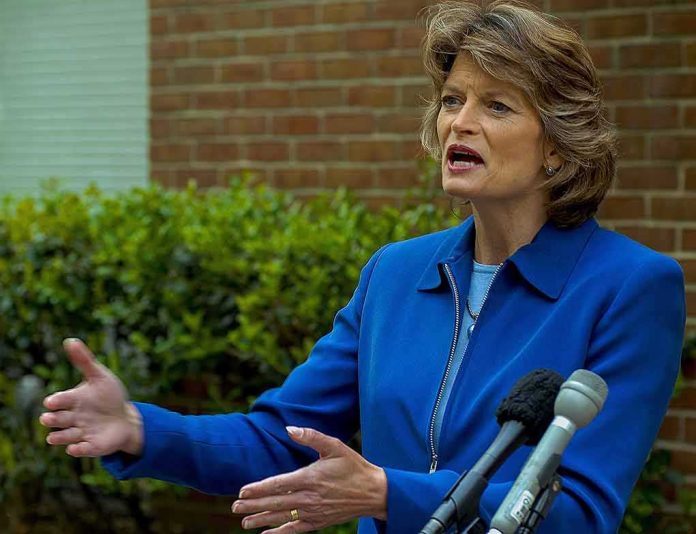
Senator Lisa Murkowski publicly endorsed Democratic gubernatorial candidate Jonathan Kreiss-Tomkins in a television interview, stating, “I am announcing my endorsement of Jonathan Kreiss-Tomkins,” and praising him as “a young Alaskan with a view and a perspective that I think Alaska needs right now.” The statement aired on Alaska’s News Source (KTUU), anchoring the development in contemporaneous, direct attribution. Kreiss-Tomkins’s campaign distributed a companion statement amplifying Murkowski’s rationale and positioning the endorsement as a call to bipartisanship; independent coverage from state and national outlets quickly followed, describing the move as a cross-party break by Alaska’s senior Republican senator.
While endorsements often bloom late in a cycle, this one carried added freight: Murkowski has a history of treating endorsements as judgments on candidates more than parties. She backed Democrat Mary Peltola in 2024 while still supporting Republican Senator Dan Sullivan—evidence that, for Murkowski, alignment runs through Alaska’s particular problems and personalities, not national sorting.
Why It Resonates in Alaska’s Political System
To outsiders, a Republican senator endorsing a Democrat for governor looks like a rupture. In Alaska, it reads as continuity. Three design features shape the landscape. First, Alaska uses a nonpartisan top-four primary that advances multiple candidates to a ranked-choice general election; that structure weakens rigid partisan gatekeeping and invites coalition-building across ideological lines. Second, Alaska’s political culture prioritizes resource management, federal-state bargaining, and local competence over ideological litmus tests; voters routinely sort by trust and track record. Third, campaign coalitions are broader and more fluid—candidates must appeal not only as a first choice but also as a palatable second. That reality nudges prominent figures, Murkowski included, to reward candidates they view as coalition-builders, regardless of label.
This environment also tempers the shock value of “against-type” endorsements. Murkowski’s backing of Kreiss-Tomkins arrives in a context where former governors and cross-party elders often weigh in on suitability and governance style, reflecting a long Alaskan tradition of candidate-centered politics rather than a sudden conversion experience.
The Mechanism: How Endorsements Can (and Often Don’t) Move Voters
Endorsements signal information under uncertainty: who a trusted elite believes is competent, aligned, or safe to support. In low-information races or crowded fields—both common under Alaska’s top-four, ranked-choice structure—such cues can matter at the margin. Yet the academic literature is unambiguous on one point: endorsement effects are contingent. Controlled experiments with large samples show that endorsements can persuade in-parisan audiences but also trigger backlash among opponents, creating parallel persuasion rather than consensus; in some contexts they are polarizing or simply inert.
Two variables dominate the effect size. The first is messenger credibility with the target audience. Murkowski’s brand in Alaska—tempered independence, longevity, and survival through a 2010 write-in victory—gives her standing with moderates and pragmatists, though it elicits resistance from more hardline Republicans. The second is tone. Studies indicate that positive, competence-focused endorsements benefit both endorsee and endorser more reliably than negative broadsides, which can boomerang. Murkowski’s language about “freshness of energy,” “common sense,” and working collaboratively sits squarely in the positive camp, maximizing any chance of lift while limiting self-inflicted harm.
Why Murkowski’s Choice Fits Her Record
Murkowski’s endorsement portfolio reflects a durable principle: Alaska-first pragmatism over national polarization. She has crossed party lines before—backing Peltola—and backed Republicans in the same cycle when she judged them fit for the job, such as Senator Sullivan. Local reporting underscores this split-ticket posture; it tracks with a state political class accustomed to bargaining with Washington for infrastructure and resource policy rather than performing for national media.
In that sense, endorsing Kreiss-Tomkins is less an ideological surprise than an organizational one. Governors in Alaska manage complex intergovernmental flows—federal dollars, energy permitting, fisheries, and Arctic infrastructure. Murkowski’s argument, amplified in the campaign release, is that Kreiss-Tomkins is oriented toward practical collaboration—an asset when ranked-choice dynamics reward consensus and when statewide governance rewards durable coalitions.
What It Could Mean for the Governor’s Race
Four practical implications follow. First, Murkowski’s endorsement gives Kreiss-Tomkins a high-credibility validator with moderates and nonaligned voters who already traffic in candidate-centric evaluations. Second, it may smooth his path to second-choice rankings from center-right voters who respect Murkowski’s judgment even if they prefer a Republican first—critical under ranked-choice tabulation. Third, it may harden opposition among committed conservatives who read the move as apostasy; the literature’s “parallel persuasion” frame applies here. Fourth, media oxygen matters: late-cycle endorsements can reset a narrative, reshaping coverage to competence and bipartisanship rather than ideological skirmishes. Whether this converts to votes depends on ballot order, late advertising, and how rival campaigns respond.
It’s also notable that this endorsement lands in a cycle where multiple prominent Alaskans have been willing to endorse across lines, signaling less a one-off break than a coalition logic consistent with ranked-choice incentives. Local outlets documented a cluster of elder-statesman support for Kreiss-Tomkins aligning on managerial competence over partisanship—an axis that often decides Alaska’s statewide outcomes.
Murkowski's governor endorsement
Sen. Lisa Murkowski endorsed Democrat Jonathan Kreiss-Tomkins for Alaska governor three days after Trump called her a disgrace.#Alaska #Elections pic.twitter.com/7As4w0BuPR
— Alaska News (@AlaskaNewsCom) October 28, 2026
How to Read It Nationally—Without Overreading
National audiences, conditioned by zero-sum partisanship, will be tempted to treat the Murkowski endorsement as a bellwether of Republican fracture. That misreads Alaska. The better lens is institutional incentives: when the electoral system asks voters to rank candidates and prizes broad acceptability, the political elite invests in coalition-builders and, at times, licenses heterodox endorsements. Murkowski’s move is the predictable output of that system, not a repudiation of party identity writ large. It also reminds us that persuasion in American politics is narrower, and more conditional, than cable narratives assume; even marquee endorsements shift margins, not tectonic plates.
Bottom Line
Senator Murkowski endorsed Jonathan Kreiss-Tomkins for governor, on camera and without euphemism. In most states, that would be a thunderclap. In Alaska, it is the sound of the machinery working as designed: candidate-first, coalition-oriented, and stubbornly resistant to national sorting. Whether it moves votes will depend on who is persuadable, how second choices stack up, and whether campaigns convert a clean signal into a broader coalition under ranked-choice rules. The endorsement is clear. Its effects, like most in politics, are earned—not automatic.
Sources:
mediaite.com, yahoo.com, alaskapublic.org, alaskasnewssource.com, thehill.com, juneauindependent.com, thegatewaypundit.com