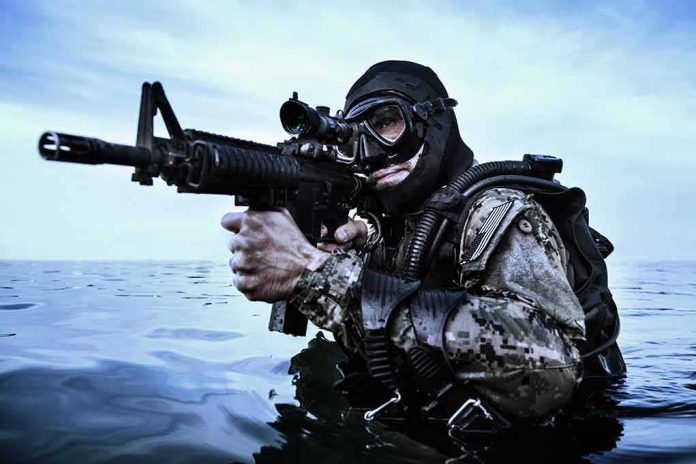
In special operations, survival often hinges less on firepower than on disciplined invisibility; the quiet skill of not being seen, not being fixed, and breaking contact cleanly is what separates a successful reconnaissance from a firefight that goes sideways.
The Short Version
- SEAL reconnaissance and direct-action missions have always balanced aggression with stealth; many successful patrols end without a shot.
- Institutional histories document SEALs operating under heavy threat, evading larger enemy forces, and surviving through concealment, movement, and rescue when needed.
- Vietnam-era swamp operations offer a clear mechanism: patient camouflage, strict noise discipline, and staged exfiltration plans allowed teams to outwait or outmaneuver numerically superior foes.
- The popular claim of “escaping 19 gunmen without firing” is operationally plausible as a type-case, but the precise incident is not identified in public records here.
Why “not firing” is a hallmark of competent reconnaissance
Special reconnaissance is designed to collect intelligence, not to trade rounds. That mission logic drives everything from insertion method to kit weight to exfil timing. The best outcome is often uneventful: establish an observation hide, watch, record, transmit, and slip out undetected. This is not romantic; it is craft. SEAL teams train to become acoustically and visually negligible—minimizing signature through camouflage, light and noise discipline, route selection, and patience. The result is that many successful patrols produce no gunfire at all, not because the operators lacked will, but because they protected the mission’s purpose. Vietnam’s mangrove swamps made this discipline explicit: visibility collapsed to a few paces, roots amplified sound, and currents reversed routes. Teams that remained undetected survived; teams that were fixed risked annihilation.
Across eras, Naval Special Warfare has codified this ethos. Even in theaters that rewarded decisive raids, units retained the freedom to abort or bypass contact when surprise evaporated. That is not caution masquerading as courage; it is economy of force. Elite units are expensive to replace. Their value lies in applying violence precisely—and in declining to fight when the fight would squander the mission or the team.
https://www.youtube.com/watch?v=6vf54BYuHz4
How SEALs make “no-shots” exits possible
The mechanics of disappearing are learned, rehearsed, and audited in after-action reviews. First, teams plan the ground. Routes are templated around terrain that degrades enemy mobility and line of sight—folds, watercourses, canopy, even civilian clutter at the edges of villages. Second, they reduce signature: faces, hands, and exposed kit are darkened; reflective surfaces are taped; radios and optics are managed for light spill; contingencies exist for thermal and canine search threats. Third, they shape time. Patrol leaders choose movement windows that bury sound—wind shifts, tide changes, or aviation overflight. Fourth, they prearrange exfil options: primary, alternate, contingency, and emergency plans, each with triggers for breaking contact, rally points, and comm windows to call supporting fires or lift assets if stealth fails. Vietnam-era riverine operations demonstrated this cycle repeatedly, with many patrols concluding quietly, and with aviation or boats ready to cover an extraction if contact forced a rapid move.
When a team does encounter a larger element—“19 gunmen” or any other number—escape without shooting is achieved through misdirection and tempo. If there is cover and darkness, operators freeze, reduce silhouette, and let the threat pass. If discovered, the team moves obliquely rather than straight back along its ingress, forcing pursuers to choose among decoys. Radios stay disciplined: brevity codes, preplanned signals, and short bursts to avoid triangulation. The comparison is not to Hollywood chase scenes; it is to stalking and counter-stalking, where being five seconds earlier at a decision point is decisive.
Institutional context: evasion, rescue, and the edge of risk
SEAL history includes stark reminders that stealth has limits and that evasion sometimes requires outside help. Operation Red Wings in Afghanistan is the canonical public example: a small reconnaissance element was compromised in the Hindu Kush; Lieutenant Michael Murphy was killed while exposing himself to make a satellite call for support; Petty Officer Marcus Luttrell survived, injured, and evaded through the protection of village locals until rescue forces reached him. That chain of events—compromise, desperate maneuver, community shelter, and eventual recovery—sits within the same family of outcomes as the quieter stories: when the mission breaks contact with violence, the priority shifts to preserving life and extracting survivors.
Institutional narratives from Naval Special Warfare and associated museums trace this pattern across decades—raids and recoveries, but also reconnaissance that ends with clean withdrawals. The community’s own histories emphasize adaptability: teams in riverine Vietnam adjusted to tides and mangroves; Cold War and post–9/11 forces combined stealth with aviation and maritime fire support; and throughout, escape and evasion remained a core competency alongside marksmanship and demolitions.
The “19 gunmen” headline and what we can responsibly conclude
As a genre, the claim of “escaping 19 armed attackers without firing a shot” describes a scenario that is tactically credible and congruent with SEAL tradecraft—especially for a reconnaissance patrol that chooses not to escalate once it detects a superior force. What this body of public material does not do is identify the specific mission, unit, date, or after-action record tying that exact headcount to a documented event. The number reads like the vivid precision that thrives in oral retellings and short-form media, even as the underlying type of outcome—evasion without gunfire—remains common in well-run reconnaissance.
For readers trained by direct-action narratives to equate competence with kinetic output, this can feel counterintuitive. Yet the measure of mastery in reconnaissance is option space: the ability to surveil when it is prudent, strike when it is necessary, and vanish when it is wise. In that frame, “no shots fired” is not a lack of courage; it is the signature of judgment operating under extreme constraints.
Lessons that travel beyond the operator community
Three durable lessons emerge. First, silence is a capability, not an absence. It is engineered through materials, planning, and culture. Second, surprise is perishable; once lost, the smart unit preserves the mission by creating time and space rather than doubling down on a bad fight. Third, resilience is collective. From Vietnam’s Seawolf gunships to Afghan villagers who protect a wounded American, survival often arrives through networks that operators cultivate long before they need them. For civilians seeking an analogy, think of crisis management: prepare routes and redundancies, rehearse signals, and decide in advance which risks you will not take. When pressure arrives, you fall to the level of your training, not the height of your intention.
Sources:
youtube.com, es.wikipedia.org, en.wikipedia.org, navysealmuseum.org, navyseals.com