
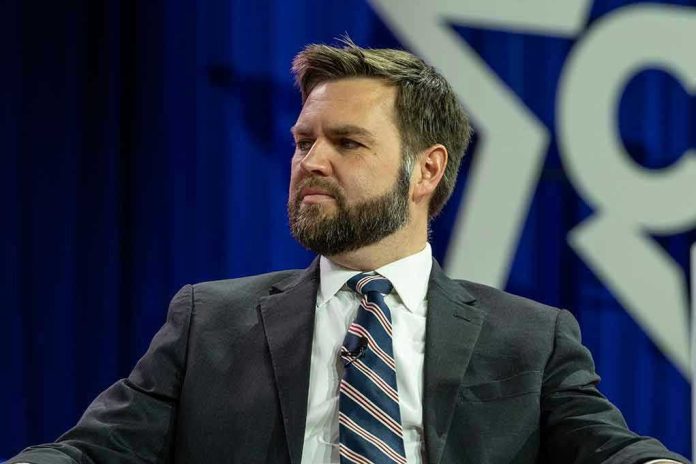
Metaphors that borrow the language of violence are a recurring accelerant in American politics: they animate allies, scandalize opponents, and, stripped of context, become Rorschach tests for intent. The controversy over a podcaster urging listeners to keep “pistols firing” toward Vice President JD Vance fits this pattern exactly — and illustrates why law, media, and audience psychology so often talk past one another when rhetoric turns hot.
At a Glance
- The disputed phrase appeared amid an explicitly electoral riff about defeating JD Vance in 2028, pointing toward metaphor rather than a literal call to violence.
- Critics framed the wording as an assassination cue, citing the pairing of “pistols” with “toward this guy” and today’s fraught security climate.
- U.S. First Amendment doctrine distinguishes protected political hyperbole from incitement and true threats; context and imminence are decisive.
- Social platforms reward outrage, making violent-sounding metaphors more likely to surface and more likely to be interpreted in the worst light.
What Was Said, and Why Context Matters
The phrase at issue — keep “pistols firing … toward this guy” — was delivered during a monologue projecting that JD Vance “thinks two years from now he’s going to be president,” with the speaker urging continued pressure to beat him in 2028. Coverage that supplied the surrounding frame emphasized the electoral aim, not a directive to commit violence. That proximity to a ballot-box objective matters. In American idiom, competitive politics imports martial verbs — fire away, take aim, go for the kill — that are instantly legible as metaphor when the target is a campaign, a policy, or a media narrative. The line between hot metaphor and threat is real, but it is drawn by context, not vocabulary alone.
Even so, context is exactly what gets erased when a clipped sentence is passed around without its setup. Critics circulated the snippet as proof of violent intent, arguing that naming “pistols” and saying “toward this guy” made the leap from metaphor to menace. That claim, however forcefully made, is interpretive; it is not proof of the speaker’s literal purpose. The legal and civic questions turn on different tests.
How the Law Separates Hyperbole, Incitement, and True Threats
First Amendment doctrine draws bright lines that everyday discourse often blurs. Advocacy of force or lawbreaking is protected unless the speech is directed to inciting or producing imminent lawless action and is likely to do so — the Brandenburg standard. “Imminence” and “likelihood” are load-bearing elements; generalized animus or future-facing political objectives do not meet that bar. A separate category, “true threats,” covers statements where a speaker communicates a serious expression of intent to commit unlawful violence; these fall outside protection, though courts have increasingly required some proof of the speaker’s subjective awareness of the threatening nature of the statement.
In Watts v. United States, the Supreme Court treated an explicit-sounding remark about shooting a president as protected political hyperbole given its rally setting, conditional phrasing, and audience response — a reminder that tone, setting, and aim can transmute words that look violent on paper into non-literal attack lines in practice. Applied here, the 2028 election frame cuts against imminence, while the absence of a concrete plan, timeframe, or exhortation to specific unlawful action weighs against incitement or a true threat. None of that absolves reckless phrasing; it situates it legally.
The Counter-Interpretation: Why Critics Heard a Threat
Opponents argued that the phrase’s weapon specificity (“pistols”) and its direction (“toward this guy”) transformed metaphor into incitement. Some labeled it “assassination porn,” urged Secret Service scrutiny, and cast it as proof of a violent political culture on the left. The criticism leaned heavily on moral risk rather than legal taxonomy: in a moment of heightened fear about political violence, public figures, they argue, should not normalize gun imagery connected to named officials.
That argument has civic force even if it falls short legally. Language can raise baseline threat perceptions among targets and their security details; it can embolden unstable listeners who treat metaphor as permission structure. The Constitution Annotated underscores why true threats sit outside protection: to shield people from fear, disruption, and the possibility of actual violence — but that rationale does not convert every violent-sounding metaphor into a prosecutable threat. The tension between legal protection and prudential restraint is unavoidable in pluralist politics.
Why Outrage-Prone Platforms Keep Making This Worse
Social media’s reward structure tilts the playing field. Research indicates that likes and shares train users to escalate moral outrage over time; incendiary phrasing earns attention, and attention becomes its own incentive. Meanwhile, platform virality tends to amputate context: a two-sentence clip is more portable than a two-minute argument. What begins as sharp-elbowed metaphor inside an electoral riff re-enters the feed as decontextualized menace; counter-messaging responds in kind, and the cycle iterates. The result is a perceived radicalization of rhetoric on all sides, even when the underlying speech, assessed in full, aims at electoral defeat rather than physical harm.
A Practical Framework for Judging Political Rhetoric
For citizens trying to parse moments like this, four questions help. First, what is the stated objective — to change votes, to disrupt an event, or to cause harm? Second, is there a call for immediate, unlawful action, or is the timeline future-facing and institutional (elections, legislation)? Third, does the language communicate a serious intent to do violence, as opposed to a metaphor that keys off competitive or martial tropes? And fourth, what is the likely audience effect: does the phrasing predictably raise the risk of harm even if it was not intended to? The Brandenburg and true-threats lines answer the legal piece; prudence and civic responsibility answer the rest.
Applied to the “pistols firing” dispute, the strongest account supported by reporting is that the phrase sat within an exhortation to defeat a would-be 2028 presidential candidate at the ballot box. That makes it protected political hyperbole under the dominant tests. It also makes it bad political craftsmanship: evocative, yes, but counterproductive in a climate where violent imagery is easily weaponized by adversaries and misunderstood by fringe listeners.
🚨 ALERT: DEMOCRAT PODCASTER SPEWS DANGEROUS RHETORIC! 🚨
Jennifer Welch just called for "PISTOLS FIRING AT ALL TIMES" against Vice President JD Vance!
Calling a sitting VP an "Antichrist sociopath" isn't just unhinged—it's a direct threat!
WHERE IS THE SECRET SERVICE?! ARREST… pic.twitter.com/1zPGgnSVjc— Ryan Fournier (@RyanAFournier) October 22, 2026
What Responsible Speech Looks Like Going Forward
There is no shortage of charged vocabulary that can channel urgency without borrowing the grammar of gunfire. Politicians and advocates who want their arguments to travel intact across hostile and algorithmic terrain should design for decontextualization — assume your sharpest ten words will be excerpted and judged alone. Choose verbs that survive the trip. The First Amendment gives wide berth to caustic dissent, and it should. But prudence, not fear, counsels that public persuasion is most effective when it leaves no daylight between what you meant and what a bad-faith clip can imply.
Sources:
foxnews.com, yournews.com, supremecourt.gov, uscourts.gov