When a president speaks and almost no one can hear it, the problem is not merely technical; it is constitutional, historical, and practical, because the evidentiary record of the presidency depends on reliable, independent eyes and ears.
The Short Version
- At a South Lawn ribbon-cutting for a new White House helipad, helicopter noise drowned out President Trump’s remarks on the official feed as the TV press pool declined coverage amid a dispute over access.
- Contemporaneous reporting places the event on September 21, 2026, with Trump cutting the ribbon and boarding Marine One; the audio of his prepared comments and exchanges was largely inaudible to the public.
- The White House video became the principal public record, but without a functioning independent pool, that record lacked intelligible sound—an avoidable failure with outsized civic consequences.
- The episode illustrates how press-access fights, on-the-fly logistics, and litigation strategy can combine to degrade the public’s ability to verify presidential speech.
What happened on the South Lawn, and why it mattered
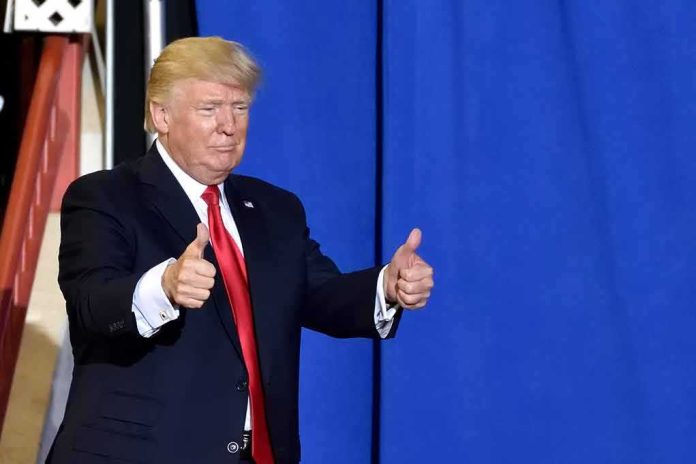
On a clear September afternoon, the White House staged a ribbon-cutting for a new helipad on the South Lawn. The staging was textbook: a brief set of remarks, a ceremonial cut, and a quick departure aboard Marine One. The execution was not. With several major television outlets absent from the rotating press pool amid an access dispute, the White House’s own video feed functioned as the primary public record of the moment—and its audio was overwhelmed by the very helicopter that defined the setting. Both the Associated Press and The Hill reported that Trump’s comments at the event could not be heard over the chopper noise; viewers were left with images and almost no words.
In normal circumstances, the independent TV pool provides redundant microphones and disciplined audio capture even in acoustically hostile environments. On this day, that redundancy was missing. The result was a presidential appearance whose official soundscape amounted to wind, rotor wash, and scattered fragments—an outcome that would be unremarkable at a construction site but is unacceptable when the speaker is the president and the subject is public business.
Mechanics: how presidential words become a durable public record
Modern White House coverage relies on a compact that predates live television: a small, credentialed pool attends events where space and security limit broader access, producing copy, images, and broadcast material that all outlets can use. The pool’s purpose is not preferential access; it is verification and distribution. It ensures that words spoken in constrained venues reach the broader public with fidelity—especially at outdoor sites with aircraft, crowds, or weather that can sabotage audio. The practice, refined since the late 1930s, is part logistics and part press-freedom architecture: without it, the evidentiary record tilts toward whatever the host chooses to release.
When the pool is sidelined—by boycott, ban, or breakdown—the government’s in-house feeds effectively become the sole conduit. That can work for staged visuals; it rarely suffices for sound. Shotgun mics lose to rotor wash; podium mics need isolation and gain staging that only dedicated crews rigorously manage. The South Lawn helipad ceremony demonstrated what happens when those controls are absent or subordinated to speed: the picture rolled, the helicopter arrived on schedule, and the words vanished into the downdraft.
The access dispute and the courts’ view
The audio failure did not occur in a vacuum. It coincided with a legal and procedural fight over press access that had prompted some networks to decline pool participation. In the days around the event, litigation challenged the administration’s restrictions on specific outlets’ access to White House spaces and coverage opportunities, with legal analysts noting that once the government opens a forum for the press, conditioning access on viewpoint is constitutionally fraught. A federal judge subsequently ordered the White House to restore access for barred outlets, underscoring how thin the legal ice is when administrations try to curate who may cover routine presidential activity.
Court skirmishes over media access are not new, but their intersection with live operational needs—like recording usable audio near a helicopter—turns abstract doctrine into immediate consequences. Remove an independent pool accustomed to hostile environments, and the probability of technical failure climbs. On the helipad day, it did, and the immediate losers were not the networks or the White House advance team; they were the citizens who could see their president but could not hear him.
The contested quote that never became the story
Some accounts around the event referenced Trump’s broader commentary about litigation and media pressure that week; he has been a frequent party to and instigator of high-profile lawsuits in his political and business life. But the alleged line that he had been sued so often he had stopped caring does not appear in any authenticated transcript of the helipad appearance. The Government Publishing Office’s document for related helipad remarks in August 2026 marks several sections as “inaudible,” reflecting how fragile the audio chain can be in that setting. With helicopter noise drowning the September ceremony, on-the-record outlets emphasized the inaudibility rather than any specific phrase—because there was no reliable way to extract one from the soundtrack.
That distinction matters. Presidential words carry legal and diplomatic weight; they are archived, cited, and sometimes litigated. When the record fails at the point of capture, subsequent disputes about what was said become insoluble. The solution is not post hoc spin; it is preemptive design that makes inaudibility the rare exception rather than a predictable outcome.
How to prevent this failure mode
There is nothing mysterious about capturing intelligible speech next to a helicopter; it requires forethought and redundancy. The combination is straightforward: enforce pool presence even during access fights by offering equivalent positions to alternates; plant multiple hardwired podium mics with windshields; place a close-lav on the principal with a high-isolation transmitter; set up a cabled or RF split to pool cameras; and route a clean feed to the in-house stream, all managed by an A1 (lead audio engineer) who can gate, EQ, and attenuate against low-frequency rotor rumble. If the pool is absent, the host must replicate that redundancy, or move spoken remarks away from the aircraft and reserve the chopper for B-roll. None of that dilutes message control; it preserves audibility.
The larger pattern: who controls the record controls the narrative
The helipad episode is a vivid case study in a recurring tension. Presidents seek to choreograph imagery; the press seeks to document words and context; the courts police the constitutional perimeter. When either side tries to settle the contest by excluding the other, the result is not clarity but silence—literal, in this case. Sustaining a trustworthy record of presidential speech requires independent capture and open, viewpoint-neutral access policies. Technical competence is part of that obligation. So is resilience: if one outlet declines to serve in the pool, another should step in; if litigation is pending, professional norms should prevent the evidentiary pipeline from collapsing while the lawyers argue.
What this means going forward
For the White House: never stage spoken remarks in acoustic conditions you cannot dominate unless professional audio redundancy is guaranteed. For the press: protect the pool function even amid disputes, because the audience you ultimately serve is not the administration or your competitors, but the public. For the courts: continue to draw bright lines around access that safeguard both the speaker’s rights and the listener’s, so that the institutional machinery that turns speech into a durable record does not depend on ad hoc benevolence.
Sources:
indianexpress.com, yahoo.com, govinfo.gov, ibtimes.co.uk, npr.org, alligator.org, cjr.org