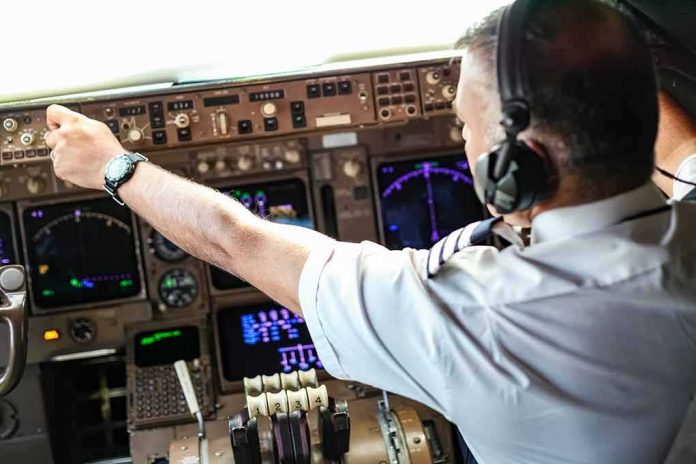
When violence originates inside the cockpit, every layer of aviation safety is stress-tested at once: design assumptions, crew procedures, vetting, and the hard ethical questions about how much trust must be placed in the two people at the controls.
At a Glance
- Authorities in the UAE concluded the Flydubai co-pilot attacked his captain with the cockpit’s crash axe and tried to seize the aircraft in what they called an attempted terrorist act.
- Passengers, cabin crew, and additional off-duty Flydubai pilots helped subdue the co-pilot, enabling a diversion and safe landing in Tabuk, Saudi Arabia.
- Early airline language emphasized an “altercation” and cautioned against premature conclusions while formal investigations proceeded.
- The case revives enduring policy debates born of 9/11 and Germanwings: pilot screening, cockpit access design, and protocols for detecting and interrupting insider threats.
What the investigation established and why it matters
Within days, the most authoritative account came from the United Arab Emirates, which is leading the criminal inquiry: the Flydubai co-pilot used the cockpit’s crash axe to attack the captain and attempted to take control of the aircraft, an act the UAE Attorney General described as an attempted terrorist attack. Saudi Arabia’s Interior Ministry—first on scene when the flight diverted to Tabuk—had already reported a violent assault by the co-pilot that injured both pilots, aligning with the later, more detailed UAE account. These are primary, named, official sources; in aviation investigations, that specificity and ownership of the claim are what lift an account from rumor to record.
The operational significance is straightforward. Modern airline safety is built on redundancy and cross-checks between two qualified pilots. When one pilot becomes the hazard, the redundancy collapses—unless others can quickly intervene. Here, passengers, cabin crew, and two additional Flydubai pilots traveling on board entered the cockpit and subdued the attacker, a decisive factor in stabilizing the flight and effecting a safe landing. The captain’s own account—fighting through severe wounds to open the reinforced door and summon help—fits that chain of events and explains how an insider threat was converted back into a manageable abnormal situation.
How an insider defeats the cockpit’s safety architecture
Since 9/11, the cockpit door has been engineered to resist intrusion from the cabin side; cameras, reinforced latches, and procedures are all designed to harden against outsiders. That asymmetry—strong against external intrusion, permissive by necessity for those already inside—creates a rare but real vulnerability: the trusted insider who weaponizes access. The Germanwings tragedy in 2015 exposed one edge of this problem when a first officer used lockout procedures to exclude the captain. The Flydubai incident illustrates the inverse: the attacker did not rely on door logic but on proximity and cockpit tools. A crash axe is part of standard emergency equipment intended for structural access in fires; like any tool, in malicious hands it can become a weapon.
Security doctrine has tried to reconcile these competing risks. Reinforced doors and sterile cockpit procedures protect against unlawful interference from the cabin; medical fitness evaluations, recurrent training, and peer observation are meant to screen for degraded judgment or malice among crew. Regulators have iterated on these layers for two decades—arming select crew on some carriers, adding behavioral observation, and refining mental health reporting regimes—but none abolish the residual risk when intent flips inside the flight deck. The Flydubai case will inevitably be read through that matrix.
What changed from the early “altercation” language
In the immediate aftermath, the airline used deliberately neutral phrasing—“an altercation occurred in the flight deck”—and urged patience while investigators assembled facts. That caution is standard practice: operators have legal exposure and a duty to avoid prejudicing interviews or contaminating evidence. As jurisdictional authorities gathered cockpit testimonies, medical reports, and flight data, public characterization sharpened. The UAE Attorney General’s statement provided the inflection point by asserting weapon, mechanism, and motive category—crash axe, attempted seizure of the aircraft, terrorist intent—on the record. At that stage, the center of gravity moved from uncertainty to a documented narrative, even as the precise motive, affiliations, and preparatory timeline remained matters for deeper investigation.
Some statements by political leaders went further on motive and ideology. Those claims, while newsworthy, are not the evidentiary spine of the case. In accountability terms, the weight sits with the investigative authority that names actors, mechanisms, and charges—and can be judged by what it is prepared to defend in court or through mutual legal assistance channels.
The mechanics of recovery: how the aircraft was saved
Accounts from the captain and multiple passengers converge on a sequence that safety professionals recognize from crisis debriefings: rapid degradation, recognition, mobilization, and distributed problem-solving. The captain transmitted emergency squawks and then, despite heavy bleeding, unlocked the cockpit door while under attack—an action that traded a door-security risk for life-saving access by allies. Cabin crew and passengers, followed by off-duty pilots, entered, subdued the assailant, and restored functional control. Israeli officials described that intervention and the presence of additional Flydubai pilots as key to the safe diversion to Tabuk. In pure risk management terms, this is a textbook example of resilience: layers not designed for this exact failure nonetheless adapted to contain it.
The question professionals will analyze in the formal report is what the flight data recorder and cockpit voice recorder reveal about the aircraft’s energy state during the struggle and the timing of inputs versus interventions. That technical timeline matters for systems design—autopilot engagement logic, control wheel steering, and any potential for envelope protection software to blunt extreme attitudes—without obscuring the human factor that made the difference.
Where the real policy debate lies
Three arenas will occupy regulators and operators. First, vetting and continuous evaluation: how to identify disqualifying risk without creating perverse incentives for pilots to hide treatable conditions. The Germanwings aftermath produced new reporting frameworks and peer-support programs; expect a fresh audit of their adoption and efficacy across jurisdictions. Second, cockpit access protocols: some carriers employ two-person-in-cockpit policies at all times; others vary based on flight phase and fleet. Those policies, while not panaceas, change the geometry of an attack and can buy time. Third, equipment and procedures: from how crash axes are stowed to reinforced-door emergency logic and cabin alert pathways, small design and training choices can modulate the cost of a rare insider event.
The base rate matters. Cockpit insider violence is extraordinarily rare; aviation is safe precisely because the system learns from outliers. But rarity is no refuge from consequence. Policy after 9/11 and Germanwings was set by black-swan logic—low frequency, catastrophic stakes—and the Flydubai investigation will feed that tradition. The discipline is to respond proportionally: fix the specific holes the evidence exposes, avoid security theater that adds complexity without resilience, and keep the core truth in view—trust is not a vulnerability to be eliminated but an asset to be governed.
https://twitter.com/warfareanalysis/status/2106426120681685280
What to watch for next
The public report will likely settle four questions: the co-pilot’s precise preparation and motive; any prior flags in medical, training, or security records and whether they triggered action; the exact flight profile and control inputs during the struggle; and the performance of crew procedures relative to company manuals. Expect regulators to issue safety recommendations rather than sweeping rulemaking, with operators adopting targeted changes in training, cockpit staffing policy, and emergency equipment handling. The standard for judging those changes is simple: do they reduce the time between recognition and interruption of an insider attack without undermining the defenses that keep everyone else out of the cockpit.
Sources:
facebook.com, reuters.com, news.flydubai.com, aljazeera.com, efe.com, en.wikipedia.org, uk.news.yahoo.com, abcnews.com, gulfnews.com, abc.net.au