When a nuclear carrier stays at sea for nine or ten months, the headline isn’t simply distance or days logged; it’s a warning light on a system calibrated for shorter deployments that is being asked, again, to do more than its maintenance and manning cycles were built to sustain.
The Short Version
- The USS Abraham Lincoln’s deployment stretched to roughly ten months, with officials citing mission demand rather than mismanagement as the driver.
- Navy statements confirm unusually heavy operational use: 266 days deployed, 200 in a combat zone, more than 10,000 sorties, and 1.5 million pounds of ordnance expended.
- Reports described distress and overboard incidents among sailors; the Navy later confirmed eight suicide attempts across the strike group while disputing a shipboard spike in ideation.
- The broader pattern predates this cruise: nominal seven-month deployments routinely creep longer when demand outruns the Optimized Fleet Response Plan and shipyard capacity.
What “never coming home” actually means: the mechanism of carrier tempo
The carrier force is organized around a repeatable rhythm: major maintenance, integrated training and workups, then a deployment that, in doctrine and planning documents, centers on about seven months at sea in a three-year cycle. The logic is sound—tighten maintenance, certify the air wing and escorts, surge when required—but it presumes predictable demand and shipyard throughput. Over the past decade, that presumption has often failed. GAO documented how extended deployments and maintenance delays compress the non-deployed phases, leaving less time to repair, train, and recover, which in turn makes the next deployment harder to execute on schedule. Average deployment length rose above the seven-month ideal during earlier surge periods and, in stress years, approached nine months for multiple carrier strike groups.
Against that backdrop, a ten-month cruise is not an accounting anomaly; it is the tail of a distribution that shifts right whenever operational demand spikes or a relief carrier’s availability slips. The Navy’s own doctrine underscores why carriers absorb that shock. A carrier strike group provides immediate, tailorable power projection and decision time for national leaders; when a crisis runs long or intensifies, there are few substitutes that can be surged with equivalent effect. In practice, that means the deployed carrier stays on station until relief arrives—if relief is ready.
The Lincoln deployment: the facts that matter
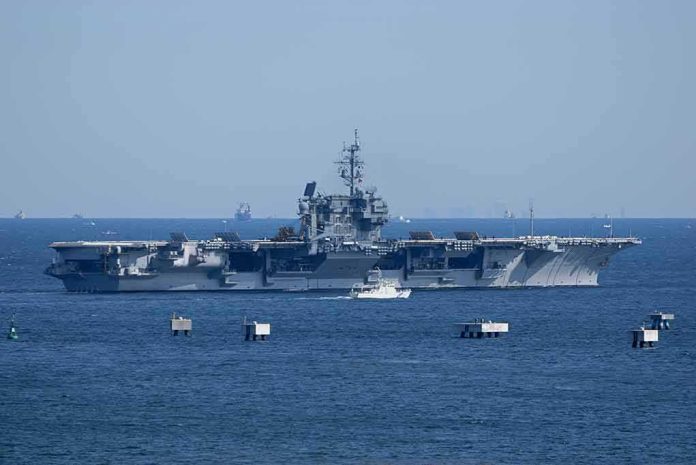
By late September, the Lincoln and Carrier Strike Group 3 were in Guam, marking the tenth month of deployment since departing San Diego the previous November. Navy leadership publicly framed the extension as mission-driven and part of a planned rotation, not a breakdown of process. The same statements acknowledged the scale of combat operations: 266 days deployed, roughly 200 of those in a combat zone, with the air wing generating more than 10,000 sorties and dropping roughly 1.5 million pounds of ordnance. Those are not routine deterrence numbers; they reflect sustained combat tasking and a strike group operating at the edge of its designed tempo.
Hardship claims accompanied the operational data. Families and media reports described morale problems and in some accounts shortages and sanitation issues for a crew of about 5,000. In August, CNN reported a sailor went overboard and another was stopped from doing so months earlier; the Navy initially pushed back on the idea of a measurable spike in suicidal ideation aboard the ship. In September, officials confirmed eight suicide attempts across the strike group, including one overboard event and one prevented on board, while maintaining that health and wellbeing remained command priorities. Two things can be true at once: the Navy can invest in embedded counselors, chaplains, and medical staff, and extended deployments can still amplify stress on crews and families. The service itself has conceded the strain that longer cruises impose, even as it defends the decisions that led to them.
The honest disagreement: mission necessity versus overdeployment
There is no factual dispute that the Lincoln stayed out far longer than the nominal standard and that the carrier and air wing were heavily employed. The Navy’s core counter-argument is about cause and framing: this was a hard deployment because the mission demanded it, and the rotation was managed with safety and support in mind. Critics—families, some veterans, and outside analysts—hear that as institutionalizing overdeployment and underplaying consequences. The strongest evidence the Navy offers is specific and material: the operational output numbers and the public assertion that the ship will rotate home as planned now that tasking permits. The strongest evidence on the other side is also specific: multiple suicide attempts across the strike group and two overboard-related episodes tied temporally to the same cruise, plus multiple outlets corroborating extended time at sea.
Where the record is thinner is causality. We have temporal proximity and credible accounts of distress; we do not yet have command investigations and medical summaries that would parse preexisting risk, unit climate, operational tempo, and personal history. Absent that, the fairest reading is this: long deployments are a known risk amplifier, not a sole cause. GAO and Navy analysts have been explicit that stretching cycles increases maintenance burden and human tempo in ways that cascade into the next phase; that observation is structural, not anecdotal.
How the Navy got here: the cycle that slips
The Optimized Fleet Response Plan was designed to stabilize readiness: a predictable 36-month cycle that, on paper, yields more sustainable deployments and dwell time. In practice, operational surges, shipyard bottlenecks, and aviation maintenance demands have repeatedly eroded its predictability. Proceedings analyses documented the shift from roughly 6.4-month averages in 2008–2011 to more than eight months during later surge years; GAO cited three carrier groups that hit nine months in 2015 and highlighted how compressed training and sustainment phases degrade future readiness. None of that makes a single ten-month cruise a scandal in isolation; it situates it as a stress test of a fleet architecture that depends on ships returning to the cycle on time and shipyards turning them around as scheduled.
When either link fails—because a crisis requires presence to continue or because maintenance overruns stack up—someone pays the bill. Often it is the deployed crew first, then the next crew whose workups compress, then the maintenance teams wrestling with deferred repairs. The Lincoln deployment sits squarely in that lineage.
TWO NAVY AVIATORS HAD TO EJECT WHILE LANDING ON THE USS DWIGHT D. EISENHOWER, AND THANK GOD THEY WERE RESCUED.
It happened off the coast of Virginia, and the Navy says four sailors were hurt in what it's calling a mishap during recovery operations.
We still don't know what kind… pic.twitter.com/y8ByQQPbeR
— Gunther Eagleman™ (@GuntherEagleman) September 29, 2026
What it means going forward: separating the necessary from the avoidable
Carriers will always be the nation’s high-demand option for rapid, sustained power projection; that reality won’t change. What can change is the discipline with which the Navy and civilian leadership constrain how often they ask the force to outrun its own cycle. Three pragmatic steps follow from the evidence. First, transparency: release command investigations and anonymized medical incident data for the Lincoln strike group’s overboard and suicide-attempt cases; sunlight clarifies what conditions are preventable and what support works best. Second, benchmarking: publish an annual, fleetwide deployment-length and dwell-time report against OFRP targets, by hull and by air wing, so outliers are visible as they form rather than retroactively rationalized. Third, capacity: continue to address the shipyard and air wing maintenance bottlenecks that GAO links to cycle compression; when relief carriers are late, deployed carriers stay late.
The human ledger: why tempo is strategy
The phrase “the mission demanded it” can’t be a blank check. It ought to be a specific assertion, testable against operational logs and relief availability, and paired with an equally concrete accounting of the human cost. The Navy has already conceded the core truth: extended deployments exact a price from sailors and families; each additional month adds load on engineering systems, airframes, and people. An institution that treats that price as a managed tradeoff rather than an incidental side effect will be better positioned to deliver the same combat power a decade from now as it did this year—without training a generation of sailors to believe the carrier only ever comes home on paper.
Sources:
19fortyfive.com, cnn.com, bbc.com, navy.mil, nytimes.com, navytimes.com, theguardian.com