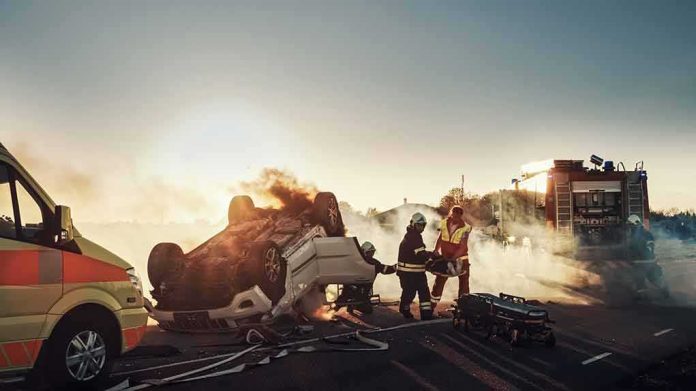
A single, unarmored sedan turned a routine checkpoint rotation into a life-or-death emergency: Neria Leiter, an Israeli reservist and the son of Israel’s ambassador to the United States, was struck in a deliberate ramming on Route 443 and rushed into hours of brain surgery in Jerusalem. The incident is tragic on its own terms; it is also emblematic of how low-tech, high-impact vehicular assaults exploit the geometry of West Bank checkpoints and the thin margins of human attention that separate vigilance from catastrophe.
At a Glance
- Multiple major outlets report that Neria Leiter, son of Israel’s U.S. ambassador, was critically injured in a car-ramming near the Beit Horon/Maccabim corridor on Route 443.
- Israeli forces shot and killed the driver, identified across reports as Mahmoud Suleiman, 29, from Beit Ur al-Tahta.
- Leiter was treated at Shaare Zedek Medical Center in Jerusalem and underwent prolonged brain surgery; hospital and family statements described life-threatening injuries.
- The attack fits a broader pattern of vehicular assaults at or near West Bank checkpoints, where movement controls and close-quarters exposure increase risk.
What Happened and Where the Facts Converge
Published reporting is consistent on the core facts. On a West Bank artery that links Jerusalem to central Israel, near the Beit Horon/Maccabim stretch of Route 443, a driver steered directly into a position where Israel Defense Forces personnel were exposed, striking reservist Neria Leiter. Multiple outlets name the assailant as a 29-year-old from the nearby village of Beit Ur al-Tahta; Israeli security personnel then shot and killed him at the scene. The IDF publicly described the event as a ramming attack at a checkpoint within the Binyamin Brigade’s zone, with the attacker “eliminated” by responding forces. Those operational details—ramming at close range, immediate lethal response—are characteristic of the doctrine that governs force protection at West Bank interfaces.
Ambassador Yechiel Leiter’s statements remove ambiguity about the victim’s identity and condition. He named his son, asked for prayers, and said doctors needed “a miracle” as medics fought to stabilize him. Reports from the receiving hospital, Shaare Zedek Medical Center, described emergency neurosurgery lasting hours and a post-operative condition still deemed life-threatening. Taken together, the corroborated location, named principals, and hospital course form a coherent factual spine for an incident whose operational dynamics are both familiar and difficult to preempt.
Why Checkpoints Create High-Reward Windows for Vehicular Assaults
Vehicular ramming is wrenchingly simple: a driver converts ordinary mass and speed into a weapon, aiming at exposed personnel clustered by necessity around a fixed point. Checkpoints concentrate risk. Troops are partially static, their attention split among identification checks, vehicle flow, and perimeter watch. Lanes, barriers, and median islands can create blind angles that narrow reaction time to seconds. Across the West and in Israel specifically, this tactic has persisted because the inputs are trivial to obtain—any car will do—and the attack geometry is straightforward. In that sense, Route 443 is not an anomaly. It is a textbook environment for a single actor to impose disproportionate harm before armed responders can interdict him.
This risk is amplified by the density of movement controls in the West Bank. United Nations and press-freedom monitors have documented hundreds of staffed checkpoints and physical obstacles across the territory. That lattice slows movement and often impedes independent observation; it also creates predictable control nodes where uniformed personnel must repeatedly expose themselves to the approaches of civilian vehicles. A tactical fact follows: if an assailant wants to target soldiers with a vehicle, he does not need to hunt for them—they are at the choke points where the road narrows and the rules slow everyone down.
The Medical Arc: What “Critical” Actually Implies
Trauma language often blurs in headline shorthand, but in this case the descriptors align with a severe primary brain injury. Reports cite emergency transfer to Shaare Zedek, immediate neurosurgical intervention lasting several hours, and continued life-threatening status afterward. For a ramming victim, that pattern typically implies diffuse axonal injury from acceleration-deceleration forces, focal contusions, or acute intracranial hemorrhage—sometimes all three. Prolonged operative time suggests decompression, control of bleeding, and perhaps evacuation of hematoma with close postoperative monitoring in intensive care. Family statements emphasizing the need for a “miracle” are neither melodrama nor euphemism; they reflect the reality that neurological recovery, even after technically successful surgery, turns on edema, secondary injury cascades, and the patient’s physiologic reserve.
Hospitals in Jerusalem have deep experience with blast and ramming trauma; they also know the limits of even world-class care against high-energy head injury. That is why, in the immediate hours and days, updates toggle between guarded and critical rather than decisive prognoses—because the brain’s course evolves in time, not by press cycle.
Naming the Assailant and the Question of Labels
Several outlets identify the driver as Mahmoud Muhammad (or Mohammad) Suleiman, 29, from Beit Ur al-Tahta; transliteration variance is common when Arabic names move through Hebrew and English desks, but the underlying identity remains consistent across reports. Israeli authorities and much of the Israeli and international press framed the incident as a terror or car-ramming attack; Hamas publicly praised it as a “natural response,” a political signal that aligns with the terrorism label many editors used. In operational terms—an intentional vehicular strike on uniformed personnel—this fits the established pattern that counterterrorism analysts have tracked for a decade: low planning threshold, rapid execution, and a narrow window for defensive fire.
The precise checkpoint label varies by outlet—Beit Horon, Maccabim, or “Binyamin Brigade area”—but those are adjacent references to the same corridor on Route 443 west of Ramallah. They reflect newsroom shorthand, not a dispute about whether a ramming occurred or who was struck.
How We Got Here: Pattern, Precedent, and Persistent Vulnerability
Vehicular assaults surged globally in the mid-2010s and, while uneven, never disappeared; their persistence owes to the tactic’s grim efficiency and the difficulty of preempting lone operators without prior signatures. In Israel and the West Bank, the method is particularly salient: dense checkpoint networks, mixed traffic environments, and frequent troop-civilian proximity provide repeated opportunities for a driver to weaponize a short approach lane into tragedy. Each incremental layer of concrete, bollard, and serpentine lane buys milliseconds of reaction time; none can turn an open road into an armored wall.
That design reality coexists with a media reality: incidents at West Bank checkpoints are immediately pulled into framing contests—terrorism for some outlets, symptomatic violence of occupation for others—often obscuring a narrow operational truth that matters first to the people on the ground. A soldier on a median has seconds. A sedan at 40 miles per hour needs fewer to cover the distance. The attack on Route 443 is, tragically, a case study in that calculus.
Neria Leiter, the son of Israel’s Ambassador to the United States Yechiel Leiter, was critically wounded in a Palestinian car-ramming attack at a checkpoint near Modi’in, between Jerusalem and Tel Aviv.
Leiter, an IDF reservist and American citizen, was serving alongside a… pic.twitter.com/BesRaITRbH
— Visegrád 24 (@visegrad24) September 27, 2026
What This Means Going Forward
Three implications follow. First, force-protection design will continue to harden checkpoint perimeters—more standoff distance, angled approach lanes, and vehicle-stopping measures that slow an oncoming car without strangling civilian throughput. Second, training and posture will keep emphasizing distributed vigilance and clear arcs of fire that account for ricochet and bystander risk in mixed-traffic corridors. Third, the medical system will remain the final, indispensable bulwark: rapid evacuation, neurosurgical readiness, and intensive care capacity are the difference between a death notice and a fighting chance.
For the Leiter family, those systems have already been tested twice; the ambassador’s public plea and the hospital’s stark language convey the human cost better than any strategic analysis could. For everyone else, the lesson is equally plain: the risk window at a checkpoint is never closed, only managed. On Route 443, management failed by a matter of seconds. The professional task—security, medical, and political alike—is to shrink those seconds wherever possible without multiplying the harms that checkpoints themselves can produce.
Sources:
nbcnews.com, cnn.com, cbsnews.com, washingtonpost.com, washingtonexaminer.com, strategiecs.com, scholarsjunction.msstate.edu