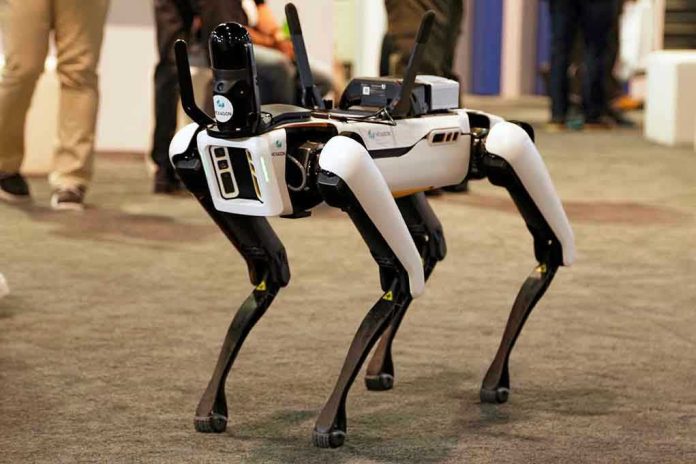
The Pentagon’s creation of an Autonomous Warfare Command is not a boutique reorg; it is a structural bet that drones, robotics, and AI now constitute a warfighting system so pivotal that only a four-star authority with service-like powers can scale it across the force.
At a Glance
- The Defense Department announced a new four-star Autonomous Warfare Command (AutoWarCom) to accelerate drones, robotics, and AI across the joint force.
- The command’s mandate is framed as service-like authority to consolidate and scale autonomous capabilities, not a niche program office.
- The initiative was unveiled in a State of the Force address at Quantico and is tied to an operational timeline around 2027 in multiple reports.
- The move follows a familiar pattern: when a domain becomes decisive, the Pentagon elevates it—think Cyber Command and the reestablishment of Space Command.
What Was Announced and Why It Matters
In a State of the Force address at Marine Corps Base Quantico, Defense Secretary Pete Hegseth announced the creation of Autonomous Warfare Command—AutoWarCom—as a four-star command with service-like authorities to scale autonomous and robotic capabilities across the joint force. The announcement was explicit about stakes: autonomous systems are not just new kit, they are reshaping equipment, doctrine, organization, and long-held assumptions about how wars are fought. Multiple outlets independently reported the same core facts, timing, and venue, underscoring that this is a department-level decision, not an aspirational concept.
The organizational choice—a dedicated four-star with authorities that emulate a military department’s ability to set standards, drive procurement models, and enforce integration—signals intent to correct a familiar problem: diffusion. When every service optimizes its own drones, data links, and autonomy stacks, the result is redundancy, incompatible control systems, and slow fielding. A single command can set interfaces, consolidate buying power, and align test, training, and doctrine to deliver interoperable mass at speed.
How It Fits Pentagon History: Centralization When a Domain Turns Decisive
The Defense Department rarely creates new top-level commands; when it does, the driver is usually a domain that has outgrown service-by-service stewardship. The reestablishment of U.S. Space Command in 2019 and the maturation of U.S. Cyber Command followed that logic: elevate authority to break stovepipes, assert joint standards, and accelerate capability delivery. Reuters’ framing placed AutoWarCom squarely in this lineage—new commands are uncommon and reserved for discontinuities in the character of war. The autonomy/drone stack has reached that threshold. It is not just ISR quadcopters at the edge; it spans attritable aircraft, surface and subsurface unmanned systems, counter-UAS, electronic warfare, computer vision, and AI-enabled command and control.
Centralization brings leverage. It can harmonize requirements, pick winners among overlapping programs, and enforce data and control-system interoperability that fosters swarming, teaming, and cross-domain kill chains. It also concentrates accountability: when one commander is measured against fielding rates, unit integration, and operational outcomes, diffusion’s “not my lane” defense disappears.
Mechanism: What “Service-like Authorities” Enable
“Service-like” in Pentagon vernacular points to the powers military departments wield: to organize, train, and equip forces at scale. Applied to autonomy, those authorities let AutoWarCom set common control architectures, approve data formats for machine perception and targeting, and establish test regimes that reflect contested electromagnetic environments rather than benign ranges. They also enable agile acquisition pathways—rapid prototyping, iterative fielding with operators, and portfolio budgeting that treats families of drones and counter-drone systems as an integrated capability rather than discrete line items.
Reports tied the command to acquisition reform concepts—Project Agincourt and a “warfighting acquisition” model that pushes entrepreneurs and operators into the same loop to shorten cycles from concept to combat. That model, if backed by budget and contracting tools, translates to faster block upgrades for autonomy software, standardized payload bays and power interfaces, and the ability to surge production of attritable systems as operational demand spikes. The Wall Street Journal and Breaking Defense placed the operationalization target around October 2027, which is consistent with the time required to publish a charter, stand up headquarters elements, and align budgets for a first program cycle.
Scope and Relationships: Where AutoWarCom Sits in the Ecosystem
AutoWarCom is framed as joint by design—its remit is to scale capabilities across services, not to replace them. That matters because each service holds deep domain expertise: the Navy in maritime autonomy and undersea comms, the Air Force in attritable aircraft and manned-unmanned teaming, the Army and Marine Corps in ground robotics and counter-UAS. A joint command’s role is to standardize control systems and data, compress the acquisition loop, and fund shared enablers—mesh networking, resilient PNT, edge processing—that make the entire portfolio more than the sum of its parts.
Reporting also referenced a Departmental Autonomous Warfighting Group (DAWG) and broader consolidation of drone spending, with figures in the tens of billions attached to the autonomy portfolio. Precise lines of authority will harden in the formal charter and budget documents, but the pattern is clear: push fragmentation into a joint construct that can set enterprise rules, then empower program offices to execute against those rules with disciplined speed.
Operational Rationale: Mass, Interoperability, and Counter-Drone Imperatives
Modern operations demand two things in autonomy: scale and survivability. Scale comes from low-cost, attritable systems that can be fielded and replenished in volume; survivability emerges from networking, autonomy at the edge, and emissions control that complicate adversary targeting. Ukraine’s battlefield has been a harsh tutor on both counts: ubiquity of drones, rapid iteration, and the constant duel between strike and counter-UAS. A U.S. command that owns both sides of that ledger—offense and defense—can drive coherent investments in sensors, directed energy, electronic attack, and AI-enabled detection that collapse the time from detection to defeat while ensuring friendly systems remain effective in dense jamming.
Crucially, “autonomous” does not mean ungoverned. Department policy requires human judgment in the use of force and robust test and evaluation for safety and reliability. Elevating autonomy to four-star stewardship creates a single owner for doctrine on human-machine teaming, standardized risk thresholds, and validation of machine learning models against adversarial conditions—exactly where fragmented governance fails. That institutional home is how you move from promising prototypes to trustworthy formations at scale.
Timeline, Implementation, and What to Watch
Outlets that reviewed internal planning language pointed to an operationalization window around October 2027. Between now and then, three milestones will reveal seriousness. First, the charter: does it specify authorities on par with the claim—control of standards, joint requirements, and portfolio budgets—or merely advisory coordination. Second, the interfaces: published technical baselines for control stations, autonomy stacks, and data models that vendors and program offices must meet. Third, the acquisition model: contracting vehicles and color-of-money flexibilities that allow rapid spiral upgrades, multi-vendor competitions on common interfaces, and surge capacity for attritable production.
A final indicator will be exercise integration. If by the first year the services are flying and sailing mixed-origin unmanned teams under a common control architecture, with shared counter-UAS overlays and joint kill-chain participation, AutoWarCom will have translated concept into practice. If instead programs continue to proliferate with bespoke control systems and one-off data formats, the command will be a title without teeth.
Precedent and Consequence
Cyber and space taught the same lesson: once a technology stack crosses from enabler to domain, unity of command accelerates maturation. Reuters underscored how rarely the Pentagon stands up a new top-tier entity; that rarity is the point. Autonomy, spanning drones to decision aids, has crossed that threshold. A four-star command with service-like authorities gives the department a mechanism to impose standards, husband resources, and measure outcomes that matter to warfighters—not just “how many prototypes” but “how many integrated, resilient, and lethal formations ready now.”
The consequence is strategic. A U.S. force that can field interoperable autonomous mass, refresh software on operational timelines, and neutralize adversary drones at scale resets escalation calculus and logistics math alike. That is why elevating autonomy from a collection of programs to a command is not administrative trivia; it is force design.
♟️ PROJECT MERIDIAN: WHO SHAPES THE FUTURE OF WARFARE?
🇺🇸 Defense Secretary Pete Hegseth has announced Project Meridian, a 120-day Pentagon study focused on the future of warfare and the technologies the United States may need for emerging battlefields.
The project will be… pic.twitter.com/uzaC2G2sPo
— KAB GLOBAL CHESSBOARD (@KABGlobalBoard) September 30, 2026
Sources:
insidedefense.com, cnn.com, defensescoop.com, armytimes.com, wsj.com, thenationalnews.com, dailymail.com, news.bloomberglaw.com, aa.com.tr, english.news.cn, businessinsider.com, breakingdefense.com