
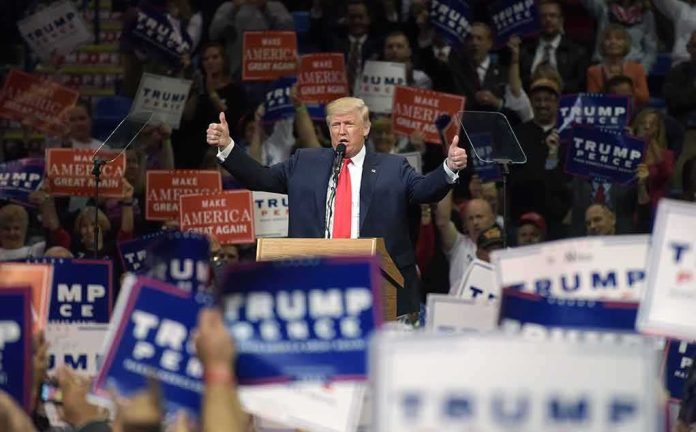
Presidential rallies in safe states are not wasted mileage; they are precision tools for mobilization, imagery, and message discipline—and President Trump’s stop in Mobile, Alabama, was a textbook example of how incumbents use friendly terrain to energize a party’s midterm effort.
At a Glance
- President Trump headlined a scheduled midterm rally at the University of South Alabama’s Mitchell Center in Mobile on Oct. 2, 2026, explicitly to boost Republican candidates.
- The event was coordinated on the GOP calendar, drew thousands, and featured a roughly 70-minute address centered on turning out Republican voters.
- Alabama’s delegation and statewide Republicans leveraged the stage to align local races with national GOP themes and endorsements.
- Strategically, the stop fit a broader red-state sweep aimed at energizing the base and reaching adjacent media markets ahead of the midterms.
What Happened in Mobile: A Coordinated Midterm Push
On a Friday night five weeks before the midterms, President Trump headlined a “Midterm Rally in Mobile, Alabama” at the University of South Alabama’s Mitchell Center. The Republican National Committee listed the event on its schedule with a fixed start time and branding that left no ambiguity about purpose: a partisan mobilization to help Republicans up and down the ballot. Local broadcasters carried the rally live; contemporaneous reporting described a crowd in the thousands and a speech that ran a little over an hour, classic rally length for a late-cycle push. From the stage, Trump urged attendees to get out and vote Republican—direct, uncomplicated, and consistent with the program’s framing.
The roster underscored that function. Coverage tied the stop to Alabama Republicans who either appeared, were named from the stage, or stood to benefit politically—among them Sens. Tommy Tuberville and Katie Britt, Rep. Barry Moore, state Rep. Rhett Marques, and attorney general candidate Katherine Robertson. This was not an unscheduled pop-in; doors opened hours ahead of the program, regional outlets previewed the logistics, and the rally slotted into a multi-stop swing across Republican-leaning states.
Mechanics: Why Parties Campaign in Safe States Before Midterms
Sending a sitting president to a deep-red venue sounds counterintuitive if one thinks only in terms of flipping states. Midterms, however, are not presidential races; they’re a mosaic of district- and state-level contests where turnout asymmetries decide control. Campaigns allocate principals where three effects are likely: base activation (volunteers, early voting, Election Day enthusiasm), sustained earned media in friendly markets, and symbolic imagery that reassures donors and activists that momentum exists—and is theirs. Alabama delivers all three. The Mobile media market spills into neighboring regions; a rally there beams repetition of core themes to Republicans who might never enter the Mitchell Center but will encounter the message repeatedly across platforms.
Political scientists and strategists long have observed that safe-state swings aren’t about conversion so much as mobilization and narrative control: rack up reliable turnout where you can bank it and define the news agenda on your own terms. In that light, Mobile’s rally was a standard, rational choice in a compressed calendar—lean into strongholds to harden the vote and help local candidates anchor themselves to the national brand without ceding message space to opponents.
The Program: Local Candidates, National Message
Rallies of this kind braid local contests into national storylines. In Mobile, coverage and live feeds captured a familiar cadence: local and statewide Republicans making the case for conservative governance, then the president amplifying that case with a broader argument about the direction of the country and what partisan control would deliver for voters. The formula works because it aligns incentives. Down-ballot candidates gain exposure and the imprimatur of the party’s most visible figure; the White House sharpens the midterm stakes and channels enthusiasm into turnout operations—door knocks, phone banks, and social amplification that spike in the event’s wake.
Naming beneficiaries matters tactically. When a president singles out Senate or House candidates, he ties their prospects to the national agenda—and gives partisans a concrete to-do list: show up for these specific races. Contemporary reports linked the Mobile stage to Alabama’s delegation and candidates by name, a signal to supporters about where volunteer hours and dollars could have immediate effect.
Scale and Documentation: Enough to Know What It Was
Local newsrooms streamed the rally, national outlets carried the highlights, and the RNC’s listing provided the when and where. That documentation is sufficient to establish the core facts: the rally occurred at the Mitchell Center on Oct. 2, it was staged to support Republican nominees, thousands attended, and the president spoke for about 70 minutes. As with most campaign events, exact crowd counts are qualitative and full transcripts are rarely posted same-day; none of that changes the basic record of the program or its purpose.
An evergreen point about these measurements: campaigns primarily track outcomes not by headcounts in the arena but by what follows—spikes in volunteer sign-ups, small-dollar donations, and early-vote returns in targeted precincts. Those are the metrics this kind of stop is designed to move, and they generally move most predictably in strongholds where partisan ID is high and activation energy is latent rather than hypothetical.
President Trump is promising $5,000 checks to every adult U.S. citizen if Republicans win both the House and Senate in the 2026 midterm elections. At a rally in Alabama, he said additional tariff revenue would fund the proposed “Trump dividend” checks. Americans are urged to go… pic.twitter.com/UjbVqN7Qg5
— Idaho Republican News (@RepublicanIdaho) October 3, 2026
Why Mobile, Why Then
Mobile combines symbolic value with practical reach. It is part of the narrative arc of Trump-era rally politics and sits in a media environment that bleeds across county and state lines. By anchoring a Friday-night program in the Mitchell Center, Republicans maximized weekend news carryover and framed the final midterm stretch around a friendly visual: packed stands, a familiar stagecraft, and an unambiguous call to action for GOP voters. ABC and AP placed the Alabama rally within a multi-state sequence—Oklahoma before, other red states next—designed to keep the president in front of Republican audiences while the party contested more marginal ground elsewhere.
Bottom Line
Strip away the spectacle and the Mobile rally is straightforward: a scheduled, well-documented midterm mobilization stop in a deep-red state where the president urged voters to back Republican candidates. It fit the historical playbook for incumbents in midterm season, amplified local races, and fed a media cycle that Republicans wanted to own. The details that matter—time, place, purpose, participation, and the core message to “get out and vote for Republicans”—are established by contemporaneous listings and reporting. In a midterm, that is the job, and in Mobile, it got done.
Sources:
youtube.com, abcnews.com, wsfa.com, wsbtv.com, events.gop.com, arabnews.com, ground.news, livenowfox.com, apnews.com