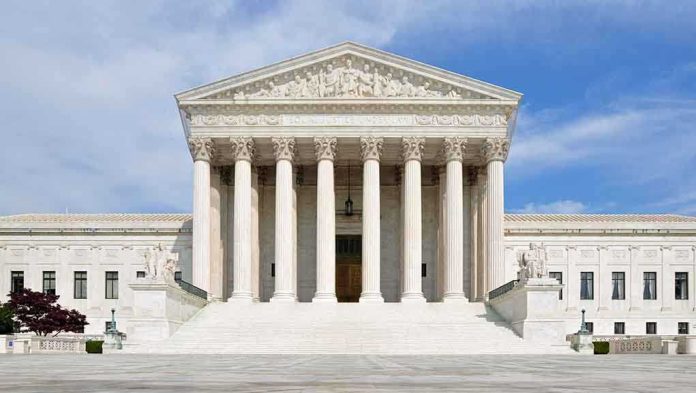
Administrative stays from the Supreme Court are not endorsements on the merits; they are throttle controls on timing. That distinction explains why President Trump’s $400 million White House ballroom project can lawfully push forward today even as the core constitutional fight over who authorizes such construction—Congress or the Executive—remains very much alive.
At a Glance
- The Supreme Court, via Chief Justice John Roberts, issued a temporary stay that lets ballroom construction continue while litigation proceeds.
- The project is consistently described as a roughly $400 million White House ballroom endeavor tied to the former East Wing site.
- A D.C. Circuit panel had previously upheld an injunction limiting above-ground work, prompting the emergency appeal to the Supreme Court.
- The core legal question is classic separation of powers: Congress’s Property Clause authority versus presidential control of the Executive Residence.
What the Court Did—and Did Not Do
On August 21, 2026, Chief Justice John Roberts issued an administrative stay that unfreezes the lower court’s injunction for now, allowing work on the White House ballroom to proceed while the emergency application is considered. This is a procedural order that preserves the status quo the applicant seeks during expedited review; it is not a merits ruling, and it does not resolve whether the President has the statutory or constitutional authority to undertake the project without fresh congressional authorization. The stay followed the administration’s emergency filing asking the Court to keep construction on track during appellate proceedings.
The fact pattern that brought the dispute to One First Street is straightforward. A federal district court enjoined above-ground construction. The U.S. Court of Appeals for the D.C. Circuit, in a 2–1 decision on August 7, 2026, upheld that injunction and set a short window for Supreme Court review. The administration then sought emergency relief, arguing that stopping work would impose irreparable harms on security planning, contracts, and logistics tied to the White House complex. The Supreme Court’s narrow stay addresses timing, not ultimate legality.
The Project and the Price Tag
Across major outlets, the initiative is described as a roughly $400 million White House ballroom project situated at or associated with the former East Wing footprint. That figure and placement matter in two ways. First, they underscore scale: at this cost and scope, the work sits well beyond routine refurbishment or privately funded décor upgrades typically left to executive discretion. Second, they shape the legal frame because large structural modifications to the White House complex implicate congressional prerogatives over federal property, appropriations, and historic preservation processes more squarely than interior refreshes do.
The optics are inescapable but legally orthogonal. High-dollar, high-visibility work at the nation’s most symbolic residence will reliably generate political controversy; the courts are not adjudicating taste. They are parsing authority—what statutory hooks or constitutional allocations empower the Executive to build a new ballroom absent a specific line-item appropriation, and what limits the Property Clause places on that discretion. The $400 million estimate and the location cues sharpen those inquiries.
The Legal Fault Line: Property Clause versus Executive Control
Every serious White House alteration fight reduces to a few core questions: What kind of change is proposed? Who pays for it, through what appropriation? And which legal channel—standing authorization, specific statute, or inherent executive authority—permits it? Historically, presidents have enjoyed broad leeway on interior or aesthetic changes, especially when privately financed or covered by preexisting facility accounts. But structural expansions and demolitions implicate Congress’s constitutional power to dispose of and make rules for federal property and to control the purse. That is why challengers have traction when they frame a large addition as exceeding the Executive’s unilateral remit.
The D.C. Circuit’s 2–1 decision sustaining the injunction signals the appellate court’s view that challengers are likely to succeed on the merits—at least enough to preserve the status quo ante during litigation. The administration’s counter-argument is that the White House complex has long been managed under executive branch authorities and standing appropriations that, together with security imperatives, give the President operational control to modernize mission-critical facilities. The merits briefing, when public, will turn on text: the scope of any applicable authorizing statutes, the reach of general government property and procurement laws, and how historic-preservation mandates interact with urgent executive requirements.
How Emergency Relief Works
Emergency applications ask a single Justice, as Circuit Justice, to grant temporary relief that prevents immediate, potentially irreparable harm before the full Court addresses the request. The bar is high but pragmatic: the applicant must show a reasonable probability of certiorari or success and a fair prospect that the Court would reverse, balanced against equities such as harm from delay. An “administrative stay” is narrower still—it halts enforcement just long enough for the Court (or the Circuit Justice) to decide the stay request itself. That is what happened here; construction can continue while the Court decides whether to grant or deny a longer stay pending appeal.
This procedural cadence matters because it avoids reading tea leaves. The Supreme Court often preserves the practical status quo of an ongoing project to avert wasteful stop-start consequences, only to later deny full relief. Conversely, it sometimes denies temporary relief yet ultimately takes the case. The signal value of an administrative stay is minimal; the legal signal will come from any subsequent stay opinion or, if granted, from merits review.
Why This Case Resonates Beyond Architecture
The ballroom litigation sits in a lineage of disputes where the physical presidency meets constitutional structure. The White House is both a residence and a workplace nested inside a national landmark; its upkeep involves security hardening, historical stewardship, and operational modernization. When an administration proposes an addition with public-facing symbolism and real structural footprint, it necessarily tests the seam between executive management and Congress’s control of federal property and spending. Courts become the referee not of design, but of institutional role.
That seam also shapes federal practice. Agencies that manage iconic properties—Interior with national monuments, GSA with federal buildings—operate under dense statutory frameworks precisely to cabin unilateral action. The Executive Residence is an outlier in day-to-day operational control, but not in constitutional hierarchy; when scale, permanence, and public cost rise, so does Congress’s claim. That is the doctrinal gravity tugging at this project.
What to Watch Next
The near-term docket milestones are predictable. First, resolution of the emergency stay application—either a reasoned order from the Circuit Justice or from the full Court—will indicate whether construction continues through the appellate cycle. Second, the D.C. Circuit’s merits schedule, including any expedited briefing or en banc signals, will show how quickly a definitive appellate judgment may arrive. Third, if the Supreme Court grants certiorari, the case will pivot from interim skirmish to final say on the scope of presidential authority over significant White House construction.
Substantively, two factual clarifiers will carry weight. Appropriations lineage—whether any enacted funds or standing accounts cover a ballroom-scale addition—will be load-bearing. Procurement and preservation records—contracting vehicles used, National Historic Preservation Act consultations, and any environmental or security exemptions claimed—will illuminate the legal channel the administration believes it is using. Those are documentary questions with concrete answers that will tighten the doctrinal analysis when they surface.
The Bottom Line
For the moment, the cranes can move. That is the practical consequence of an administrative stay: it keeps a contested project on its current trajectory while the courts decide who, under our Constitution and statutes, gets to say yes to a new ballroom at the White House. Read it as careful case management, not a final judgment. The ultimate answer will turn on text, structure, and funding—exactly where separation-of-powers disputes properly belong.
Sources:
bbc.com, cnbc.com, theguardian.com, reuters.com, washingtontimes.com, dw.com, scotusblog.com, rand.org, chathamhouse.org