When a passenger ferry capsizes within sight of shore, the headline shock obscures a consistent truth about maritime disasters: most lives are saved or lost in the first hour, and the quality of search-and-rescue coordination is as decisive as the sea itself.
At a Glance
- A passenger ferry carrying roughly 260–270 people overturned a few kilometers off Kyrenia/Girne on northern Cyprus, bound for Turkey.
- Officials reported 237 survivors brought ashore and confirmed fatalities, with dozens initially missing as rescue operations surged.
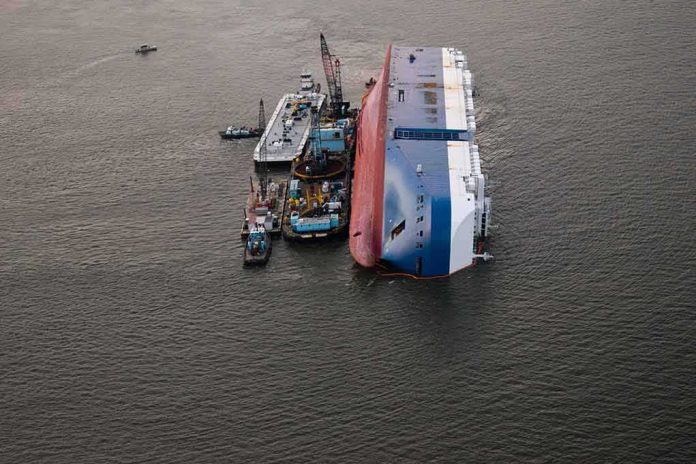
- Authorities deployed coast guard vessels, helicopters, and civilian boats; survivors were seen clinging to the upturned hull and wearing lifejackets.
- Early indications point to rapid flooding before capsize; the definitive cause awaits formal investigation.
What Happened: The Core Facts Hold
A large passenger ferry operating the short northern Cyprus–southern Turkey route capsized off Kyrenia/Girne, with multiple major outlets reporting a total complement in the high 260s. Officials from Northern Cyprus stated that 237 people were rescued and taken ashore, with the balance at first unaccounted for as nightfall complicated the search. Early fatality counts varied across outlets as is common in the first hours; by later updates several outlets reported at least six to seven confirmed dead, alongside those missing during the active operation.
The early mechanical story is consistent: the vessel began taking on water within a few nautical miles of departure and then overturned. Images and first-hand accounts described survivors in lifejackets atop the upturned hull and in the water, while helicopters and multiple craft converged. Northern Cyprus officials publicly emphasized the breadth of the response and asked the public to avoid spreading misinformation while crews worked the scene.
How Ferries Fail: Flooding, Stability, and Speed
Passenger ferries are designed to be stable despite sea states, but rapid water ingress can defeat that stability in minutes. Two pathways dominate in casualty literature: water enters where it should not—through doors, vents, or breaches—or the vessel’s loading and configuration leave it with too little righting energy to recover once a list begins. In some high-profile cases, a single operational lapse has been enough to trigger a cascade; in others, latent design or maintenance shortcomings set the stage. The MAIB’s analysis of Herald of Free Enterprise remains canonical: uncontrolled flooding of the ro-ro space swiftly produced a catastrophic capsize, long before outside assistance could matter.
High-speed catamarans, which often ply short Mediterranean routes, trade traditional displacement margin for speed. They are not inherently unsafe, but their stability envelopes can be tighter and more sensitive to water ingress because buoyancy is distributed across slender hulls connected by a bridging deck. If a compartment floods quickly, reserve buoyancy erodes; if trim changes abruptly, steering corrections can unintentionally amplify list. Formal investigation—inspections, log retrieval, and hull survey—is what converts these generalities into a cause chain.
The First Hour: Why Search-and-Rescue Decides Outcomes
Survival at sea depends on time, temperature, and flotation. Within two kilometers of shore and in summer conditions, survival odds improve markedly if rescuers arrive with enough platforms to pick up dozens simultaneously. That was the pattern here: coast guard units, helicopters, and nearby civilian craft were pressed into service. Reporting describes a coordinated operation led by Northern Cyprus authorities with Turkish assets assisting—boats shuttling survivors, helicopters hoisting from the water, ambulances staged ashore for rapid triage. This matches best practice observed in other ferry incidents where rapid, multi-asset response curbed fatalities despite sudden capsize.
Transport leaders in Northern Cyprus also provided early operational facts—distance off Kyrenia, water ingress preceding capsize, and the broad rescue posture—offering enough scaffolding to understand the sequence while deferring apportionment of fault until investigators report. That separation—operations now, causation later—is what serious maritime regimes aim for, because premature conclusions corrupt both public understanding and evidence collection.
Why Early Numbers Conflict—and Why That’s Normal
Disaster arithmetic is messy in real time. Headcounts in the first hours come from partial manifests, pier tallies, helicopter crews, and hospital intakes. Some outlets cited 260, others 267 or 270 aboard; early death tolls ranged from none confirmed to seven. Such spread is the rule, not the exception, in ferry capsizes, converging only when investigators reconcile the manifest, survivor lists, and next-of-kin reports. Reuters, the Associated Press, and BBC all ultimately aligned on the scale of the event, the rescue total, and the ongoing search window, which establish the uncontested backbone: a fully-laden passenger ferry capsized minutes off Kyrenia, hundreds were aboard, hundreds were rescued, and fatalities occurred.
The precise identity of the vessel and its intended Turkish port also varied in early reports, an artifact of parallel information streams—local broadcasters, port officials, and national ministries—working from different slices of the same event. Those details typically settle once registries, operators, and transport ministries publish the incident docket and the investigating authority issues its preliminary note.
From Incident to Investigation: What Comes Next
Marine casualty work proceeds on a reliable track: secure the scene; stabilize the survivor and missing-person counts; then reconstruct the timeline with radio logs, AIS/GPS tracks, and bridge records if available. Investigators will examine the hull’s watertight integrity, recent maintenance, and loading condition at departure. They will correlate mayday timing to flooding onset and interview bridge and engineering crew about alarms, pump performance, and helm response. Comparable inquiries—from the UK MAIB’s archive to Asia’s post-Sewol regime—show how stability calculations, steering records, and door/vent status often separate conjecture from cause.
If the wreck rests in deep water, remote survey will substitute for diver inspection; side-scan sonar, ROV video, and structural modeling can still reveal breach lines, door positions, and deformation. Should evidence indicate operational failings rather than structural failure, prosecutors in many jurisdictions bifurcate processes: a no-blame safety investigation to prevent recurrence and a separate criminal track to address negligence, as recent cases elsewhere have demonstrated.
At least 8 dead after ferry with nearly 270 passengers and crew capsizes off Cyprus’ northern coast, 22 missinghttps://t.co/maUGyxsW71 pic.twitter.com/vkQ5gUIP2l
— TONY V (@_MTMTE) August 30, 2026
Why This Route, Why These Stakes
The Kyrenia–southern Turkey corridor is short, busy, and familiar to passengers who treat it as a routine hop. That normality breeds throughput—and, at times, complacency. The stakes are not abstract: a fully loaded passenger catamaran can flip from stable to unrecoverable in minutes if a large compartment floods. Lifejackets, practiced crew, and nearby assets convert that narrow window into survivorship; confusion, delayed calls, or poor coordination squander it. Here, the rescue arithmetic—hundreds recovered, dozens initially missing—reflects both the scale of the capsize and the effectiveness of the initial response.
The public will want definitive answers: exact headcount, vessel identity, why water entered, whether a turn-back was attempted, and whether inspection regimes were fit for purpose. Those answers belong to the formal record, not social media fragments. Expect the preliminary report to fix the manifest, anchor the timeline, and outline plausible causal chains; expect the final report to quantify stability margins and detail the failure sequence. That’s how one incident improves the next crossing’s odds—by turning narrative into engineering.
Sources:
youtube.com, aljazeera.com, lemonde.fr, cbc.ca, usnews.com, krone.at, upi.com, reuters.com, assets.publishing.service.gov.uk