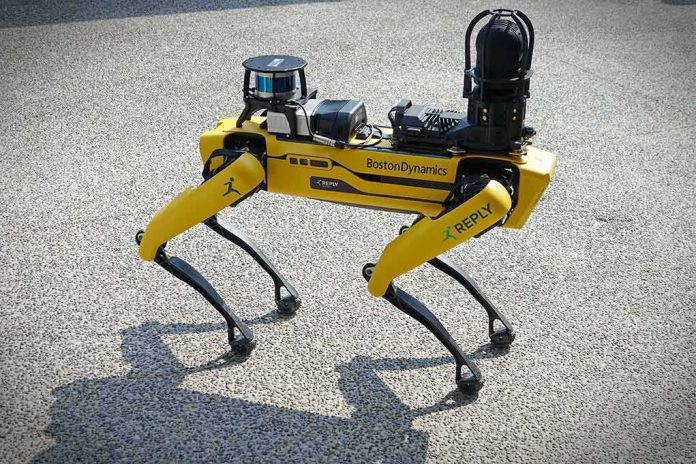
When a coercive agency buys a new machine and calls it a safety tool, the real question isn’t whether the device works—it’s where it will fit inside the agency’s authority and how its use will be bounded in practice.
At a Glance
- ICE is preparing to spend up to $2 million on Boston Dynamics “Spot” robots, justified as a way to improve officer safety, inspection, and hazard assessment in risky environments.
- The robots are remotely operated, camera-rich quadrupeds designed for reconnaissance and access in hard-to-reach spaces, not as weapon platforms; Boston Dynamics prohibits arming Spot.
- This procurement sits within a yearslong enforcement-tech arc—drones, automated towers, data brokers, and mobile forensics—marketed as efficiency upgrades but criticized as enforcement militarization.
- The strategic value is real: remote eyes and sensors reduce human exposure to unknown threats. The governance challenge is equally real: clear, auditable limits on deployment, data handling, and mission scope.
What ICE Is Buying and Why It Matters
ICE signaled an intent to procure Boston Dynamics Spot robots and accessories in the $1–$2 million range, describing a mission profile centered on “inspection, situational awareness, and hazard assessment” in environments that may pose risk to personnel. The agency’s language mirrors how public safety organizations typically justify ground robots: send the machine first, especially into confined spaces, unstable structures, or sites with unknown chemical, electrical, or explosive hazards. The scale—up to roughly a couple dozen units if purchased as basic platforms with support packages—would be enough to seed multiple field offices for targeted use cases rather than blanket deployment.
That core rationale is operationally sound. Human operators routinely face uncertainty at entry points, in crawlspaces, basements, tunnels, and industrial or maritime environments. A compact, stair-capable quadruped with 360-degree video, thermal options, gas sensing, and a manipulator arm can map sightlines, sample air, open a door, or place a sensor without risking a person. The cost calculus is simple: one serious injury avoided pays for a fleet’s worth of capability over its lifecycle.
How the Robots Work: Capabilities and Limits
Spot is a battery-powered quadruped designed to traverse stairs, thresholds, debris, and wet or uneven pavement with far more stability than a wheeled platform. The base platform typically carries a panoramic camera suite; agencies add payloads like thermal imagers, LIDAR mapping, chemical detectors, and a robotic arm for light manipulation. Crucially, these units are driven by trained operators via a tablet or control console; in law enforcement settings they are used as telepresence and sensor carriers, not autonomous decision-makers. Boston Dynamics and peer robotics firms have publicly and contractually disallowed weaponization—no firearms or less-lethal launchers mounted to Spot—and the company co-signed an industry letter to that effect.
That distinction matters. A remotely piloted inspection robot alters risk exposure; an armed or semi-autonomous platform alters the use-of-force continuum. The procurement reporting to date points to the former—remotely operated reconnaissance—aligned with a familiar toolkit that already includes bomb squad robots and throw-phones. The governance questions revolve less around mechanics and more around where, when, and how often these tools are dispatched, and what information they collect en route.
The Operational Niche: Where Spot Makes Sense
Enforcement agencies have long used robots to manage dangerous uncertainty: explosive ordnance, barricaded subjects, hazardous-materials scenes. Spot extends that template into spaces that defeat tracks or wheels. Consider rowhouse basements with standing water and live wiring; storm drains and utility corridors; cavernous warehouses cluttered with pallets and mezzanines; or vessels in port with tight companionways. In each case, a quadruped can scout, stream real-time video, take air samples, and test doors. The trade is speed for safety: entries may slow by minutes while the robot scopes the scene, but the odds of ambush or avoidable injury drop.
The same logic applies in post-breach evidence sweeps or warrant service at facilities with unknown hazards. ICE, like many federal and local agencies, has experimented with alternative robots for similar tasks; contract records indicate comparable platforms able to deploy smoke or specialized tools have been explored elsewhere, reflecting a market with overlapping capabilities and price points. Spot’s differentiator is mobility in cluttered, human-scale architecture.
The Broader Pattern: Safety Rhetoric, Expanding Toolkits
ICE’s plan arrives amid a broader acquisition pattern: more sensors, more remote presence, more data aggregation. Over the past decade, federal immigration enforcement has invested in drones, automated surveillance towers, commercial data sets, facial recognition, mobile device access tools, and social media scraping—each framed as efficiency and officer protection upgrades. The robot dog story follows that script. The fact pattern is not in dispute—ICE is exploring or planning this purchase—but the meaning of that fact depends on one’s lens: risk mitigation in dangerous work versus normalization of quasi-military tooling inside civil enforcement.
That dichotomy recurs because both claims contain truth. Better tools can reduce harm to officers and bystanders; the same tools can also lower the “operational friction” that once deterred marginal or expansive uses of authority. The result is a standing governance problem: how to capture the safety upside while preventing quiet mission creep.
Governance That Matches the Technology
The gear is the easy part; the policy is the hard part. Three pillars keep safety tools from becoming surveillance defaults. First, purpose limitation: write down the authorized use cases narrowly—hazard reconnaissance before entry, post-incident scene safety checks, evidence search after an all-clear—and require supervisory sign-off for deviations. Second, data discipline: define what sensor feeds are recorded, for how long, who can access them, and for what investigative purposes; inspection video should not become generalized intelligence unless statutory predicates are met. Third, transparency and auditability: publish annual usage statistics disaggregated by operation type, location class (residential, commercial, industrial), and outcome (injury avoided, hazard detected), with inspector general spot checks.
These controls are not exotic. They mirror frameworks that many police departments adopted—often under consent decrees or council ordinances—when rolling out drones and cell-site simulators. They also align with procurement best practice: match capability to documented need, socialize policy before deployment, and build an exit ramp if the tool underperforms.
Costs, Scale, and Practical Constraints
Spot platforms for public safety typically price in the five- to low six-figure range per unit before payloads, warranties, and training; a multi-year package that includes arms, spares, and service contracts quickly climbs. A $1–$2 million spend thus buys a modest fleet plus integration and sustainment—not hundreds of robots, but enough to staff hazard teams across regions. Operators need certification; batteries and joints need maintenance; and the robots break when abused. Those frictions naturally limit use to scenarios where command staff believe the safety or evidentiary payoff justifies the delay and cost of rolling a robot. If anything, the risk in early years is underuse, not overuse: many agencies buy specialized platforms and struggle to integrate them into routine tactics and training.
Judgment: Useful Tool, Only as Good as Its Rules
On the evidence, ICE’s Spot procurement is a straight safety-and-sensing buy—remote eyes, ears, and arms for places an officer shouldn’t walk first. The capability is proven in bomb squads and urban search-and-rescue. The controversy is not about mechanics; it is about mission boundaries inside a civil enforcement regime that already leans on expansive data and remote sensing. The way to reconcile those facts is not to shun the tool but to bind it: specific use cases, strong data handling, public reporting, and independent audit. Done that way, a robot dog is closer to a periscope than a paradigm shift. Done poorly, it becomes one more step toward automated, opaque enforcement. The technology will not choose which path we take; the policy will.
"The procurement notice for the robot dog comes after the Department of Homeland Security approved spending $16 million for ICE to purchase electric shock gloves to give to officers around the country." https://t.co/ZgD606YiAC
— lil (@golillybe) August 28, 2026
This Is What To Watch Next
Look for final contract details and any published concept-of-operations documents; those will signal whether ICE treats Spot as a specialized hazard asset or folds it into everyday field work. Watch for payload selections—gas detection and mapping imply safety priorities, while heavy analytics packages imply surveillance aims. And watch for usage reporting: numbers, categories, and outcomes are the audit trail that will show whether the safety promise is being met without sliding into routine reconnaissance.
Sources:
thegatewaypundit.com, straitstimes.com, ua.news, gadgetreview.com, bostonglobe.com