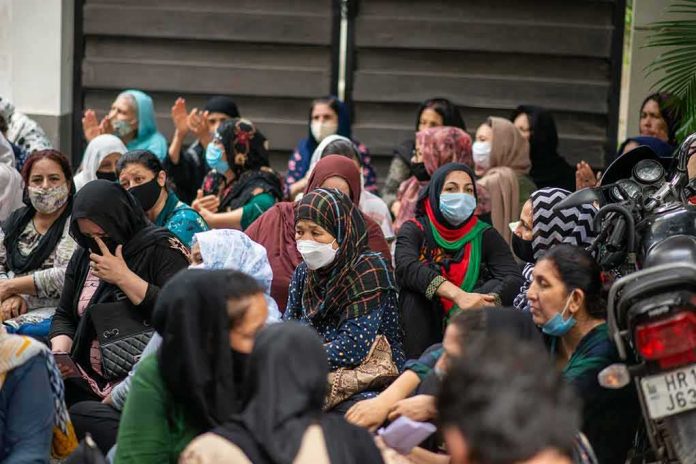
Muslim population growth in the United States is real, measurable, and concentrated in a handful of metropolitan areas — but the leap from that demographic fact to a claim of coordinated territorial conquest is a much larger assertion than the evidence on record can support.
Key Points
- Pew Research Center puts the 2017 U.S. Muslim population at roughly 3.45 million, about 1.1% of the country, concentrated heavily in New York, New Jersey, Illinois, Texas, and Michigan.
- Visible institutional growth — new mosques, expanded Islamic centers — is documented, including a 40,000-square-foot expansion approved in Clifton, New Jersey, in early 2026.
- The “beachhead” framing rests on demographic concentration and historical Islamic narrative about Medina, but no supplied evidence shows internal strategy documents, coordinated funding directives, or centralized political command.
- Growth is attributed by researchers to ordinary fertility and immigration patterns, and Muslim civic participation — including rising voter registration — mirrors standard minority political incorporation, not a documented capture strategy.
- Mosque zoning disputes are a recurring, legally regulated feature of American land-use law that predates and extends beyond any single religious community.
The Demographic Backbone Is Solid — And Smaller Than the Rhetoric Suggests
Start with what is actually well established. Pew Research Center’s demographic work, built from census data layered with original survey research conducted in English, Arabic, Farsi, and Urdu, estimated the U.S. Muslim population at 3.45 million in 2017 — about 1.1% of the national population. That figure has grown by roughly 100,000 people annually, driven by two unremarkable forces: higher fertility among Muslim American households and continued immigration. Pew’s own long-range projection has Muslims reaching 8.1 million by 2050, or 2.1% of the country — a doubling in share, but still a small minority nationally, even as it becomes more visible regionally.
That visibility is the crux of the matter. Concentration, not aggregate size, is what makes Muslim communities culturally and politically salient in specific places. New York, New Jersey, Illinois, Texas, and Michigan carry the largest state populations, and metro-level estimates consistently point to New York City, the Detroit–Dearborn corridor, Chicago, Houston, and Philadelphia as the country’s principal hubs. Dearborn’s prominence in particular is not folklore — it reflects more than a century of Arab and Muslim settlement tied to auto-industry labor migration, not a recent, deliberate campaign. Concentration of this kind is exactly what demographers expect from chain migration and community network effects, the same pattern that built Chinatowns, Little Italys, and Polish enclaves in earlier immigration waves.
Mosque Expansion Is Real — and Governed by Ordinary Zoning Law, Not Secret Strategy
The clearest concrete development animating the “American Medinas” framing is institutional: mosques and Islamic centers are getting bigger. Clifton, New Jersey’s planning board approved a 40,000-square-foot expansion of the Islamic Center of Passaic County in February 2026, and similar projects have surfaced in other Muslim-dense communities over the past decade. These approvals happen through the same municipal zoning and land-use process that governs a Baptist church expansion or a synagogue parking lot — a process reinforced federally by the Religious Land Use and Institutionalized Persons Act, which the Department of Justice has used to sue municipalities for denying mosque permits on discriminatory grounds, most notably in Connecticut, Illinois, and Virginia disputes. That legal architecture exists precisely because religious land-use fights are common across faiths, not unique to Islam, and because zoning boards routinely treat these as ordinary permitting matters rather than ideological flashpoints.
This matters for weighing the “beachhead” thesis honestly. A mosque expansion approved through public hearings, recorded votes, and standard planning review is not, on its own, evidence of a hidden agenda — it’s evidence that a congregation outgrew its building and followed the same bureaucratic path every growing religious institution follows. The absence of a paper trail showing coordinated intent isn’t proof that no such intent exists, but it is the difference between an observable fact and an inferred motive, and readers should hold that distinction firmly.
Medina’s History Is Real Theology — Applied Here as Modern Metaphor
The historical anchor of the framing is genuine and well documented: in 622 AD, Muhammad’s migration from Mecca to Medina, the Hijra, marked the founding of the first organized Islamic political community, a city that became both spiritual center and governing base. That history is foundational to Islamic tradition and taught without controversy in comparative religion courses. The leap the “American Medinas” framing makes is rhetorical, not evidentiary — it maps a seventh-century political-religious founding narrative onto twenty-first-century American zip codes without producing any document, memo, or sworn statement connecting the two. A compelling historical parallel is not the same thing as proof of an operational plan, and the distinction is one careful readers should insist on.
Civic Participation Looks Like Assimilation, Not Capture
The strongest counter-evidence against a coordinated-conquest reading comes from data on how American Muslims actually engage politically. The Institute for Social Policy and Understanding’s 2025 polling found 85% of eligible Muslim voters registered, up from 60% in 2016 — a trajectory indistinguishable from the civic incorporation curve seen in other immigrant-heavy religious minorities across American history, including Catholics, Jews, and more recently Hindu and Sikh communities. Rising registration, local candidacies, and school-board involvement are the textbook markers of a community integrating into normal electoral politics, not indicators of a centralized command structure directing outcomes across five states at once. No document in the available record shows funding directives, strategy memos, or cross-city coordination — the opportunities to establish such proof exist (FOIA requests, nonprofit financial audits, sworn depositions) but remain, as of this writing, unexercised.
What the Evidence Actually Supports
Readers should walk away with two facts intact and one inference discounted. The facts: Muslim Americans are a growing, geographically concentrated population, and their institutions are expanding visibly in specific cities. The discounted inference: that this growth constitutes a coordinated, named strategy to convert American cities into political and religious strongholds modeled on seventh-century Medina. Demographic visibility during a period of cultural anxiety has a long American history of being recast as organized threat — from 19th-century nativist fears about Catholic immigration to mid-20th-century anxieties about Jewish neighborhoods — and the pattern deserves recognition for what it is: recurring, not new, and not, on the present record, substantiated by direct documentary proof.
Sources:
thegatewaypundit.com, en.wikipedia.org, halaltimes.com, x.com, factually.co