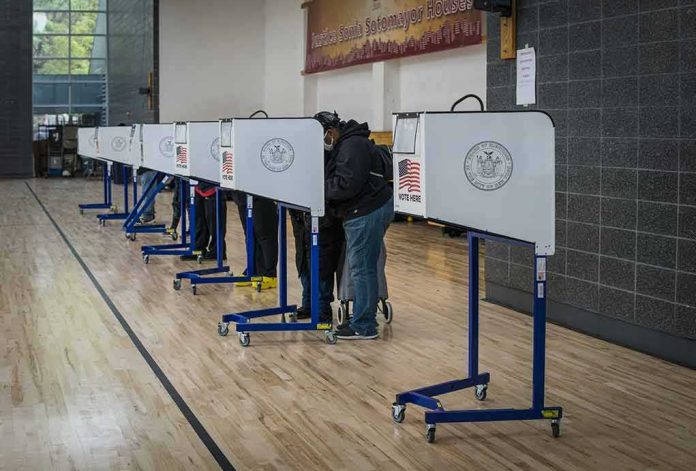
Federal election monitoring sits at the intersection of two bedrock principles of American democracy—state control of elections and federal protection of voting rights—and the current clash over Harmeet Dhillon’s DOJ deployment of monitors to six states is best understood as a test of where that line is actually drawn in law, not just in rhetoric.
Key Points
- Federal election monitoring is not new; DOJ has deployed monitors and observers for decades under both parties, primarily to enforce federal voting-rights laws.
- The current DOJ, led on civil-rights enforcement by Harmeet Dhillon, is pairing monitors with aggressive demands for statewide voter data and litigation, raising sharp federalism and privacy objections.
- Michigan’s top officials argue the DOJ is exceeding its authority, stressing that states run elections and that DOJ staff cannot freely enter polling places or interfere with administration.
- The core legal dispute turns on the difference between court-ordered federal observers and Civil Rights Division “monitors,” and on how far federal civil-rights statutes allow DOJ to reach into state election systems.
How Federal Election Monitoring Normally Works
Since the Voting Rights Act of 1965, the Justice Department’s Civil Rights Division has routinely sent personnel to watch elections for compliance with federal voting-rights laws. In recent cycles, DOJ announced plans to monitor dozens of jurisdictions across more than 20 states, under both Democratic and Republican administrations, as a matter of standard practice. These deployments have historically focused on protecting racial and language minorities, voters with disabilities, and others covered by federal statutes, rather than on policing general “fraud.”
Legally, there are two distinct tools. First, “federal observers” authorized under Section 3(a) of the Voting Rights Act may enter polling places and observe the voting and counting process, but only when a federal court has issued a specific order for designated jurisdictions. Second, Civil Rights Division “monitors” are DOJ employees or attorneys who visit election sites, talk with voters and local officials, and observe public aspects of election administration; their authority to go inside voting locations is more contested and often depends on permission from state or local officials. That distinction—observer versus monitor—is at the center of today’s fights.
Dhillon’s DOJ: Monitors, Data Demands, and Litigation
Under Assistant Attorney General Harmeet Dhillon, the Civil Rights Division has framed election integrity as a top priority for the 2026 primary season and beyond. In interviews, Dhillon has explained that DOJ has requested election and voter-roll data from every state plus the District of Columbia, emphasizing that “under various federal rights statutes, the Attorney General does have the right to audit various election data.” Roughly one-third of states have voluntarily complied or entered settlements; others are resisting and now face lawsuits.
Dhillon has also confirmed that her division is sending election monitors into multiple jurisdictions—15 in six states for the 2026 primaries—often in response to requests from campaigns, candidates, or sometimes state officials who cite “questions” about past compliance with federal law or historical problems in those areas. In a separate context, DOJ recently sent a federal prosecutor to observe ballot counting in Los Angeles County after allegations of fraud tied to delayed results, illustrating how monitoring can extend beyond polling places to central counting facilities and post-election processes.
In Michigan, the Civil Rights Division sent letters to Detroit, Lansing, and East Lansing signaling the deployment of monitors for the August primary and demanding precinct lists, training materials, and voter-roll information by set deadlines. DOJ framed this as routine oversight responding to operational concerns—reports of long lines, insufficient provisional ballots, and technical problems in earlier elections—again emphasizing its civil-rights enforcement mandate. Critics see something different: an escalation that merges traditional civil-rights monitoring with a more aggressive, data-driven scrutiny of state election systems.
Michigan Pushes Back: Who Runs Elections?
Michigan’s elected leadership has responded with unusually direct resistance. Attorney General Dana Nessel has argued that “states run elections, not the federal government,” pointing to repeated court decisions affirming state primacy in election administration. Secretary of State Jocelyn Benson, who oversees Michigan’s elections and is also a candidate for higher office, called DOJ’s claims “completely and factually baseless,” citing a post‑2024 review that found just 15 credible fraud cases out of 5.7 million ballots cast.
Substantively, Nessel and Benson draw three lines. First, they accept that federal law prohibits discrimination and intimidation and say they welcome neutral “observers” who respect state rules. Second, they insist that neither DOJ’s monitoring program nor the federal observer statute gives the department authority to direct local officials, demand hands-on access to voting equipment, or interfere with on-the-ground decision-making. Third, they argue that DOJ staff, absent a valid court order under the Voting Rights Act, “can only enter the polls if they have permission from the local jurisdiction,” relying on guidance like the Michigan Election Interference Law Handbook and a 2018 U.S. Commission on Civil Rights report to support that limit.
In practical terms, this means Michigan may allow DOJ personnel to observe from public areas outside polling locations or in central counting centers, but it reserves the right to keep them out of voting rooms if state or local officials determine their presence would conflict with state law or voter privacy. That stance mirrors positions taken by some Republican-led states in earlier years, which also told DOJ monitors they could remain outside but not inside polling places without explicit state consent or a court order.
The Legal Fault Line: DOJ Authority vs. State Sovereignty
Behind this institutional sparring lies a focused legal dispute: how far federal civil-rights statutes, especially the Voting Rights Act, the National Voter Registration Act (NVRA), and related provisions, extend into the operational core of state election systems. The Brennan Center’s Michigan Election Interference Law Handbook underscores that, absent a court order under Section 3(a), DOJ “lacks clear authority to deploy federal observers inside in-person voting locations.” While DOJ can send staff to monitor from public spaces and communicate with voters or officials, their capacity to enter the actual voting area is, at minimum, legally uncertain.
Dhillon’s DOJ is pressing a more expansive view, especially on data access. According to reporting on her recent interviews, the department has filed lawsuits against more than a dozen states to compel delivery of voter-roll and election records, arguing that the Attorney General’s authority to investigate potential civil-rights violations necessarily includes broad power to inspect state election databases. Democracy Docket, a prominent voting-rights litigation group critical of Dhillon, characterizes this as an “unprecedented interpretation” that would give DOJ “near-limitless authority to seize election records,” with courts reduced to rubber-stamping its demands.
That aggressive posture is all the more striking when set against Dhillon’s prior public statements as a private attorney. She previously argued that the federal government has “little to say” about how states run elections and that efforts by Washington to override state authority are “completely unconstitutional.” Now, as the nation’s chief civil-rights prosecutor, she defends sweeping federal authority over state-managed voter rolls and election data. Her critics call this hypocrisy; her supporters frame it as the natural consequence of applying civil-rights statutes as written, regardless of prior political rhetoric.
Monitors, Intimidation, and Public Perception
Even when the legal lines are understood, how monitoring plays on the ground depends heavily on context. Federal observers historically were most visible in jurisdictions with a documented history of racial discrimination—often welcomed by civil-rights groups and local minority communities as a safeguard against suppression. Today’s deployments, by contrast, are frequently framed through the lens of fraud allegations and partisan conflict.
In Michigan and other battleground states, Democratic officials argue that targeting heavily Democratic, heavily Black cities such as Detroit, Atlanta, and Philadelphia stigmatizes their voters and workers, and revives patterns reminiscent of past intimidation. Benson has warned against tactics like aggressive challenges to voters’ citizenship based on surnames, likening them to practices from the Jim Crow South, and has promised to station state and nonpartisan observers to watch the federal monitors themselves.
On the other side, Republican legislators and conservative commentators point to concrete incidents—non‑citizens discovered voting, outdated voter rolls containing deceased registrants, and alleged unlawful changes to ballot-handling rules—as reasons to welcome federal scrutiny, particularly when the state officer in charge of elections is also a partisan candidate. They argue that monitors and robust audits are necessary to restore public trust in jurisdictions they see as resistant to cleaning their voter lists or tightening verification procedures.
The result is a feedback loop. Each new DOJ letter or monitoring announcement is instantly reframed in partisan media: as an “election-stealing power grab” by Trump’s DOJ in one narrative, or as Democrats “panicking” because they allegedly fear real oversight in another. This rhetorical escalation does not change the underlying statutes, but it does shape how voters and local officials react when federal personnel show up at a polling site.
🚨 JUST IN: Assistant AG Harmeet Dhillon has just informed election officials nationwide "IT IS A CRIME" to knowingly let non-citizens vote in elections
TIME TO CRACK DOWN!
DOJ is also sending election monitors to 6 states 👏🏻
"We did this week send a memo and a cover letter to… https://t.co/p6s4eYlR9V pic.twitter.com/xZ3djh24gj
— Eric Daugherty (@EricLDaugh) July 8, 2026
What This Standoff Means Going Forward
From a legal perspective, the most consequential questions are likely to be resolved not on cable news but in courtrooms. If DOJ continues to sue states over access to voter rolls and election records, federal judges will have to decide how far civil-rights enforcement powers extend, and whether the department’s current interpretation is truly “unprecedented” or simply a robust use of existing authority. Similarly, as more states push back against monitors entering polling places, courts may clarify when, if ever, DOJ can send personnel inside without state consent.
For states, this environment demands clarity and preparation. Many have already developed internal guidance—like the Michigan and California election interference handbooks—spelling out who may be present in polling places, how to respond to federal or partisan observers, and what conduct crosses the line into unlawful intimidation. Negotiated agreements, such as the Texas-DOJ arrangement that permits federal observers outside polling locations and in central counting centers but bars interference with voting, show one model for balancing federal oversight with state sovereignty.
For voters and election workers, the stakes are more practical than theoretical. Properly constrained federal monitoring can deter blatant discrimination, identify systemic barriers, and provide an external check on jurisdictions with troubling histories. Deployed in an atmosphere of maximal partisan suspicion, it can also be perceived as a tool of intimidation or a signal that elections are inherently suspect. The difference will turn not only on what DOJ believes it is authorized to do, but on whether it can exercise that authority with restraint, transparency, and a willingness to accept real limits.
The core insight is simple: federal monitors are neither inherently benign nor inherently abusive. They are one more instrument in a system that is, by design, fragmented between state and national power. When used within well-understood legal boundaries, they can strengthen confidence in the right to vote. When pushed beyond those boundaries, or perceived as partisan weapons, they risk corroding the very trust they are meant to protect.
Sources:
redstate.com, democracydocket.com, justice.gov, instagram.com, michigan.gov, clickondetroit.com, reddit.com, pbs.org