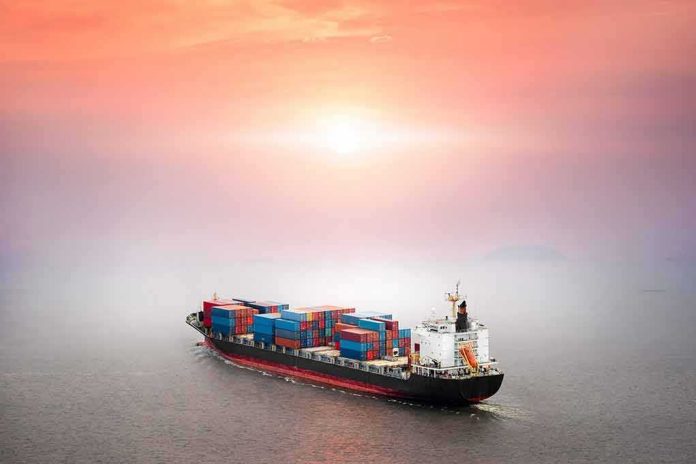
Maritime attacks in the southern Red Sea are no longer isolated shocks but the visible edge of a structured, expanding campaign that has turned one of the world’s busiest sea lanes into a contested battlespace where attribution, law, and global commerce collide.
Key Points
- The reported attack on a cargo vessel southwest of Yemen’s Hodeidah fits a well-documented pattern of Houthi operations but, on present evidence, cannot be definitively attributed to any group.
- Since late 2023, Houthi forces have systematically targeted commercial shipping with missiles, drones, and boarding operations, sinking multiple vessels and killing mariners in apparent war crimes.
- The ambiguity in early incident reporting—“unknown armed assailants,” delayed claims of responsibility, limited forensic detail—is a recurring structural feature of Red Sea attacks, not an anomaly.
- The campaign has reshaped global trade patterns, driven expensive rerouting around Africa, and forced a new kind of naval coalition response centred on protecting civilian shipping.
- Understanding who attacks what in this corridor requires looking beyond single incidents to the broader mechanics, incentives, and legal framework of the Red Sea crisis.
From Single Incident to Pattern: Where the Latest Attack Fits
When the UK Maritime Trade Operations (UKMTO) office reports that a cargo vessel has come under attack 30 nautical miles southwest of Hodeidah, it is describing more than an isolated encounter with “unknown armed assailants.” That piece of water lies off a Houthi-controlled stretch of Yemen’s coast, in a corridor that has seen dozens of hostile contacts between merchant ships and armed actors since late 2023. In this latest case, UKMTO advisories and broadcast media converged on a few hard facts: the location, the presence of armed attackers, and an instruction to other ships to exercise caution. No group claimed responsibility in the immediate aftermath; neither the vessel’s identity, flag, nor the extent of damage and casualties were publicly disclosed. That lack of detail matters for forensic attribution—yet in this theatre it is also entirely typical. Crews under fire are focused on survival, coastal authorities often move slowly, and armed groups have learned that delaying claims allows them to calibrate public messaging once consequences are clearer.
The temptation, especially among outside commentators, is to leap from geography to certainty: Houthi-controlled coast, documented Houthi threats, therefore Houthi attack. The evidence supports a strong presumption but not a conclusive verdict. An expert reading keeps those two categories separate. The incident sits squarely inside an established pattern of Houthi maritime aggression and is highly consistent with it; the specific perpetrator of this particular attack remains formally unconfirmed.
How Houthi Maritime Operations Evolved Into a Red Sea Crisis
To understand why an anonymous attack in this corridor immediately raises the spectre of Houthi involvement, you have to trace how a local insurgent movement turned maritime commerce into a primary theatre of conflict. In November 2023, the Houthi movement—already entrenched in Yemen’s civil war—began launching missiles and armed drones toward Israel in response to the Gaza war. Lacking the range and capabilities to sustain direct strikes on Israeli territory, they pivoted quickly: commercial vessels transiting the Bab el-Mandeb Strait and southern Red Sea became proxy targets.
Their campaign unfolded in phases. Initial operations focused narrowly on ships with clear Israeli ownership or recent calls at Israeli ports. Within months, the definition of “Israel-linked” broadened dramatically to include vessels whose owners operated other ships that had docked in Israel, and then ships associated with the United States and United Kingdom once those states began joint strikes against Houthi positions. By mid-2024, the movement had carried out over a hundred attacks against commercial and naval vessels, using anti-ship ballistic missiles, one-way explosive drones, fast skiffs, and heliborne boarding operations.
A critical inflection point came with the seizure of the car carrier Galaxy Leader in November 2023, forcibly boarded by Houthi fighters arriving by helicopter. The vessel, partly owned by an Israeli businessman, was taken to Hodeidah and its multinational crew held for months with limited contact with families. This operation demonstrated both capability and intent: the Houthis were prepared to treat foreign merchant ships as legitimate bargaining chips in a wider proxy struggle with Israel and its allies.
Concrete Cases: Magic Seas, Eternity C, and the Legal Line
The attacks on the MV Magic Seas and MV Eternity C in July 2025 crystallised international concern. Human Rights Watch reconstructed these incidents in detail and concluded they were clear violations of the laws of war—apparent war crimes. Magic Seas, a Greek-operated, Liberian-flagged bulk carrier, was attacked roughly 51 nautical miles southwest of Hodeidah by Houthi naval forces between July 6 and 9. According to multiple accounts, the assault involved rocket-propelled grenades, other projectiles, and explosive-laden drone boats; the ship was eventually sunk, with crew killed and injured in the process.
In parallel, Eternity C, also Greek-owned and Liberian-flagged, was attacked just west of Hodeidah. Houthi forces struck the vessel repeatedly until it sank, then reportedly detained six surviving crew members. The group publicly claimed responsibility, framing the ship as Israel-linked and therefore a legitimate target; subsequent investigation found no evidence the vessel was a military target or connected to Israel. From a legal perspective, these cases crossed several red lines: deliberate attacks on clearly civilian vessels not engaged in hostilities and unlawful detention of rescued crew.
These are not anecdotes but part of a broader dataset. Human Rights Watch and independent maritime trackers have documented dozens of Houthi attacks on merchant ships since November 2023, many of them similarly disconnected from any genuine military objective. International legal characterisation has followed: the conduct is increasingly described not just as terrorism or piracy but as war crimes within an armed conflict framework.
The Mechanics of “Unknown Assailants”: Attribution in a Crowded Sea Lane
Given this record, why do many incident reports still speak of “unknown armed assailants”? The answer lies in the mechanics of maritime incident reporting and the incentives of all parties involved. UKMTO bulletins, often the first formal notice, are intentionally descriptive rather than accusatory. They rely on initial crew reports, AIS (Automatic Identification System) data, and sometimes limited imagery. When a master under fire reports skiffs closing at high speed, projectiles impacting the hull, or an explosive drone in the water, UKMTO will record the facts and location; attribution requires another layer of analysis and corroboration.
The Houthis add a second source of uncertainty. Their media arm frequently delays claims for days, sometimes exaggerates links to Israel or Western states in ways that later prove false, and occasionally remains silent on attacks that fit their operational profile. That behaviour serves internal and external messaging needs but makes early incident narratives unreliable indicators of responsibility. Other armed actors, including criminal groups and local militias, also operate in the region, and while their capacity is generally lower, they cannot be ruled out categorically in every skiff-based attack.
Consequently, the interval between “unknown assailants” and “Houthi responsibility” is often filled by inference: geography, weapon type, pattern of previous attacks, and contemporaneous threats from Houthi spokesmen like Yahya Saree. Analysts and media do well to draw that pattern clearly—highlighting why Houthis are the most likely suspects—while keeping a separate evidentiary line for formal attribution in each case. The cargo ship attacked southwest of Hodeidah sits squarely in that grey zone.
Strategic Motives: From Local Insurgency to Global Leverage
It is easy to describe this campaign purely in tactical terms—missiles, drones, boarding parties—but its logic is fundamentally strategic. The Red Sea carries roughly 12–15 percent of global seaborne trade and about $1 trillion in goods annually in pre-crisis conditions. By turning this corridor into a risk zone, the Houthis have acquired leverage that far exceeds Yemen’s economic weight: they can impose costs on global supply chains, threaten energy flows, and force major powers to allocate military resources to a theatre of their choosing.
Houthis frame their actions as solidarity with Hamas and resistance against Israel, the United States, and the United Kingdom. Their declarations of naval blockades on “Israeli enemy” shipping and expanded targeting criteria are calibrated to resonate domestically and regionally. At the same time, Iran’s backing—technical, financial, and political—enables access to advanced weaponry and ties the campaign into the broader Iran–Israel proxy conflict. That linkage is not simply rhetorical; it explains why escalations in Gaza, Lebanon, or direct Iran–Israel exchanges are often followed by spikes in Red Sea maritime incidents.
Other states have their own framing incentives. Western governments emphasise the terroristic, indiscriminate nature of the attacks to justify naval operations and sanctions, while Saudi Arabia and its partners sometimes stress Houthi aggression to divert domestic attention from Yemen’s humanitarian catastrophe. The risk in all such narratives is premature or overly broad attribution—assuming any Red Sea attack must be Houthi-driven. A careful evidentiary approach remains the best antidote.
Global Consequences: Trade Rerouting, Insurance, and Naval Coalitions
The economic shock of these attacks is already measurable. Major container lines and energy shippers have diverted high-value cargo away from the Suez–Red Sea route, sending vessels around the Cape of Good Hope at much higher cost and longer transit times. Insurance premiums for transiting the southern Red Sea have spiked, particularly for ships perceived as higher-risk based on ownership or routing. Bulk carriers and lower-value cargoes still use the corridor, but they do so in a far more hostile environment, accepting a calculated risk that smaller margins can absorb.
Militarily, the response has taken the form of multinational naval task forces—most notably Operation Prosperity Guardian, announced by the United States and partners in late 2023—and the European Union’s EUNAVFOR ASPIDES protective mission. These missions provide escorts, air and missile defence, and rapid-response capability for distress calls. Yet capacity is finite. EUNAVFOR ASPIDES, for example, has only a handful of ships in theatre at any given time, limiting how many commercial vessels can be covered. U.S. carrier strike group deployments in the Arabian Sea have not, on their own, deterred Houthi operations; the group continues to attack, sink ships, and detain crew when it judges the risk acceptable.
Law and Responsibility: War Crimes, Terrorism, and the Future of Maritime Order
From a legal standpoint, the Magic Seas and Eternity C attacks mark a decisive line. Human Rights Watch and others have classified these operations as war crimes: deliberate, lethal attacks on clearly civilian vessels with no military role and unlawful detention of survivors. That language situates Houthi maritime activity within the laws of armed conflict, not merely criminal or “pirate” behaviour. It also raises questions about accountability. Yemen’s domestic institutions are fragmented, and international mechanisms for prosecuting non-state actors for war crimes at sea are limited and politically fraught.
At the same time, Western governments have redesignated the Houthis as a terrorist organisation and imposed targeted sanctions in response to the Red Sea attacks. That step complicates diplomatic engagement but has not stopped the campaign. The broader maritime order—built on the assumption that merchant ships can transit international straits without facing organised military attack—is under stress. The Red Sea episode is now a case study in how non-state actors can exploit chokepoints to weaponise global interdependence.
What Unresolved Incidents Tell Us—and What They Don’t
Returning to the cargo ship attacked southwest of Hodeidah, the absence of a named perpetrator, video evidence, or recovered weapon fragments means the incident cannot yet be conclusively tied to the Houthi movement. That uncertainty matters, especially for insurers, flag states, and legal analysts. It does not, however, make the episode any less relevant to understanding the broader crisis. It illustrates how quickly a single attack—anonymous on day one—slots into an established pattern that shapes behaviour, expectations, and risk calculations.
For shipowners and crews, the operational lesson is straightforward: any transit through the southern Red Sea and Bab el-Mandeb today involves exposure to a campaign that has already sunk multiple vessels, killed mariners, and drawn the label of war crimes from major human rights organisations. For policymakers, the deeper question is how to restore a maritime order in which “unknown armed assailants” are the exception, not the new normal, and in which non-state actors cannot leverage global trade routes for coercive advantage with near impunity.
Cargo vessel in Red Sea reports coming under attack, UK maritime body says
Cargo vessel in Red Sea reports coming under attack, UK maritime body sayshttps://t.co/wGFmfheRP1— Douglas Walton (@DouglasWalton99) July 5, 2026
Sources:
feedpress.me, cbsnews.com, dw.com, nbcnews.com, youtube.com, bbc.com, apnews.com, en.wikipedia.org, jurist.org, news.un.org, pbs.org