

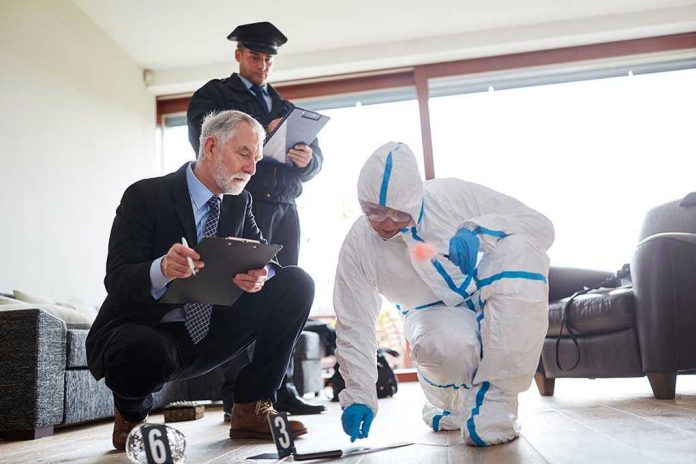
The case of Paul Novak illustrates a fundamental truth about homicide investigation: when fire destroys the physical evidence, the case lives or dies on the integrity of the people who talk — and in this instance, the person who talked was the woman who had every reason to stay silent.
Key Points
- Paul Novak, an EMT in Sullivan County, New York, was convicted of murdering his ex-wife Catherine in a staged house fire after his then-girlfriend recanted a fabricated alibi and confessed his plan to investigators.
- The fire’s intensity eliminated all usable forensic evidence, making the prosecution entirely dependent on testimonial evidence — a circumstance that courts have upheld as legally sufficient when witness accounts are coherent and corroborated.
- A co-conspirator, Scott Sherwood, pleaded guilty to conspiracy to commit murder and provided testimony corroborated by documentary records including Walmart receipts and EZ-Pass toll data.
- The New York Appellate Division, Third Department, rejected Novak’s appeal in 2017, finding the evidence legally sufficient to sustain convictions on both first- and second-degree murder.
- The case raises enduring questions about testimony-driven prosecutions: when physical evidence is gone, the system must weigh witness credibility with particular rigor — and here, that credibility held under appellate scrutiny.
A Marriage, an Affair, and a Plan That Needed Silence
Paul Novak worked as an EMT in rural Sullivan County, New York — a profession built on the premise of saving lives. By the time investigators closed in on him, the evidence would suggest he had spent years constructing the opposite: a plan to end his ex-wife Catherine’s life and profit from it. The motive, as prosecutors framed it, was layered. There was a romantic entanglement with Michelle LaFrance, a desire to shed the obligations of a prior marriage, and — critically — an insurance policy on Catherine’s life whose beneficiary arrangements would later draw scrutiny. Novak was indicted on October 24, 2012, on charges that included murder in the first and second degree, arson, burglary, larceny, and insurance fraud.
What made the case structurally unusual from the outset was the near-total absence of physical forensic evidence. The fire at Catherine Novak’s home in Narrowsburg burned with enough intensity to eliminate the kind of biological and trace evidence — blood, fibers, DNA — that typically anchors a homicide prosecution. Investigators suspected Novak almost immediately, but suspicion is not proof, and for nearly four years the case stalled. The break came not from a laboratory but from a living room in Florida, where Michelle LaFrance sat down with investigators and told them what she knew.
The Confession That Broke the Case Open
LaFrance’s original contribution to the investigation had been destructive: she had provided Novak with a false alibi, a fabricated account of his whereabouts designed to place him somewhere other than Narrowsburg on the night Catherine died. When she recanted that alibi in a lengthy interview with law enforcement — a session that reportedly ran approximately six hours — the evidentiary landscape changed entirely. She told investigators that Novak had traveled to Narrowsburg with a plan to use chloroform and strangulation, and that a man named Scott Sherwood had driven him to the scene.
Sherwood’s subsequent cooperation transformed the case from a single witness’s account into something more architecturally sound. He pleaded guilty to conspiracy to commit murder and agreed to testify against Novak in exchange for a reduced sentence — three to twelve years, with a favorable letter supporting early release. The defense, predictably, hammered this arrangement. A co-conspirator testifying for leniency is among the most vulnerable categories of witness in any criminal trial, and Sherwood’s documented history of mental illness — including depression, anxiety, and bipolar disorder — gave the defense additional grounds to challenge his reliability. The court permitted a psychiatrist to observe his testimony, though not to render a formal determination of his mental status or credibility. These were legitimate concerns, and the jury heard them.
Where the Documentary Evidence Matters
What the defense could not fully neutralize was the paper trail. Sherwood’s account of the night was corroborated by Walmart receipts — for duct tape, a hat, and gloves — and by EZ-Pass toll records that placed him on the route to and from Narrowsburg at the relevant times. This is where the case rises above a simple he-said, she-said dynamic. Testimonial evidence from interested witnesses is inherently vulnerable to attack; transactional records are not. When a co-conspirator’s narrative aligns precisely with purchase records and electronic toll data, the corroboration is structural rather than merely verbal. Prosecutors have learned, in the decades since DNA evidence reshaped criminal justice expectations, that juries are skeptical of testimony alone — and rightly so. The documentary corroboration here was not incidental; it was load-bearing.
LaFrance’s own position is worth examining carefully, because the “scorned girlfriend” framing that dominated media coverage of the case can obscure the legal significance of what she actually did. She did not simply accuse a former lover out of spite. She confessed to having committed a crime herself — fabricating an alibi for a murder suspect — and she provided investigators with a named co-conspirator whose involvement could be independently verified. That is a materially different act from offering a self-serving accusation. It is, in legal terms, a statement against penal interest, and it came at personal cost.
The Appellate Test: Was the Evidence Legally Sufficient?
Novak’s conviction was not the end of the legal contest. His appeal reached the New York Appellate Division, Third Department, which in 2017 affirmed the conviction, finding the evidence legally sufficient to support both the first- and second-degree murder verdicts. The appellate standard in New York requires that a reviewing court determine whether any rational trier of fact could have found the essential elements of the crime beyond a reasonable doubt — a deferential standard, but not a toothless one. The court’s affirmation means that, even accounting for the absence of forensic evidence and the credibility vulnerabilities of both LaFrance and Sherwood, the evidentiary record was not so thin as to fail constitutional scrutiny.
This matters for how we understand the case’s broader significance. The defense argument — that a conviction built on the testimony of a recanting alibi-provider and a mentally ill co-conspirator seeking leniency is inherently unreliable — is not frivolous. It reflects genuine concerns about testimony-driven prosecutions that the criminal justice literature takes seriously. Research on wrongful convictions consistently identifies incentivized informant testimony and inadequate forensic corroboration as risk factors. But the presence of a risk factor is not proof of an error; it is a reason for scrutiny. Here, the scrutiny was applied — at trial and on appeal — and the conviction held.
What This Case Reveals About Testimony-Driven Prosecutions
The Novak case belongs to a recognizable category: homicides where fire, water, or time has destroyed the physical record, leaving prosecutors to build their case from the accounts of people who were there. Studies of cases prosecuted without physical evidence suggest conviction rates in the range of 67 percent when witness credibility and narrative coherence are strong — a figure that reflects both the persuasive power of a coherent testimonial account and the residual doubt that physical absence creates. The criminal justice system has always run on testimony; the forensic revolution of the past three decades has raised expectations without eliminating the underlying reality that most cases turn on what people say.
What distinguishes stronger testimony-driven cases from weaker ones is corroboration — not necessarily scientific corroboration, but the kind of independent verification that makes a witness’s account harder to dismiss as fabrication or confusion. In the Novak case, that corroboration came from toll records, purchase receipts, and the internal consistency between two witnesses who had independent reasons to know what they knew. The defense’s best arguments — Sherwood’s mental health history, the leniency deal, LaFrance’s initial lie — were all placed before the jury. The jury convicted anyway. The appellate court found that rational. That is how the adversarial system is supposed to work.
The Enduring Questions the Case Leaves Open
No honest account of this case can ignore what was lost when the fire burned. Without physical evidence of cause of death, without biological material linking Novak to the scene, the case rests entirely on the proposition that LaFrance and Sherwood told the truth when it mattered — after having lied, or at minimum stayed silent, for years. That proposition is not implausible; people do come forward, and they do so for complicated reasons that don’t automatically invalidate what they say. But it is a proposition that required the jury to make a judgment call about human character under conditions of maximum uncertainty.
The insurance records, the motive, the geographic and logistical details corroborated by toll data — all of this builds a circumstantial architecture that is persuasive. Persuasive, however, is not the same as airtight. The Novak case is a conviction that rests on the credibility of people who had previously demonstrated a willingness to deceive. Courts have decided that is enough. Whether it should be — whether the system’s tolerance for testimony-driven convictions in the absence of forensic corroboration is appropriately calibrated — is a question that extends well beyond this case and into the structural design of criminal justice itself. What is clear is that in Sullivan County, New York, a woman’s decision to stop lying ended a four-year evidentiary stalemate and put a man in prison for murdering his wife. The courts have called that justice. The record, as it stands, supports that conclusion.
Sources:
youtube.com, law.justia.com, jscholaronline.org, facebook.com, tv.apple.com, nij.ojp.gov