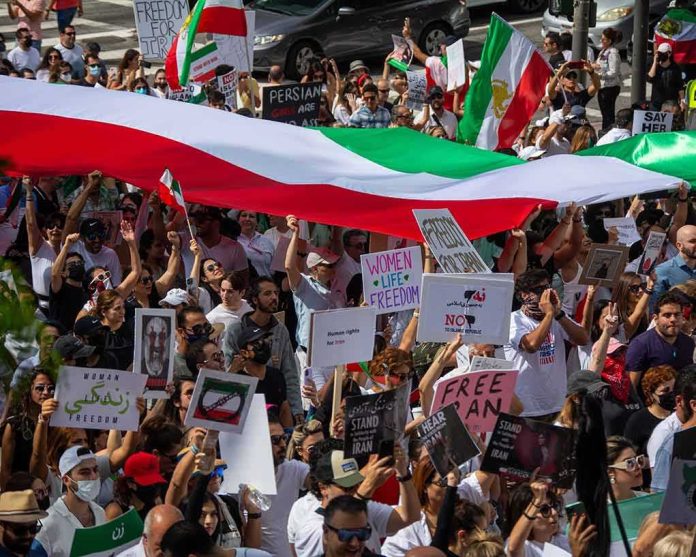
As Iranian dissidents waved a banned Persian flag outside the World Cup in Los Angeles, global soccer officials once again chose appeasing a brutal regime over standing with freedom.
Story Snapshot
- Hundreds of Iranian dissidents in Los Angeles used the World Cup to protest Tehran’s massacres back home.
- Protesters flew the pre-1979 Lion-and-Sun flag, a historic symbol of resistance now banned by Iran and barred by FIFA.
- FIFA allowed Iran’s regime-backed team and flag, while moving to block the opposition flag at stadiums.
- The clash shows how global sports bodies silence pro-freedom voices while lecturing the West about “human rights.”
Iranian Dissidents Turn World Cup Match Into a Human Rights Protest
Outside the World Cup stadium in the Los Angeles area, at least 200 Iranian protesters gathered ahead of Iran’s opening match against New Zealand, not to cheer their national team but to condemn the Islamist regime that the team represents.[3] Many in the crowd were part of the long-time Iranian American community, sometimes called “Tehrangeles,” which fled the revolution, the secret police, and the religious dictatorship that followed. For them, this match was not just about soccer, but about life and death.
Protesters carried large banners and chanted against Tehran’s rulers, tying their anger directly to reports of a deadly crackdown on dissent inside Iran earlier this year.[2] Demonstrators said they could not separate the team on the field from the government in Tehran that jails, tortures, and kills its own people. For those who lost friends and family in the streets of Iranian cities, a World Cup game on American soil became one of the few places they could be seen and heard without fear of arrest.
The Lion-and-Sun Flag: A Banned Symbol of Freedom and National Pride
At the center of the protest stood one powerful image: the historic green, white, and red tricolor with the golden lion and sun in the middle, Iran’s national flag until the 1979 Islamic Revolution. The Islamic regime banned this flag after seizing power and replaced it with its own Islamic emblem, trying to erase the older, more national and less religious identity it represented. Today, the Lion-and-Sun flag has become a core symbol of the opposition, used by diaspora groups worldwide.[1]
Iranian Americans often fly this flag to show pride in Persian culture while rejecting the tyrannical religious government that rules Iran now.[2] That is why many dissidents insist that this is the “real” flag of Iran, not the one flown by the mullahs. Protesters at the Los Angeles match wore shirts with the Lion-and-Sun emblem and held flags alongside photos of protesters killed during crackdowns back home, tying their banner directly to the struggle for a secular, freer Iran.[2] To them, banning this flag is not neutrality; it is taking the side of the regime that outlawed it.
FIFA Bans the Resistance Flag While Pretending to Keep Politics Out
Despite that context, the International Federation of Association Football (FIFA) moved to ban the Lion-and-Sun flag from World Cup venues again in 2026, just as it had in earlier tournaments.[4] Security at the Los Angeles stadium told fans that the flag could not enter because it was considered a “political” symbol.[2][3] A U.S.-based group, the Iranian Institute for Liberty, even sued over this flag rule, but a judge in Los Angeles allowed FIFA’s policy to stand for matches.[2] Inside the stadium, only the Islamic Republic’s official flag was permitted.
FIFA’s own association records show that it treats Iran’s football body as a normal national federation, complete with an office in Tehran and full membership privileges. On paper, Iran’s federation must follow FIFA rules and keep sports separate from politics, but reporting from experts and regional analysts shows the opposite in reality: Iranian sports bodies are routinely led or influenced by regime insiders and military-linked officials. When FIFA says “no politics,” it ends up shielding those who abuse power, while silencing the victims who dare to raise an older national flag in protest.
Sports as a Battleground Between Regimes and Dissidents
Scholars and journalists have long noted that major sports events, from the Olympics to the Super Bowl, often become stages for political protest, no matter how hard organizers try to stop it. Iran’s World Cup controversy fits that pattern: dissidents used the global spotlight to reclaim national symbols from an oppressive government, while officials tried to shut them down in the name of “neutrality.”[1] History shows that these protests, though peaceful, can pressure public opinion and sometimes push real policy changes over time.
Iranian-Americans protest in Los Angeles as Iran draw 2–2 with New Zealand amid World Cup political tensions. https://t.co/WLLOJ5iJrr pic.twitter.com/NW8F16xyF9
— ARISE NEWS (@ARISEtv) June 16, 2026
The Iranian diaspora has now held many such rallies since protests and massacres shook Iran in 2025 and 2026, linking their cause with broader fights for freedom around the world.[5] For American conservatives who value free speech, religious liberty, and the right to bear arms, the lesson is clear: unaccountable global bodies like FIFA will bend for dictators but crack down on dissidents. When a simple historic flag for liberty is treated as more dangerous than the regime that banned it, it shows why national sovereignty and constitutional rights at home matter more than ever.
Some Iranian Americans Wave Protest Flags, Others Cheer as Iran Play World Cup Opener
Iran kicked off their World Cup in Los Angeles on Monday, drawing 2-2 with New Zealandhttps://t.co/OdSbHRKRM5— Kayhan Life (@KayhanLife) June 16, 2026
Sources:
[1] Web – Iranian Dissidents Fly Persian Flag, Protest Massacre at World Cup …
[2] Web – Why Are Iranian Protesters Using the Prerevolution Lion and Sun …
[3] Web – At Iran’s World Cup opener, a banned flag became a flashpoint at …
[4] Web – A Russian opposition activist holding Iran’s pre-revolution Lion and …
[5] Web – At least 200 Iranians gathered outside a World Cup stadium in Los …