

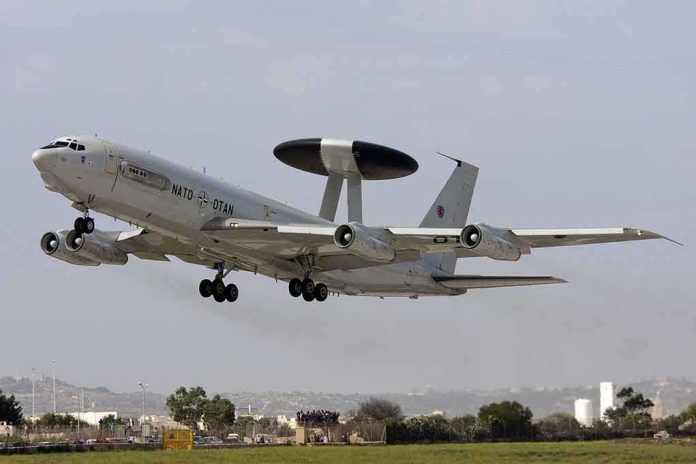
The Trump administration’s decision to cut jets and warships from NATO duty in Europe is less a retreat than a long‑overdue message to European freeloaders: start defending your own continent.
Story Snapshot
- The United States plans to cut about one‑third of its fighter jets assigned to NATO in Europe, along with tankers, bombers, and key warships.
- European officials admit the change will force Europe to step up its own surveillance and long‑range strike capabilities.
- Trump officials frame the move as “right‑sizing” after decades of NATO over‑reliance on Washington.
- Critics warn the cuts may reduce NATO’s ability to monitor Russia and hit long‑range targets in a crisis.
What Washington Is Actually Cutting From NATO Duty
Reports based on briefings to NATO say the United States plans to remove a large set of aircraft and ships from the pool reserved for alliance missions in Europe, not from the U.S. military overall.[3] The number of U.S. fighter jets available for NATO operations would drop by about one third, from roughly 150 F‑16 and F‑15E jets to about 100.[1] Maritime patrol planes, which hunt submarines, would fall from 26 to 15, while all eight aerial refueling tankers would be pulled from Europe and likely shifted to other regions.[4]
Reports also say one missile‑launching submarine, an aircraft carrier, and several destroyers and other warships would be reassigned away from NATO crisis duty.[4] The United States also plans to provide only half as many strategic bombers for alliance missions as before.[3] None of this means America is disarming. It means these forces will no longer be automatically promised to NATO planners in a crisis. They can still be used by the United States anywhere the commander in chief decides they are needed most.
Why Trump Is Forcing Europe To Carry More Weight
According to reporting on a briefing at NATO headquarters, a senior U.S. envoy told allies that European defense has become too dependent on American muscle, especially for key tasks like air refueling, submarine hunting, drones, and long‑range bombing.[3] A NATO spokeswoman backed that view, saying there has been an “over‑reliance” on the United States in alliance force planning and that, as Europe and Canada invest more in defense, responsibilities can be reorganized.[3] In other words, Washington is finally matching words with actions after years of complaints that Europe enjoys U.S. protection without paying its fair share.
For decades, many European governments chose welfare programs, green energy pushes, and bloated bureaucracies over serious defense spending. Now, after Russia’s 2022 invasion of Ukraine and repeated warnings from Trump that NATO members must meet their spending pledges, those same countries are rushing to buy weapons and rebuild their militaries.[2] By cutting guaranteed U.S. assets for NATO operations, the Trump administration is effectively telling Europe: you say you are stepping up, so prove it by filling the gaps in tankers, patrol planes, and warships yourselves.[6]
The Security Risks Critics See — And How Serious They Are
European officials and defense analysts worry these cuts will make it harder for NATO to watch Russian submarines or launch long‑range cruise missiles if a crisis erupts.[4] With fewer maritime patrol aircraft and no dedicated U.S. submarines on the NATO list, tracking Russian boats in the North Atlantic and Arctic could become more challenging. Reduced access to U.S. bombers and carrier‑based jets may also shrink the alliance’s ability to hit targets deep inside hostile territory at the start of a conflict.[1] Critics claim this could embolden Moscow or tempt it to probe NATO’s defenses.
U.S. Plans NATO Force Reduction
The US has informed NATO allies of plans to reduce some military contributions in Europe, including fighter jets, naval assets, and support aircraft. U.S. officials say the move is intended to shift greater responsibility for conventional defense… pic.twitter.com/mN3RmxSLGE
— Inside the conflict (@InsidConflict) June 13, 2026
Those concerns are real, but they leave out key facts. First, the U.S. nuclear umbrella over Europe is not changing, according to reports summarizing allied briefings.[6] Second, the U.S. can still surge forces into Europe if American leaders judge that a direct threat to NATO territory exists. What is changing is automatic availability and the expectation that Washington will always be first responder. That shift lines up with core conservative ideas: strong defense, but no blank check for globalist institutions that refuse to carry their own load.
What This Means For American Taxpayers And National Priorities
For American families already hit by years of inflation, high energy prices, and federal overspending, this move speaks to a basic fairness question. U.S. taxpayers have funded Europe’s security for nearly eighty years while some European leaders attacked American energy, pushed radical climate rules, and lectured Washington on “values.” Now, with China growing stronger and the Indo‑Pacific theater demanding more attention, U.S. planners are reportedly shifting some of these high‑end assets toward Asia.[2] That reflects a hard choice about where American lives and dollars are most at risk.
Conservatives who support a strong military but oppose endless foreign commitments will see this as a needed reset, not isolation. The Trump administration is not leaving NATO or abandoning Europe. It is tightening the terms of the deal. If European governments want the full shield of American power, they must match it with real capability, not just speeches at summits. That means buying their own tankers, drones, and ships instead of assuming Washington will forever pick up the tab.[3] For once, the burden‑sharing debate has teeth, and allies in Europe are paying attention.
Sources:
[1] Web – US to cut fighters, warships from NATO mission in Europe
[2] Web – US plans major cut to jets, warships for NATO operations in Europe …
[3] Web – US planning to significantly cut fighter jets, warships for NATO …
[4] YouTube – US Pulls Jets, Warships & Bombers From Europe | Times Now World
[6] YouTube – US plans to slash fighter jets, warships to NATO in Europe, NY …