America is rushing into an AI gold rush that could quietly rewrite your power bill, your grid, and even your politics.
Story Snapshot
- AI data centers are set to double or more their power use this decade, after years of flat U.S. demand.
- Government and Wall Street now treat AI-driven electricity growth as a core planning assumption, not a side issue.
- Record U.S. power demand in 2026–2027 will come from a mix of AI, electrification, and industrial growth, not AI alone.
- Everyday Americans could end up paying for Big Tech’s “always on” AI habit through higher rates and new gas plants.
AI is turning a sleepy power grid into a growth industry again
For almost 15 years, U.S. electricity demand barely moved. The Energy Information Administration says use stayed mostly flat from the mid-2000s until around 2020, then began to grow again at about 1.7 percent per year. That may not sound like much, but for a huge system that once felt “finished,” any new growth is a shock. Now add a brand-new, power-hungry customer class: massive AI data centers that never sleep.
Goldman Sachs Research estimates that power demand from data centers in the United States will soar as AI spreads, helping drive electricity growth “not seen in a generation.”[1] Their analysts expect data center power demand to rise 160 percent by 2030, with data centers using about 8 percent of all U.S. power by then, up from 3 percent in 2022.[1] A large share of that jump comes from AI workloads that push chips and servers hard around the clock.
How much of the coming power surge is really about AI?
The fight is not about whether AI adds to demand; it clearly does. The fight is over how big a slice it takes. The Department of Energy says its projections for U.S. electricity demand now explicitly include “data center expansion and the rise of artificial intelligence applications.” That means AI is built into the official forecasts, not tacked on as an afterthought. Columbia researchers project U.S. data centers may consume about 88 terawatt-hours a year by 2030 from generative AI alone.[2]
Yet the Energy Information Administration points to a broader picture. Its recent outlook ties record power demand in 2026 and 2027 to three big forces: commercial growth from data centers, more electricity use in homes and businesses, and the switch away from fossil fuels for heating and transport. Commercial demand is now expected to grow faster than residential, which lines up with a boom in data centers but also with factories, warehouses, and offices that are plugging in more equipment. AI is a major driver, but not the only engine under the hood.
Why AI data centers are such a problem for the grid
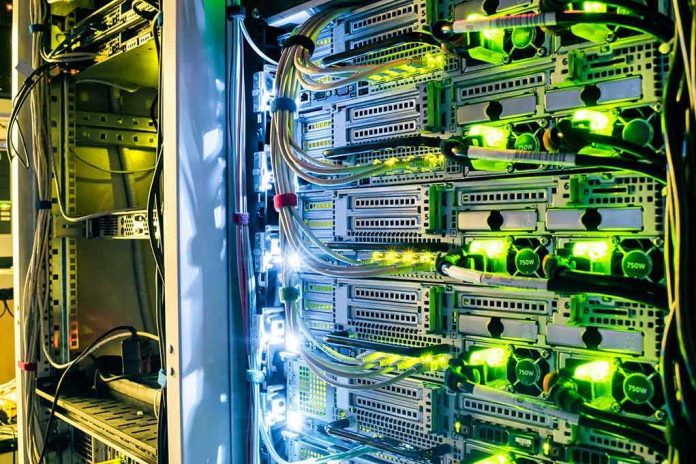
AI servers do not act like your fridge or laptop. They gulp steady, heavy power, twenty-four hours a day, seven days a week. Research shared by multiple analysts shows that data center electricity use in the United States could rise more than 130 percent by 2030, with global demand nearing 945 terawatt-hours.[2] A substantial part of that growth comes from AI “accelerated servers,” the specialized hardware that trains and runs large language models.[2]
USIT @lizvstein joined us in studio to talk space, AI, and semis.
"I've heard a lot of people try to come up with mental models for intelligence that maybe it's not going to be a cyclical thing and that we're actually in a long-duration infrastructure super cycle build-out… pic.twitter.com/h8nbx292T9
— Jack Kuhr (@JackKuhr) June 10, 2026
Investigations already show how this new demand hits regular people. A major analysis found that areas near heavy data center activity are much more likely to see sharp wholesale power price increases, which then roll into customer bills.[4] In some grids, data center development added billions of dollars in extra costs over a single year.[4] From a conservative, common-sense view, that raises a clear fairness question: why should families and small businesses subsidize Big Tech’s power binge?
Record U.S. demand, new gas plants, and who pays
Goldman Sachs estimates that data centers alone will force U.S. utilities to invest about fifty billion dollars in new generation capacity by 2030, plus new gas pipeline capacity to feed it.[1] That aligns with other analysis showing total U.S. electricity demand could climb twenty-five percent by 2030 and seventy-eight percent by 2050 compared to 2023. Utilities do not eat those costs; they spread them across ratepayers. For retirees on fixed incomes and working families, even a small monthly jump matters.
Energy planners now expect data centers to consume up to twelve percent of all U.S. electricity by 2028 in some scenarios.[5] At the same time, AI-specific servers may use between 165 and 326 terawatt-hours a year globally by 2028, up from as low as 53 terawatt-hours in 2024.[2][3] Some analysts project AI alone could claim several percent of U.S. electricity by late this decade. Taken together, those numbers make one thing clear: AI is not a rounding error. It is a new industrial load class, on par with heavy industry.
The political fight that is coming to your state
Once you see AI as heavy industry, the political fault lines look obvious. On one side, tech firms promise jobs, tax revenue, and “innovation hubs.” On the other, local communities face higher bills, new power plants, and lines carved across farmland and suburbs to feed server farms. New research already links data center growth with local price spikes and large infrastructure costs.[4][5] That will make future fights over siting and cost-sharing very intense.
From an American conservative angle, the core question is not “Is AI good or bad?” The question is who bears the cost of this boom and who controls the buildout of the grid. Common sense says: do not let central planners and corporate lobbyists make those choices alone. As AI pushes U.S. electricity demand to record highs in 2026 and 2027 and beyond, voters will have to decide whether they want to underwrite always-on digital casinos, or demand real rules that put households and small businesses first.
Sources:
[1] Web – Power use to smash records as AI use surges…
[2] Web – U.S. Electricity Under Pressure: AI Energy Demand
[3] Web – Projecting the Electricity Demand Growth of Generative AI Large …
[4] Web – AI, Data Centers, and the U.S. Electric Grid: A Watershed Moment
[5] Web – Energy Markets Race to Solve the AI Power Bottleneck