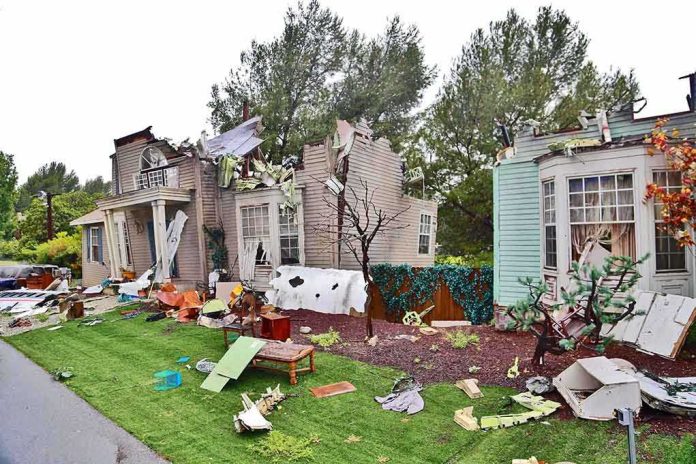
The real story of the recent Midwest outbreaks is not whether the danger was overhyped, but how accurately forecasters characterized a genuinely high‑end wind, hail, and tornado threat—and what that reveals about how we should read terms like “Tornado Emergency” and “EF‑3 risk” the next time they appear.
Key Points
- Forecast centers correctly identified a multi‑day, high‑end severe weather pattern, including an Enhanced/Level 3 risk and a derecho‑type wind swath through the Midwest.[1][2]
- Illinois and the broader region experienced numerous tornadoes, destructive straight‑line winds above 75–80 mph, and hail up to baseball and even grapefruit size, causing major damage and widespread power outages.[1][2][3]
- Some of the most alarming language—“Tornado Emergency,” “EF‑3+ risk,” “200 million at risk”—accurately reflected the environment but interacted with incomplete early data, creating gaps between live TV framing and later NWS survey details.[1][3][4]
- The episode underscores a recurring tension: the public needs fast, emphatic warnings in rapidly evolving outbreaks, even though early wording will always be rougher and more probabilistic than the next day’s survey map.
A severe pattern, not a one‑off freak event
When you zoom out from the sirens, social clips, and scrolling lower thirds, the recent barrage of tornadoes and hail across Illinois and the Midwest looks exactly like what it was: a classic, multi‑day severe weather regime in a favorable spring pattern, accurately flagged days in advance by national and private forecast centers.[1][2][5]
The NOAA Storm Prediction Center (SPC) upgraded parts of the Midwest, including the Chicago corridor, to an Enhanced (Level 3 of 5) risk as it became clear that a powerful mesoscale convective system would sweep east with embedded tornado potential and widespread destructive winds.[1] AccuWeather and FOX Weather independently characterized the setup as a three‑day severe weather event affecting on the order of 200 million people across the Plains and Midwest, with golf‑ball‑size hail and several tornadoes highlighted from North Dakota through Iowa into Illinois.[5][7] That scale is not marketing; it is the geographic and population footprint of an early‑summer jet stream overlapped with rich Gulf moisture.
Within that broader regime, individual days produced distinct high‑impact episodes. One produced a derecho‑type corridor of damaging winds stretching hundreds of miles and knocking out power to more than half a million customers across several states.[1] Another day centered on an Illinois–Indiana corridor that saw homes leveled, trees and power lines downed, and at least one 911 center south of Chicago overwhelmed by calls.[1] These are precisely the kinds of outcomes you expect when a Level 3 risk verifies.
Illinois: tornadoes, destructive hail, and a stressed warning system
For Illinois, the hazard mix was brutally familiar: tornadoes on the ground in multiple counties, enormous hailstones, and long swaths of damaging wind. The National Weather Service in Lincoln and Chicago outlined a scenario with large hail up to 2 inches, damaging winds, and “potentially strong tornadoes” spanning late afternoon into the overnight hours.[1] Their watches and warnings lined up with what unfolded—tornado watches stretching from Oklahoma to Michigan, and a cluster of warnings across northeastern Illinois and northwestern Indiana as storms matured.
One of the most intense moments came when a Tornado Emergency was issued for Bell Plain, Illinois—a rare escalation reserved for confirmed, particularly dangerous tornadoes impacting populated areas. That language matched a live, on‑the‑ground reality: a tornado was observed, radar signatures were strong, and the path intersected vulnerable communities.[1] This was not a casual label; it is part of a structured warning escalation system meant to push people off the fence when minutes matter.
Hail was not a side show. On March 10, a separate but related regional event produced baseball‑size hail—2.75 inches in diameter—near West Branch, Iowa, and Davis and Lena in northwest Illinois, as documented in an NWS Quad Cities event summary.[3] In the broader outbreak cycle, Fox Weather highlighted hail zones in Illinois with stones up to grapefruit size, damaging vehicles and roofs and stripping siding from homes.[3] Those sizes are consistent with nearly 100 reports of severe hail, ranging from “lime” to “softball” size, across the Iowa–Wisconsin–Illinois corridor in the same multi‑day regime.[2]
It is important to separate the occasional messy phrasing in live coverage (“golf ball sized ro um hail,” “ping‑pong sized hail”) from the underlying meteorology. Hail sizes on air often start as visual estimates from spotters or the public; formal NWS event summaries, compiled after the fact, are the gold standard, and those confirm that truly large hail was widespread.[3]
Beyond Illinois: a corridor of tornadoes and extreme hail
The storms that hit Illinois were part of a broader outbreak stretching from the central Plains to the upper Midwest. ABC and other outlets reported more than two dozen tornado reports from eastern Kansas to southern Minnesota and Wisconsin over a few days, with additional tornadoes confirmed into northern Illinois and Indiana.[2][6] In Kansas, for example, a pair of EF‑2 tornadoes struck Miami County, damaging about 100 structures and completely destroying or severely damaging 50–60 of them.[2]
To the north, Wisconsin and Iowa endured some of the most dramatic hail. Softball‑sized stones fell near Maple Bluff, Wisconsin, large enough to puncture roofs and total vehicles.[2] Life‑threatening storms “erupted across the Midwest and Southern Plains,” as one Fox Weather segment put it, bringing hail as large as grapefruits and scattered tornadoes that carved visible swaths of destruction.[3]
Farther south and west, the same broad pattern produced a deadly outbreak from the Plains into the Great Lakes, including an EF‑3 tornado near Beggs, Oklahoma, with peak winds estimated at 135–140 mph.[4] That rating comes from NWS damage surveys, which combine radar analysis with forensic assessment of structural damage; calling it EF‑3 is not a hunch but a formal classification pinned to observed impacts.[4]
How live forecasting handled a fast‑moving outbreak
Events like this expose how modern severe‑weather forecasting really works. They begin not with a single headline but with days of incremental updates from SPC and regional NWS offices: convective outlooks, mesoscale discussions, and watch issuances that narrow the threat zone as the atmosphere evolves.[1][5] A mesoscale discussion referenced by storm chaser Corey Gerken, for instance, highlighted storm‑relative helicity in the 200–300 m²/s² range, minimal capping, and strong low‑level shear—textbook ingredients for supercells and isolated strong tornadoes from Nebraska into Iowa and Missouri.[2]
Television and streaming outlets stand atop that infrastructure, translating technical updates into public‑facing language. During the Midwest events, AccuWeather’s live coverage noted a “high risk” on its internal four‑tier index for a corridor from northern Missouri through Chicago into Michigan; FOX Weather similarly emphasized a Level 3 of 5 risk with hurricane‑force straight‑line winds topping 75 mph and the potential for EF‑2 or stronger tornadoes.[5][7]
Because these systems evolve quickly, the first wave of public language is inevitably probabilistic and occasionally coarse. Radar may show “ragged” rotation that warrants a tornado warning even when a classic hook echo is absent. Embedded vortices within squall lines—sometimes even anticyclonic, or clockwise rotating, as noted near Kirksville, Missouri—can generate brief tornadoes that are difficult to confirm in real time.[2] Later, NWS survey teams reconcile these hints with physical damage on the ground, occasionally downgrading or narrowing what looked, in the moment, like a large and continuous tornadic path.
Hype, trust, and the language of risk
Whenever a high‑impact outbreak coincides with dramatic on‑air language, questions about “hype” follow. There are several potential distortions worth taking seriously.
First, media outlets operate in a competitive, advertising‑driven environment. Emphasizing “high risk,” “200 million at risk,” or “EF‑3+ tornado threat” undeniably attracts attention and can reinforce their brand as the place to turn when weather gets dangerous.[5] That commercial incentive can push presentation toward the upper bounds of plausible severity, even while underlying forecasts remain within the envelope of what SPC and NWS are already indicating.
Second, there is real public fatigue from false alarms. Communities that have sat through multiple siren‑filled evenings with no visible tornado understandably become more skeptical. That skepticism, however, collides with institutional pressure on NWS to limit “over‑warning” even as climate and land‑use changes appear to be nudging severe weather frequency and impact upward in parts of the central U.S. The result is a narrow channel: warn too often, and trust erodes; warn too rarely, and people die.
In the Illinois and Midwest cases discussed here, the weight of evidence favors the view that official forecasters and most national outlets were more right than overwrought. The Enhanced/Level 3 risk verified with numerous tornadoes, widespread 70–80+ mph winds, and truly destructive hail.[1][2][3] Where the communication can fairly be critiqued is not on the existence of the threat, but on specificity and follow‑through: which communities were actually hit hardest, how clearly that was distinguished from the broader “at risk” area, and how quickly live narratives were updated once damage surveys refined the picture.
The Destructive Force of June 11, 2026: A Midwest Tornado Outbreak Case Study
On June 11, 2026, a potent severe weather outbreak swept the Midwest, generating at least 17 tornadoes, widespread damaging winds, and large hail. Northern Illinois and northwest Indiana experienced… pic.twitter.com/YLWcZUMn6V
— Williams Weather (@McCallsWeather) June 12, 2026
Practical lessons for future Midwest severe weather days
What, then, should an informed Midwesterner take away from this outbreak cycle?
First, treat Level 3/Enhanced days—and especially any mention of a derecho‑type wind event or Tornado Emergency—as serious as you would a winter blizzard warning. These labels are reserved for environments with a demonstrated potential for widespread damage, not routine thunderstorms.[1][2]
Second, distinguish between forecast scale and impact scale. When AccuWeather says “200 million people are at risk,” that does not mean 200 million people will be hit. It means the atmosphere is capable of producing hazardous storms anywhere in a very large zone; a relatively small fraction of that area will see the worst of it.[5] Your job is to know which risk tier your county is in, not to extrapolate from a national map.
Third, look for post‑event NWS survey summaries. They are the corrective lens that sharpens the blurry picture drawn in real time. In the March 10 hail event, for example, the Quad Cities office documented no injuries or fatalities in its area despite dramatic images of damaged homes and vehicles; the same multi‑day system produced deaths elsewhere in the region.[3][4] Understanding that kind of spatial nuance helps reconcile “I saw chaos on TV” with “no one died in my county.”
Finally, acknowledge the friction points that persist. Overlapping tornado and flash‑flood warnings still generate confusing guidance—“go to the basement” versus “avoid basements if flooding”—and local emergency management agencies often struggle to communicate shelter options clearly in those moments.[2] Social media platforms’ tendency to throttle or remove “dangerous” user‑captured storm footage can reduce informal situational awareness even as official channels strain to keep up. None of that negates the core value of the warning system; it simply marks where work remains.
Sources:
[1] YouTube – Tornadoes, hail slam Illinois as severe storms pummel the Midwest
[2] Web – Numerous tornadoes and hurricane-force wind gusts slam the Midwest
[3] YouTube – LIVE | Upper Midwest Severe Threat | June 10, 2026
[4] Web – Event Summary: March 10, 2026 Widespread Severe Hail, Some …
[5] Web – Deadly Tornadoes Strike Plains and Great Lakes – WeatherNation
[6] Web – Summary of March 15, 2026 Severe Thunderstorms
[7] Web – Severe storms left a trail of destruction in the Midwest and Plains …