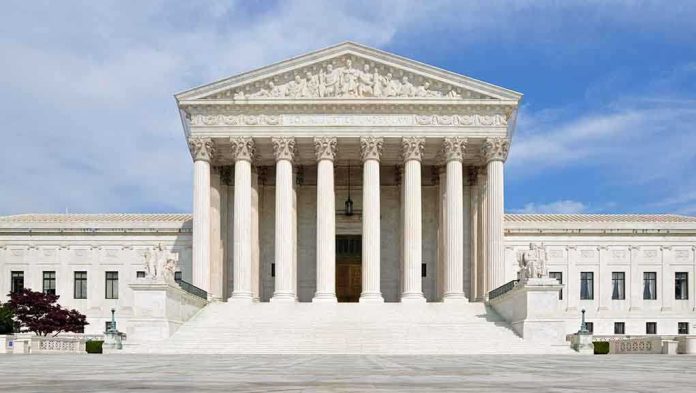
A federal judge ruled nitrogen gas execution is unconstitutional — and now the Supreme Court has stepped in to block Alabama from carrying out a death sentence, leaving a convicted double murderer alive while the state scrambles to find another method.
Story Snapshot
- The U.S. Supreme Court blocked Alabama from executing Jeffery Lee by nitrogen gas, upholding a lower court’s ruling that the method violates the Eighth Amendment’s ban on cruel and unusual punishment.
- Federal Judge Emily Marks issued a permanent injunction after finding nitrogen hypoxia poses a substantial risk of severe pain during execution.
- A witness to Alabama’s first nitrogen execution described the condemned man heaving back and forth and hitting his mask — raising serious questions about the method.
- Alabama Attorney General Steve Marshall is now pursuing lethal injection as an alternative, arguing the state’s supplies and staffing for other methods are limited.
What the Courts Decided
The Supreme Court declined Alabama’s request to lift a lower court’s block on the planned nitrogen gas execution of Jeffery Lee. [6] Federal Judge Emily Marks had already issued a permanent injunction, ruling that nitrogen hypoxia violates the Eighth Amendment. Her decision followed an earlier finding that the method presents a substantial risk of serious harm — pain beyond death itself. The Supreme Court’s refusal to intervene means that ruling stands, at least for now.
It is important to note that the Supreme Court’s action appears to be a refusal to lift the injunction — not a full constitutional ruling on the merits of nitrogen gas as an execution method. That distinction matters. The justices did not issue a sweeping opinion declaring the method permanently banned. Still, the practical effect is the same: Alabama cannot use nitrogen gas to execute Lee while the injunction holds.
What Witnesses Saw at Alabama’s First Nitrogen Execution
Alabama carried out its first nitrogen gas execution in early 2024 on death row inmate Kenneth Eugene Smith. Reverend Dr. Jeffrey Hood, a spiritual adviser who witnessed the execution, described what he saw as deeply disturbing. He said Smith began heaving back and forth on the gurney and repeatedly struck the gas mask from inside. Hood called it “suffocating people to death” and described the scene as torture. His account became a central piece of evidence in the legal challenge that followed. [1]
Defense lawyers for Lee argued that nitrogen gas causes “conscious suffocation” — meaning the person being executed is aware of the sensation of not being able to breathe before losing consciousness. That claim, backed by Hood’s eyewitness account, helped persuade Judge Marks to block the method. The court also ordered Alabama to look at alternatives, including lethal injection or a firing squad, if it wants to carry out Lee’s sentence. [1]
Alabama’s Response and Lee’s Crime
Alabama Attorney General Steve Marshall pushed back hard, calling Lee’s legal fight a delay tactic. Marshall argued that Alabama lacks the supplies and staffing needed to quickly switch to lethal injection or a firing squad. Despite that, the state moved quickly after the Supreme Court’s decision and began pursuing lethal injection as an alternative path forward. Marshall made clear the state intends to carry out Lee’s sentence one way or another. [1]
Alabama seeks lethal injection execution for death row inmate after Supreme Court rejects nitrogen gas method https://t.co/gL2ks5UiD3
— CBS News (@CBSNews) June 13, 2026
Jeffery Lee was convicted of a double murder committed in 1998. Supporters of the execution argue that decades of legal delays deny justice to the victims and their families. That argument carries real weight. At the same time, courts exist precisely to ensure the government does not inflict unnecessary suffering — even on convicted killers. The Eighth Amendment sets a floor on how the state may treat those in its custody, and multiple courts found Alabama came close to crossing that line with this method.
A Broader Fight Over How States Execute
This case fits a pattern playing out across the country. States began adopting nitrogen gas after lethal injection drugs became harder to obtain. Pharmaceutical companies stopped selling drugs for executions, forcing states to find new methods. Nitrogen hypoxia was marketed as a cleaner, more humane alternative — but Alabama’s experience has raised serious doubts. [9] The Supreme Court has historically been reluctant to block execution methods, making this intervention notable even if it falls short of a definitive constitutional ruling.
The conservative case here is not simple. Most conservatives support capital punishment for the worst crimes, and Lee’s double murder puts him squarely in that category. But conservatives also believe in limited government power and constitutional guardrails. If the government is going to take a life, it should do so in a way that does not cross into cruelty. The courts found Alabama’s nitrogen protocol may do exactly that. The state now has a chance to use a proven method and carry out a sentence that justice demands. [4]
Sources:
[1] YouTube – Supreme Court blocks Alabama nitrogen gas execution method
[4] Web – The Supreme Court blocked Alabama from executing a man using …
[6] Web – Supreme Court declines to let Alabama move forward with nitrogen …
[9] Web – Supreme Court nixes Alabama request for nitrogen execution … – PBS