

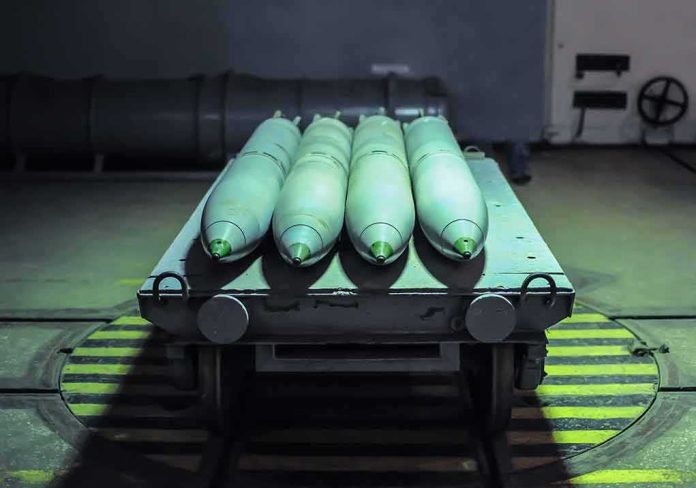
Emergency detonations are not about choosing safety over danger; they are about choosing which danger you can control. The Iowa Army Ammunition Plant’s degraded lead azide stockpile forced exactly that decision: act under emergency authority with strict conditions, or risk an unplanned explosion under worsening stability.
The Short Version
- EPA issued an emergency hazardous-waste permit after determining degraded lead azide posed an “imminent and substantial” threat, authorizing in-place intentional detonation with stringent controls.
- The stockpile is large and specific: 68 drums, nearly five tons, located at the Iowa Army Ammunition Plant, with both reactivity and lead toxicity risks documented by EPA.
- A federal appellate stay paused the EPA permit; the government argued separate emergency rules could still authorize treatment without a permit when immediate danger exists.
- Environmental and public-health groups challenge the detonation plan’s necessity and plume risk, pointing to chemical-neutralization alternatives and exposure pathways for airborne and deposited lead.
What emergency authority actually allows—and why it exists
Environmental law anticipates moments when normal permitting is too slow for a degrading hazard. EPA can issue an emergency hazardous-waste permit when a material presents an “imminent and substantial” endangerment to human health or the environment; that permit can authorize time-limited storage and treatment outside an existing facility’s routine authorization. In Iowa, EPA used that tool to approve in-place, intentional detonation of lead azide at a site not covered by the installation’s effective RCRA permit—paired with prescriptive monitoring, public notifications, cleanup, reporting, and operational constraints such as wind-speed limits. The program’s logic is pragmatic: when instability is advancing, controlled treatment with guardrails can present a lower overall risk than letting the clock keep running.
Parallel to EPA’s emergency-permit path, federal rules contain emergency exclusions that allow hazardous-waste treatment without a permit if there is an immediate threat to health, safety, property, or the environment. Government filings in the Iowa litigation underscored this fallback—arguing the Army could proceed even under a court-ordered pause of the EPA permit, if imminent danger required it. That theory was live in court, not resolved; the Eighth Circuit issued a stay that disrupted the permit-driven plan while briefs on authority and urgency moved forward.
The hazard: why degraded lead azide is different from ordinary explosives
Lead azide is a primary explosive—shock- and friction-sensitive by design—used to initiate detonations. Age and improper conditions can alter its crystal morphology, increase sensitization, and produce instability that compounds risk with each handling step. EPA described the Iowa material as both reactive and toxic for lead—two distinct hazards that matter operationally. Reactivity raises the stakes of every touch, tilt, or temperature swing; toxicity reshapes the off-site risk profile if any combustion or low-order detonation liberates particulate lead. Unlike many secondary explosives that can be moved to industrial destruction lines with standard packaging controls, degraded primary explosives in bulk are candidates for treatment in place precisely because movement multiplies the accident pathways.
Scale and specificity matter. EPA’s site profile fixes the problem set at 68 drums—nearly five tons—of degraded lead azide at the Iowa Army Ammunition Plant. Large quantity plus degradation narrows safe options fast. The longer the delay, the more cycles of temperature, humidity, and mechanical stress the stockpile experiences; instability is path-dependent, and the system has already used up margin.
What “controlled detonation” means in practice
“Open detonation” is not carte blanche to blow and hope. The EPA permit required a full operating picture: pre-event sampling to establish background, during-event air monitoring, post-event sampling to characterize deposition, community notifications, cleanup commitments, and a specified wind-speed threshold to manage plume transport potential. These are not perfunctory conditions; they frame the physics of fragmentation, thermal decomposition, and particle entrainment in a way that regulators and public-health teams can measure. The Army’s operations would also be bounded by meteorological windows, exclusion zones, and reporting that enable after-action accountability if dispersion or deposition exceeds modeled expectations.
Two caveats remain. First, the public record available in real time rarely includes the underlying stability testing, accident-sequence probabilities, or full dispersion modeling that informed the emergency decision. Second, as the permit’s monitors record data only when the event occurs, the safety case before an operation is necessarily based on models, not measurements in that exact configuration—a perennial limitation of emergency action.
The core dispute: is detonation the least-bad option?
On one side is a formal endangerment finding and an emergency permit authorizing in-place detonation with controls, grounded in the argument that degraded primaries are too dangerous to neutralize or move at this scale. On the other side, environmental groups, a consulting expert, and state public-health materials warn about airborne lead and argue for chemical neutralization—sulfur-reduction methods such as MuniRem—contending the Army discounted feasible alternatives. The counter-case raises two substantive points: first, that detonation can create a lead-containing dust plume and potentially other toxic products (e.g., hydrazoic acid) that drift beyond the installation; second, that established neutralization chemistries can destroy lead azide without explosive release, immobilizing lead instead of dispersing it.
Both positions rely on recognizable technical logics. Detonation converts friction/handling risk into a controlled energy release; neutralization converts an explosive into inert salts in a wet process designed to keep crystals below sensitizing thresholds. The divergence is less about chemistry than about feasibility under the specific constraints of degraded, drum-scale quantities. EPA’s emergency action implicitly accepted the Army’s case that manipulating many crystallized containers for days to weeks increases near-term accident probability; the counter-argument is that risk of deposition from detonation is unacceptable when neutralization technologies exist. What the record does not surface publicly is a line-by-line alternatives analysis with quantified timelines, handling steps, and failure probabilities—exactly the documentation that would let outsiders test the “only practicable option now” claim.
Law, logistics, and timing: how the plan hit turbulence
The decisive legal event was not a scientific reversal but a procedural stay. The Eighth Circuit temporarily halted the EPA emergency permit after environmental groups sought review, placing the Army’s permit-reliant plan on hold. In response, government lawyers pointed to emergency exclusions that could authorize action without the stayed permit, an assertion that remained in active litigation as schedules shifted. News coverage amplified the stakes by emphasizing plume reach, the nearly five-ton quantity, and evolving detonation dates—all of which erode public confidence when technical underpinnings are not yet visible.
Operationally, weather conditions became both a safety factor and a communications challenge. The EPA notice set a surface wind-speed limit; the Army referenced meteorological windows as part of its scheduling. But absent publication of the full dispersion assumptions—source term, particle-size distribution, lift, stability class, deposition velocities—skeptical audiences had little to interrogate beyond reassurances and a wind-speed number.
President Trump says he has ordered the Army not to go forward with the planned detonation of a Iowa bunker filled with drums of lead azide until the courts weigh in. https://t.co/Dha4Y29v9c
— NBC News (@NBCNews) November 23, 2026
How to judge emergency disposal choices going forward
This case clarifies what the public should demand—and what agencies should furnish—when emergency detonation is on the table. Four items turn a contested plan into an auditable one: (1) the technical basis for the endangerment finding (inspection photos, stability assays, thermal data, and accident-tree probabilities); (2) a comparative alternatives analysis with explicit handling steps, durations, and quantified risks, including neutralization and continued storage; (3) the full dispersion and deposition model with meteorological scenarios and uncertainty bands; and (4) a monitoring plan with detection limits, locations, and a commitment to publish raw data and cleanup triggers quickly. EPA’s emergency-permit framework already points in this direction—monitoring, notifications, cleanup, and reporting are baked in—but credibility, especially when courts intervene, depends on showing the math, not merely asserting it.
Bottom line
Degraded lead azide in bulk is a problem with no painless solution. The strongest documentary record supports three settled facts: regulators deemed the stockpile an imminent hazard and authorized in-place detonation with controls; the quantity and location are fixed and nontrivial; and the legal pathway through a stayed permit collided with the government’s separate emergency-authority theory, leaving timing in flux. Reasonable experts can disagree over the last-mile choice between detonation and neutralization, but the threshold question in any future case is the same: which sequence—handling-intensive treatment, extended storage, or controlled detonation—minimizes total risk over the next days and weeks, not in the abstract? The answer should be demonstrated in detail before the first blast cap is wired.
Sources:
military.com, epa.gov, hhs.iowa.gov, apnews.com, response.epa.gov, desmoinesregister.com, edition.cnn.com