
The fight over Arynne Wexler’s roast of Zohran Mamdani was never really about the joke itself — it was about who gets to decide, after the laughter and the outrage have both gone viral, where political satire ends and something uglier begins.
Key Points
- Conservative comedian Arynne Wexler delivered a sexually explicit set about NYC Mayor Zohran Mamdani and his wife Rama Duwaji at Commentary Magazine’s November 8 fundraising roast, and the clip drew millions of views on X.
- Critics spanning journalist Piers Morgan, former U.S. Ambassador to Israel Dan Shapiro, and Middle East analyst Khaled Elgindy called the material racist and Islamophobic rather than mere political ribbing.
- Defenders, including commentator Will Chamberlain, argue Wexler “did nothing wrong” because roast format and public office both license harsher material.
- Even some conservative voices split from the “leftist meltdown” framing, suggesting the dispute isn’t cleanly partisan.
- American courts have long drawn a bright line protecting satire that no reasonable listener would mistake for a factual claim — a standard this controversy tests but does not resolve.
What Happened at the Roast
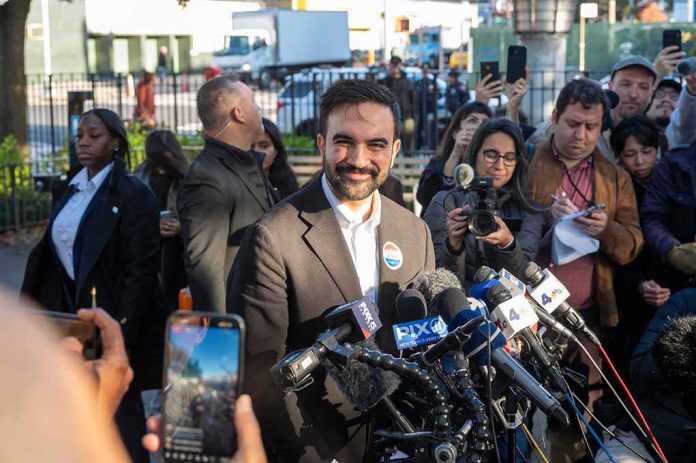
Commentary Magazine’s annual fundraiser on November 8 was built around roasting former Israeli Ambassador to the U.S. Ron Dermer, but comedian Arynne Wexler used part of her set to turn on New York City Mayor Zohran Mamdani instead. She called him “the grand mufti of New York,” joked that he and his wife, artist Rama Duwaji, use “old speeches of Ayatollah Khamenei” as foreplay, and made a crude remark about how the couple met on the dating app Hinge. Wexler posted the clip herself on Friday; by the time Gateway Pundit’s Cullen Linebarger wrote it up, the video had reportedly logged 6.7 million views on X — the kind of number that turns a banquet-hall bit into a national argument within days.
That virality is itself instructive. Researchers at Yale have shown, across more than 12 million tweets, that posts earning more likes and retweets for expressing outrage train users to express more outrage over time, and separate work on out-group animosity finds that political content aimed at an opposing camp gets shared roughly twice as often as content about one’s own side. A joke about a sitting mayor’s marriage and faith, told at a conservative gala and framed by a right-leaning outlet as a “meltdown” trigger for the left, is close to optimized for that algorithmic dynamic — regardless of whether the joke itself was any good.
The Case Against the Joke
The backlash was not limited to anonymous social-media noise, which matters for how seriously it should be weighed. Piers Morgan, no stranger to provocative commentary himself, called the material “disgusting”. Dan Shapiro, who served as U.S. Ambassador to Israel, used the identical word. Khaled Elgindy described the set as “racist and Islamophobic tropes masquerading as comedy”, and journalist Laila Al-Arian argued the jokes would have ended a comedian’s career had the target not been Muslim. That is a specific, named, and ideologically varied chorus — a former diplomat, a prominent British-American broadcaster, and Middle East analysts all converging on the same objection: that the “mufti” framing and the Khamenei line didn’t satirize Mamdani’s politics so much as his religion and ethnicity, dressed up as a punchline.
The Case for the Roast
Defenders push back on two grounds. First, context: a roast is an unusually permissive genre, where guests arrive expecting savagery, and Wexler’s set — originally aimed at Dermer — fit a format built for exactly this kind of material. Second, status: Mamdani is not a private citizen but the elected mayor of the largest city in the country, and American political culture has a long, bipartisan tradition of mocking officeholders in terms far cruder than policy debate allows. Commentator Will Chamberlain summarized this view bluntly, saying Wexler “did nothing wrong.” Gateway Pundit’s coverage leaned hard into this frame, casting the backlash itself as the story — proof, in its telling, that the left can dish out mockery of conservatives but cannot absorb it aimed back.
That framing has a wrinkle worth noting honestly: the “meltdown” narrative assumes the criticism was purely partisan, but it wasn’t entirely. Writer Richard Hanania, who is no ally of progressive politics, panned the material on quality grounds, arguing that right-wing comedy tends to get “dumber and worse” than its targets deserve — a critique from inside the conservative commentariat, not outside it. That matters for assessing the strength of each side: the objections came not just from predictable ideological opponents but from a former ambassador, a mainstream broadcaster, and a right-leaning critic simultaneously, while the defense rested mainly on format and status rather than rebutting the specific charge that the jokes leaned on religious and ethnic stereotype rather than political substance.
Where the Law Actually Draws the Line
None of this is new legal territory, even if each flare-up feels urgent in the moment. The Supreme Court settled the baseline in 1988’s Hustler Magazine v. Falwell, ruling that public figures cannot collect damages for emotional distress caused by a parody unless it contains a false statement of fact made with actual malice. The Court’s logic was protective of even deliberately offensive satire, on the theory that public debate needs breathing room for exaggeration. More recent rulings, such as Loomer v. Maher, have reinforced that comedic remarks viewed in context — rather than parsed as literal assertions — remain constitutionally shielded. Legal commentators distinguish satire from defamation on a simple test: if no reasonable person would take the claim as literally true, it’s protected speech, however cutting. Wexler’s jokes were plainly exaggeration, not factual allegation, which is why no legal claim has emerged from this episode — but constitutional protection and social acceptability are two different questions, and the controversy lives entirely in the gap between them.
Comedian Arynne Wexler unleashed a savage roast of NYC Mayor Zohran Mamdani at Commentary Magazine’s gala, branding him the city’s Grand Mufti, linking his marriage to Rama Duwaji with child-purchase and jihadist innuendo, and tying him to Ayatollah Khamenei.…
— Maverick (@PainInYourFeed) November 14, 2026
Why This Keeps Happening
Public-figure comedy will keep generating exactly this collision, because the incentives on every side point toward escalation rather than resolution. Outrage drives engagement, engagement drives bookings and clip views, and each side’s partisans