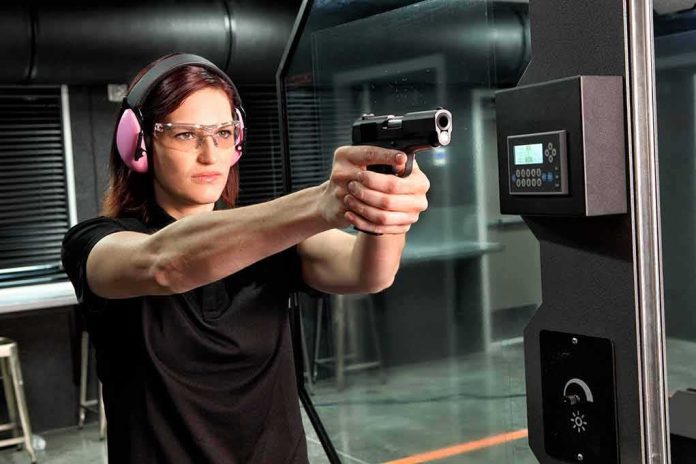
The most important change in American gun ownership over the past decade is not raw volume but who is buying: women have been closing a long-stable gender gap, with a clear, sustained rise in personal firearm ownership since 2018.
The Short Version
- Multiple high-quality surveys show a step-change in women’s personal gun ownership beginning in 2018 and persisting through 2024.
- Republican women account for a disproportionate share of the increase, even as some male subgroups ticked down.
- Women constitute nearly half of recent first-time purchasers, indicating a structural, not cyclical, shift.
- The trend matters for politics, the gun industry, training culture, and public health, where assumptions built on a male-dominated ownership base are increasingly outdated.
What changed: a step up after decades of stasis
For much of the modern survey era, women’s personal gun ownership hovered in a narrow band while men’s rates were higher and steadier. That pattern broke after 2018. Analyses of the General Social Survey (GSS)—a long-running, nationally representative study fielded by NORC at the University of Chicago—show women’s personal ownership rising from roughly 10% in 2018 to 15% in 2021 and 16% in 2024, marking a pronounced departure from the previous decade-plus of stability. Those figures are meaningful because the GSS asks consistent questions over time and is a touchstone for trend detection in U.S. social behavior. The signal is not a one-year blip; it is a new level.
Triangulating beyond a single series reinforces the shift. Gallup’s multi-year groupings report that overall U.S. personal ownership has been roughly flat near 30%, but that concealment masks a sharp climb among specific women—particularly Republican women—whose increases offset declines among Democratic and independent men. When multiple independent surveys with different sampling frames and question wordings converge on the same directional finding, the inference strengthens.
Who is driving the increase
The most visible driver is partisan: Republican women’s personal ownership climbed from about 19% in 2007–2012 to 33% in 2019–2024 in Gallup’s six-year rollups. That is a large relative jump in a subgroup that historically lagged Republican men by a wide margin. The partisan asymmetry matters because it shapes downstream attitudes on safety, regulation, and candidates; the electorate now includes more women who are direct stakeholders in gun policy rather than observers through a spouse or household member.
Beyond partisanship, the composition of recent purchasers signals breadth. Post-2021 acquisition surveys indicate that women comprised roughly 46% of those who bought a gun for the first time between 2021 and 2024, a dramatic departure from the historical norm in which women represented about a quarter of owners. First-time buyer share is crucial: it captures net inflow, not just churn among existing owners, and it seeds future training, club membership, and political engagement rooted in personal, not proxy, experience.
How we know: measurement strengths and limits
Firearm ownership is notoriously hard to measure because the U.S. has no comprehensive national registry, and ownership is typically captured through self-report. That makes survey craft—sample design, question wording, and reference windows—do more work than in domains with administrative backstops. Here, the case for a real rise rests on three pillars. First, the GSS trend break occurs in a series with stable methodology across decades, which reduces the odds that mere questionnaire noise explains the change. Second, Gallup’s independent time series points to the same subgroup dynamics—women up, especially Republicans—even while topline ownership looks flat. Third, buyer-flow evidence shows women nearly matching men among new owners, corroborating that the base is being replenished from a different demographic than before. Taken together, the pattern is consistent across sources that answer different parts of the question.
Precision about the level varies by instrument—some estimates place women’s personal ownership closer to one in seven, others nearer one in four—but the directional consensus is solid: up from a long plateau, with a measurable post-2018 step. When assessing claims that rely on single-point percentages, lean on trend integrity and cross-series alignment rather than any one snapshot.
Why it happened: plausible mechanisms
Several forces likely combined to shift women from household exposure to personal ownership. Periods of social and economic disruption historically correlate with spikes in first-time gun purchases; the late-2010s through early-2020s delivered public-health crises, civil unrest, and concerns about police response times, all of which elevate perceived self-reliance. Parallel to risk perception, the market adapted: compact, concealable handguns with manageable recoil; training curricula tailored for new adult learners; and women-led shooting communities made the path from curiosity to competent ownership shorter and less intimidating. Political polarization also sharpened identity signaling around guns, with Republican women in particular reshaping their relationship to ownership as participation rather than adjacency.
Public-health and safety perceptions have moved with these changes. Survey research finds large gaps between owners and non-owners in beliefs about whether a gun improves personal safety; among women, owners are far more likely to say it does, which can reinforce both initial acquisition and continued carry training. Perception is not mere attitude—it predicts behavior, and behavior changes the composition of the ownership base over time.
Implications for policy and politics
An electorate with more women gun owners behaves differently from one where most women’s exposure is secondhand. Policy debates about storage mandates, carry permitting, and defensive-gun-use reporting now meet a female constituency with direct stakes. The evidence that Republican women’s ownership rose most sharply helps explain why gun policy has become more salient in some suburban and exurban districts: the demographics of owners no longer map neatly to rural male archetypes. Campaigns and advocacy groups that still segment messages along outdated lines—men as owners, women as safety-focused non-owners—will misread priorities and miss votes.
For the gun industry and training ecosystem, a sustained influx of first-time women owners recasts core business assumptions. Demand shifts toward concealable handguns, on-body carry solutions that work with women’s apparel, range environments designed for adult beginners, and instruction that treats women as primary students rather than invited guests. Organizations that have built credibility with new owners—women-run ranges, instructors, and clubs—become durable community nodes, not marketing novelties.
🔺Gun ownership hit 2.5M license holders, rising 50% from 2016-25
🔺26% of 🇨🇦 homes own at least one firearm
🔺Women represent one of the fastest-growing demographics (13% of gun owners)
🔺More Canadians say self-defence is their primary reason (30%) — up from 6% in the late 90's pic.twitter.com/5R8M6dxwrB— CCFR/CCDAF (@CCFR_CCDAF) September 28, 2026
What to watch next
Two questions will determine whether this era is remembered as an inflection or a plateau. First, does the post-2018 step consolidate into higher steady-state ownership among women as cohorts of first-time buyers renew permits, upskill, and purchase additional firearms? Second, do subgroup dynamics spread beyond Republican women to independents and Democrats, or do we see a durable partisan bifurcation where gains among women are concentrated ideologically? Continued convergence across GSS, Gallup, and buyer-flow studies will answer both. For now, the throughline is clear: women are more likely to be owners in their own right than at any point in modern measurement, and institutions that assume otherwise are already behind the data.
Sources:
reason.com, rand.org, news.gallup.com, vitalcitynyc.org, ammo.com