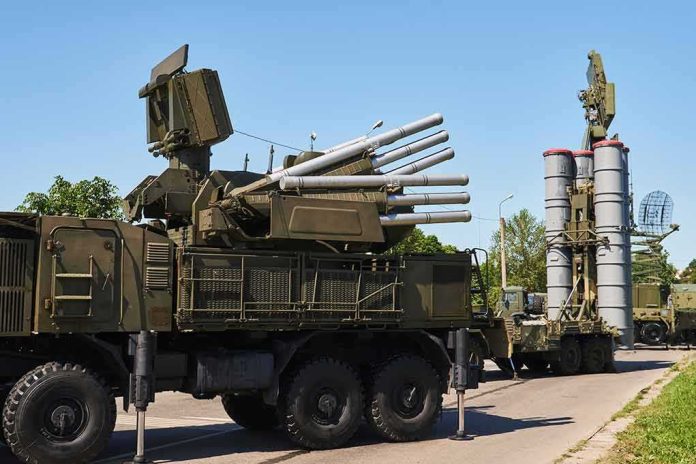
Russia’s air war over Kyiv has become a contest between scale and scarcity: Moscow can keep generating salvos, but Ukraine’s ability to keep absorbing them depends on a finite stock of high-value interceptors that are hardest to replace. The result is not a simple collapse of air defense; it is a system under relentless strain, where drones are still being shot down in large numbers while ballistic and hypersonic missiles increasingly slip through and produce the damage that shapes public perception.
Intro Header
- Repeated Russian strikes on Kyiv show sustained pressure on Ukraine’s layered air defenses.
- Ukrainian officials say interceptor supplies are thinner than before, especially for Patriot-class systems.
- Open reporting supports heavy strain, but it does not prove audited stockpile exhaustion.
- The sharpest gap is between strong drone interception and weaker protection against ballistic missiles.
Why Kyiv’s Air Defense Problem Is More Specific Than “Running Out”
The central fact is not that Ukraine’s air shield has vanished; it is that the shield is being asked to do several different jobs at once, and the most expensive job is the one under the greatest pressure. In the supplied reporting, Ukrainian officials repeatedly describe Russian attacks saturating defenses, and in some cases they say the capital was hit by waves in which dozens of missiles and hundreds of drones were launched overnight. That pattern matters because air defense is not one instrument. Drones, cruise missiles, ballistic missiles, and hypersonic weapons require different detection and interception chains, different interceptor types, and different magazines. A system can remain effective against one threat while becoming dangerously thin against another.
That is exactly the picture the record presents. BBC reported a major strike in which Ukraine said it downed 18 of 41 missiles and 108 drones, while AP later reported a strike in which all 29 ballistic missiles reached their targets. Those are not the numbers of a defense that has fully failed. They are the numbers of a defense that is still functioning, but unevenly. The drones are being thinned out; the ballistic missiles are getting through. When that distinction is blurred in public debate, the conversation becomes less about military mechanics and more about visible destruction, which is a different and less precise measure of capability.
The Evidence for Strain Is Real, Even If “Running Out” Is Too Absolute
The strongest support for the shortage thesis comes from the scale and repetition of the attacks themselves. Reuters described a May 2026 wave in which Kyiv was the main target and more than 670 attack drones and 56 missiles were launched overnight, with the capital absorbing major damage and fatalities. Reuters also reported another massive strike on Kyiv and surrounding areas involving hundreds of drones and missiles, including an Oreshnik hypersonic missile near the capital. AP later said attacks killed 22 and “exposed widening gaps” in Ukraine’s air defenses. Taken together, those reports show a durable operational problem: the air force is not facing isolated raids, but serial barrages designed to force constant expenditure.
Zelenskyy’s public comments reinforce that reading. In the ABC transcript, he said Ukraine had received “threefold less” interceptor missiles in 2026 than in 2025 and pressed for more Patriot systems. CBC likewise reported him describing Russian strikes on civilian logistics and business sites with no connection to the war, which underscores the strategic purpose of the raids: to damage the rear areas that keep the country functioning. That is the architecture of coercive air warfare. It is not merely about battlefield disruption; it is about making the defender spend faster than it can replenish, especially when the most capable interceptors are also the most scarce.
Why the Interceptor Shortage Claim Is Stronger Than the Public Record Can Prove
Still, the phrase “running out of air defenses” is stronger than what the supplied evidence can strictly establish. The record does not contain audited stockpile levels, monthly burn rates, or a threshold showing how close Ukraine is to exhausting its inventory. It also does not isolate the exact cause of each penetration. A missile getting through can reflect too few interceptors, but it can also reflect salvo density, launcher positioning, radar coverage, crew fatigue, the physics of ballistic flight, or simply the fact that some targets are much harder to stop than drones. The public reporting supports the existence of strain; it does not quantify the exact mix of causes.
That distinction is important because the strongest counter-reading is not that Ukraine’s defenses are fine. They are plainly not fine under the current barrage pattern. The stronger counter-reading is that the situation may be better described as a shortage of the right interceptors, at the right moment, for the right targets. BBC reported one attack with a 93% interception rate overall, and AP reported 693 Russian targets neutralized or disrupted in another night of attacks. Those figures matter. They show that Ukraine’s defense apparatus is still working at scale, even while certain missile classes punch through. In other words, the system is degraded in the places that matter most, not absent everywhere.
Deadlock in Starlink Negotiations Puts Ukraine at Risk of a Reversal
Negotiations between Ukraine and billionaire Elon Musk over the Starlink system have stalled. While Kyiv is running out of air-defense missiles, Russia’s growing satellite advantage could prove devastating. It…
— Horizon News (@HorizonNews2026) August 8, 2026
Patriot Missiles, Ballistic Threats, and the Real Bottleneck
Patriot has become the emblem of this problem because ballistic missiles are the kind of target that exposes the difference between a broad air-defense umbrella and a truly layered anti-ballistic shield. The reporting supplied here shows Ukrainian officials pressing for more Patriot missiles and, in one transcript, discussing U.S. shortages affecting supply. That fits the broader wartime logic: the defender is not merely trying to protect skyspace; it is trying to reserve its scarce high-end interceptors for the weapons that can do the most damage, while cheaper systems and guns handle drones and lower-end threats. When the expensive layer is thin, the whole architecture becomes brittle.
The most revealing detail is the mismatch between output and input. Ukraine can still report large numbers of drones shot down, yet suffer catastrophic consequences when a smaller number of ballistic missiles arrives in the same attack package. That is why the debate cannot be reduced to one ratio or one battlefield night. The salient issue is not whether Ukraine can intercept something; it is whether it can sustain enough interceptors, enough launchers, and enough coverage density to keep the heaviest salvos from converting air superiority into civilian harm. On the supplied record, the answer is that it is struggling to keep up, and the strain is visible in the damage as well as in the words of its own officials.
What This Means for the War Beyond Kyiv
Kyiv is the clearest theater because it is the political and logistical center, but the implications extend much farther. A capital that must preserve interceptors for ballistic threats has fewer options for defending energy infrastructure, rail nodes, warehouses, and other fixed assets that also matter to war endurance. That is why repeated strikes on Kyiv are strategically significant even when many drones are intercepted. They force allocation decisions. Every expensive interceptor fired at one incoming weapon is one less available for the next salvo, and Russia’s method appears designed to exploit exactly that arithmetic. The air war becomes a contest of manufacturing capacity, alliance timing, and operational discipline as much as of radar and courage.
The public record therefore supports a disciplined conclusion: Ukraine is not “out” of air defense in the literal sense, but it is under severe and continuing interceptor pressure, especially against ballistic and hypersonic missiles. That is the more exact way to understand the claim. It is also the more durable one. The problem is not the dramatic metaphor of emptiness; it is the grinding mathematics of depletion versus replenishment, made visible by each new wave over Kyiv.
Sources:
19fortyfive.com, bbc.com, abcnews.com, aljazeera.com, reuters.com, pbs.org, npr.org, cbc.ca