In a war already saturated with competing narratives about “biolabs” and banned weapons, the allegation that occupying forces are mishandling anthrax‑infected cattle carcasses in Kherson is less an outlier than a textbook case of how biological risk, military occupation, and information warfare now intersect.
Key Points
- Ukraine’s Defence Intelligence says Russian occupation forces are transporting and burying anthrax‑infected livestock at roughly 50 sites in Kherson, with about 10 posing particularly high risk near populated areas.
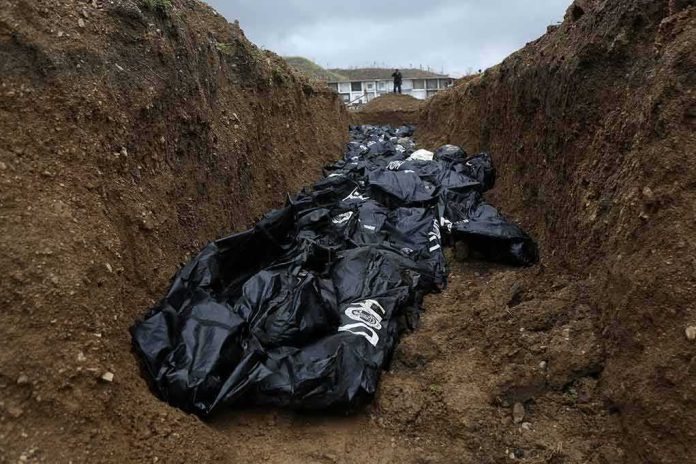
- The carcasses are reportedly buried rather than incinerated, in neglected pits often within one kilometer of homes and in areas of high groundwater, conditions that facilitate long‑term soil contamination and potential spread of disease.
- Kyiv characterizes this negligence or intent as “biological terrorism” and warns the burial sites could be used in a false‑flag operation to accuse Ukraine of biological weapons use.
- No independent international verification is currently possible in occupied Kherson; the claims rest on Ukrainian intelligence and are treated as “Ukraine says” reports by international media.
- The episode fits a broader pattern of reciprocal biological warfare accusations in the Ukraine conflict, highlighting how environmental hazards are weaponized both physically and rhetorically.
What Ukraine’s Intelligence Services Are Alleging in Kherson
Ukraine’s Defence Intelligence (DIU, also known as GUR) has issued a formal statement asserting that Russian occupation forces in the Kherson region are “deliberately creating conditions for the spread of anthrax.” At the core of this claim is a specific pattern of animal carcass disposal. According to DIU, livestock confirmed or suspected to be infected with anthrax are being transported to cattle burial grounds across the occupied territory rather than being incinerated, which is the standard bio‑security practice when dealing with highly resilient pathogens like Bacillus anthracis. Intelligence reporting identifies up to fifty burial sites in the occupied part of Kherson, with roughly ten singled out as especially dangerous due to their physical condition and proximity to settlements such as Askania‑Nova, Skadovsk, and Zaliznyi Port.
The description of those sites is detailed and consistent across multiple Ukrainian and secondary outlets: the pits are said to be in “extremely neglected condition,” lacking solid fencing, warning signage, or other protective structures, and located near roads and populated areas—sometimes less than one kilometer from residential buildings. Over time, the soil covering the carcasses subsides, potentially exposing contaminated material. Where groundwater tables are high, Ukrainian intelligence warns that anthrax spores from decomposing carcasses could be mobilized through water or brought to the surface, contaminating soils, pastures, and possibly wells. DIU frames this pattern not as isolated mismanagement, but as an uncontrolled burial regime that poses a direct threat to civilians and to Kherson’s agricultural sector.
Anthrax as a Weaponizable Environmental Hazard
To understand why animal carcass disposal matters so much, one has to appreciate anthrax’s biology and its history in warfare. Anthrax is caused by Bacillus anthracis, a spore‑forming bacterium capable of surviving in soil for decades—possibly up to a century—in the form of dormant spores that can re‑activate if ingested or inhaled by animals or humans. This durability is precisely why anthrax has appeared on virtually every modern list of potential biological warfare agents. NATO and other defense organizations classify it among the core bacterial threats with “bioweapon potential,” because the organism is easy to culture, the disease can be lethal, and the spores are environmentally persistent.
Historically, anthrax has rarely been deployed as a weapon on a large scale, but accidents in state bioweapons programs have illustrated its potential. The 1979 Sverdlovsk incident, in which an aerosol plume of anthrax spores escaped from a Soviet military facility, produced the deadliest documented outbreak of inhalation anthrax, with at least 66 fatalities and a 50‑kilometer downwind corridor of human and animal disease. Subsequent epidemiological and genomic investigations revealed this was a “perfectly ordinary” environmental strain used in a clandestine bioweapons program, not a specially engineered organism, underscoring that ordinary anthrax, if mishandled, is sufficient to generate catastrophic outcomes.
Against that backdrop, burial pits filled with infected carcasses near villages and farm fields are not a minor sanitary infraction. They represent concentrated reservoirs of spores in exactly the environments—pasturelands, water‑rich soils—where livestock and sometimes humans interact. In peacetime, veterinary services manage such burial sites carefully: pits are deep, lined or isolated from water, fenced off, and monitored for erosion. Failure to maintain those protections does not automatically equate to deliberate weaponization, but it does create conditions under which a pathogen recognized as a potential biowarfare agent can spread opportunistically.
Why DIU Calls It “Biological Terrorism” and Warns of False Flags
DIU’s statement goes beyond technical risk assessment to make a legal and political claim: it describes the “deliberate or negligent creation of conditions for an anthrax outbreak” as an act of biological terrorism against civilians in occupied territories. In contemporary arms control language, biological warfare is defined as the use of biological toxins or infectious agents with the intent to kill, harm, or incapacitate humans, animals, or plants in the context of war. Terrorism adds the dimension of targeting civilians for intimidation or coercion. The DIU framing hinges on two elements: the intentional transport of infected carcasses to inadequate burial sites, and their proximity to civilian communities, which together are alleged to show either deliberate harm or reckless disregard at a scale amounting to terror.
The second layer of the accusation is more explicitly strategic. DIU warns that Russia may exploit these very burial grounds to stage false‑flag operations: kinetic attacks (explosions, shelling) on the sites to aerosolize or expose spores, followed by information campaigns accusing Ukraine of using “biological weapons.” That concept aligns with a broader evolution of chemical and biological tools in hybrid warfare, where the utility of such agents lies as much in narrative leverage as in physical harm—creating panic, discrediting an adversary, or generating pretexts for escalation.
In the Ukraine conflict specifically, Russia has already spent considerable effort alleging U.S.–Ukrainian biological weapons programs via supposed “biolabs,” referencing pathogens like anthrax in materials submitted under the Biological Weapons Convention framework. Independent analyses have found no evidence to substantiate those claims, but they demonstrate how biothreat narratives are used as political instruments. Ukraine’s anthrax burial allegations, and its explicit anticipation of a false‑flag scenario, can be read in part as pre‑emptive counter‑narrative: not only warning of a genuine biological hazard, but inoculating international opinion against future Russian claims of Ukrainian bioweapons use.
Evidence, Verification, and the Limits of Wartime Transparency
Crucially, the Kherson anthrax story currently stands on a narrow evidentiary base. The primary source is DIU’s official statement, amplified by Ukrainian and international media that explicitly frame it as “Ukraine says” rather than as independently verified fact. There are no publicly available laboratory reports, soil sampling data, or third‑party inspections from organizations like WHO or FAO; occupied Kherson is not accessible to neutral health agencies, which limits the possibility of on‑site verification. We also lack open‑source satellite analysis that would either map the alleged 50 burial grounds or contradict their existence.
On the other side of the ledger, there is likewise no detailed refutation from Russian occupation authorities—no veterinary pathology documentation showing absence of anthrax in carcasses, no official assertion that carcasses are incinerated rather than buried, no geospatial rebuttal of claims that pits lie less than a kilometer from homes. Side B in this dispute, as captured in the research, consists more of general skepticism and the predictable narrative that Ukrainian biothreat claims are propaganda, rather than of concrete counter‑evidence. In that sense, the factual core—that there are burial sites of infected cattle in Kherson and that sanitary norms are being violated—is uncontested publicly, while the attribution of intent (“deliberately creating conditions”) and the legal characterization (“biological terrorism”) remain interpretive claims anchored in Ukrainian intelligence assessments.
For the reader, the practical implication is straightforward: the scenario described by DIU is technically plausible and consistent with known anthrax biology and with how occupation authorities sometimes cut corners on veterinary and environmental management. But until independent sampling or documentation emerges, it cannot be elevated to the same evidentiary status as, say, the Sverdlovsk accident, which was reconstructed in detail through epidemiology and genomics decades later.
Anthrax Burials in a Wider History of Livestock and War
Using livestock disposal practices as a vector of harm is not new, though it has rarely been acknowledged openly during conflicts. In many warzones, the first services to degrade are veterinary oversight and environmental health. Carcasses from outbreaks may be dumped or buried hurriedly to avoid resource costs, and trenches, bunkers, or roads are dug through contaminated lands without prior mapping of legacy burial sites. That combination can produce outbreaks without any sophisticated bioweapons program. A reported episode from the Zaporizhzhia region—where Russian troops allegedly contracted anthrax after digging trenches into an old cattle grave—illustrates how negligence alone can weaponize the environment; the pathogen does not care whether trench lines are dug intentionally into the pit or inadvertently.
Anthrax’s historic overlap with conflict is murky partly because accusations of deliberate use are hard to prove. Studies of the Rhodesian anthrax outbreak, for example, concluded that claims of intentional spread among cattle leading to human cases “have never been proved,” despite intense debate. That lesson cuts in both directions in Kherson: it cautions against premature certainty about deliberate Russian biological warfare, but it also underscores how difficult it is to secure neutral proof when an area is under military control and the pathogen in question is endemic to many agricultural regions.
Hybrid Warfare, Information Operations, and the Civilian Cost
The Kherson anthrax burial narrative sits squarely at the intersection of hybrid warfare and public health. Modern analyses of chemical and biological weapons risks emphasize that these agents can be woven into broader campaigns that fuse conventional military operations, cyber attacks, and information operations. In such campaigns, the value of a contaminated site, a toxic release, or a pathogen outbreak is often measured not primarily in immediate casualty counts but in the downstream effects on morale, trust, economic activity, and international support.
From Ukraine’s perspective, framing the burial practice as biological terrorism achieves several objectives. It raises the alarm for local populations and international donors about a concrete health risk. It reinforces a broader narrative of Russia as a serial violator of humanitarian and arms control norms, bolstering calls for sanctions and military aid. And it anticipates and discredits potential future Russian accusations of Ukrainian bioweapons use. From Russia’s perspective—judging from its existing biolab rhetoric—counter‑narratives are likely to label such claims as disinformation and to present any anthrax events as spontaneous or as the result of Ukrainian negligence or sabotage.
Lost in this contest of narratives are the civilians and farmers who live near those burial sites, whatever their precise number. For them, the distinction between deliberate biological warfare and reckless environmental mismanagement is morally important but biologically irrelevant. The spores in the soil behave the same either way. Livestock that graze contaminated pastures or drink contaminated water will sicken; humans handling or consuming infected meat or inhaling disturbed dust can develop cutaneous, gastrointestinal, or inhalational anthrax, each with serious health implications. In occupied territories, access to prophylaxis, diagnostics, and treatment is often constrained, magnifying the toll of any outbreak.
What This Episode Reveals About Biological Norms in Modern Conflict
Whether or not the Kherson carcass burials ultimately meet the strict definition of biological warfare under the Geneva Protocol or the Biological Weapons Convention, they expose the fragility of biological norms in protracted conflict. Those treaties ban the development, production, and use of biological weapons, but they say little about the gray zone where environmental hazards, neglected infrastructure, and opportunistic exploitation of disease intersect. A burial pit that violates veterinary standards is not, on its face, a banned weapon; yet if it is used as a staging ground for false‑flag attacks or deliberately left unsafe as a means of intimidation, it stretches the spirit of those norms.
Looking ahead, the most constructive responses lie not only in attribution but in resilience. Mapping and securing legacy cattle burial sites, investing in veterinary surveillance even in contested regions, and building rapid international mechanisms to investigate suspected deliberate biological events—all are part of the toolset envisioned by WHO and others for managing bioterror and biowarfare threats. As long as access to occupied territories remains blocked, those tools cannot be applied fully in Kherson. But the episode is a reminder to policymakers that biological security does not begin and end with sophisticated labs and engineered pathogens; it includes something as deceptively mundane as how we bury infected animals in wartime.
Sources:
feedpress.me, united24media.com, glavnoe.in.ua, mezha.net, washingtontimes.com, tridge.com, gur.gov.ua, instagram.com, x.com, kyivpost.com, euromaidanpress.com, news.liga.net, lieber.westpoint.edu, pmc.ncbi.nlm.nih.gov, en.wikipedia.org, ndupress.ndu.edu, youtube.com, gov.uk, carnegieendowment.org