
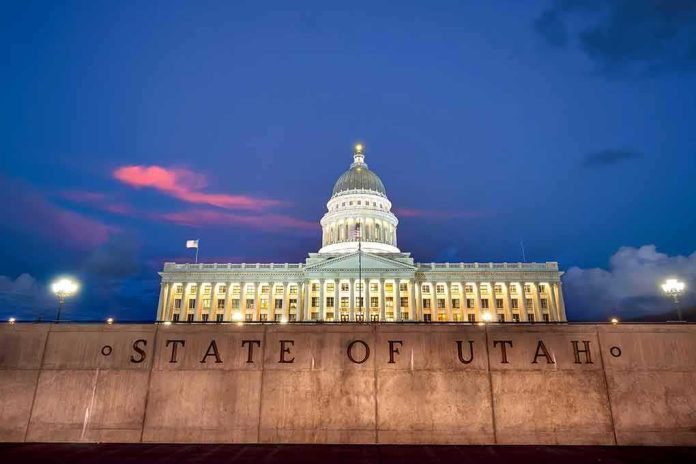
Utah’s fireworks ban landed because the state is already fighting fire on too many fronts at once.
Quick Take
- Governor Spencer Cox declared a state of emergency and temporarily banned personal fireworks through July 5.[10]
- State officials said Utah had more than 353 wildfires burning across more than 141,000 acres.[10]
- The Cottonwood Fire had burned more than 70,000 acres and remained 0 percent contained.[11]
- Officials said nearly 80 percent of Utah’s fires are human-caused, not natural.[10]
Fire Danger Forces a Statewide Crackdown
Governor Spencer Cox moved after Utah’s fire season turned severe and fast-moving. He declared a state of emergency and ordered a temporary ban on personal fireworks through July 5.[10] State Forester Jamie Barnes said the dry, hot, windy conditions left the state exposed to new ignitions. That warning carried real weight because one careless spark can now turn into a major blaze in minutes.
Officials said Utah was dealing with more than 353 active wildfires that had burned over 141,000 acres.[10] Barnes said the Cottonwood Fire had passed 70,000 acres and stayed 0 percent contained, while the Iron Fire had burned more than 37,000 acres and was only partly contained.[11] Those numbers show why leaders treated the holiday weekend as a public-safety problem, not a celebration issue.
Drought, Wind, and Human Ignitions Made the Risk Worse
Barnes said all 29 Utah counties were in severe drought, and 22 counties were in extreme drought.[11] He also warned that winds could reach 50 miles per hour while humidity fell into the single digits.[11] The National Weather Service in Salt Lake City later issued a rare “particularly dangerous situation” red flag warning, which matched the danger state officials were already describing.[8]
Utah officials also said nearly 80 percent of the fires were human-caused.[10] They listed common ignition sources such as dragging chains, debris burns, target shooting, and fireworks.[10] That matters because it shifts the debate from bad luck to bad behavior. When the land is this dry, even small mistakes can feed a fire that crews may not be able to stop quickly.
Enforcement Questions and Industry Pushback
Not everyone accepted the order without a fight. Brian Leahy, a co-owner of a personal fireworks company, said attorneys were reviewing the order and argued that no municipality could enforce it.[14] He also said his business would keep selling fireworks without restrictions.[14] His criticism raises a simple question: if sellers and buyers ignore the ban, how much protection will the state really get?
JUST IN: Mayor Mark Anderson announced Logan City’s full support for the statewide fireworks ban implemented yesterday by Utah Governor Spencer Cox. Personal fireworks are prohibited July 2–5, but the city's July 3 professional fireworks show will go on as planned. pic.twitter.com/xbct2duxsM
— KSL 5 TV (@KSL5TV) June 26, 2026
The company also warned that people might just move their fireworks use into remote desert areas, where fires can be harder to reach and harder to control.[14] That concern is not proof the ban is wrong, but it shows the risk of weak compliance. Governor Cox said Utah had set aside $120 million for fire suppression and rehabilitation, and federal aid could cover most suppression costs on federal lands.[10] He also said firefighting resources were stretched thin, with no type one hand crews available for new fires.[11]
Why the Order Matters Beyond Utah
Utah’s move reflects a broader truth that many Western states keep relearning the hard way. When drought, heat, and wind line up, fireworks stop being harmless fun and start becoming a real public threat. The order also highlights a larger tension between emergency power and personal freedom. Utah leaders used the state’s authority to protect lives and property, but the pushback shows how quickly officials can face resistance when they restrict a popular tradition.
For conservative readers, the bigger issue is common sense. A state does not shut down fireworks for politics when the ground is this dry and the fire crews are this thin. It acts because the danger is real, the margin for error is gone, and the cost of delay could be measured in homes, livelihoods, and possibly lives.
Sources:
[8] Web – Utah declares state of emergency, restricts fireworks as US largest …
[10] Web – Utah restricts fireworks, declares state of emergency as largest US …
[11] Web – Utah restricts fireworks, declares state of emergency as largest US …
[14] Web – Current Map | U.S. Drought Monitor