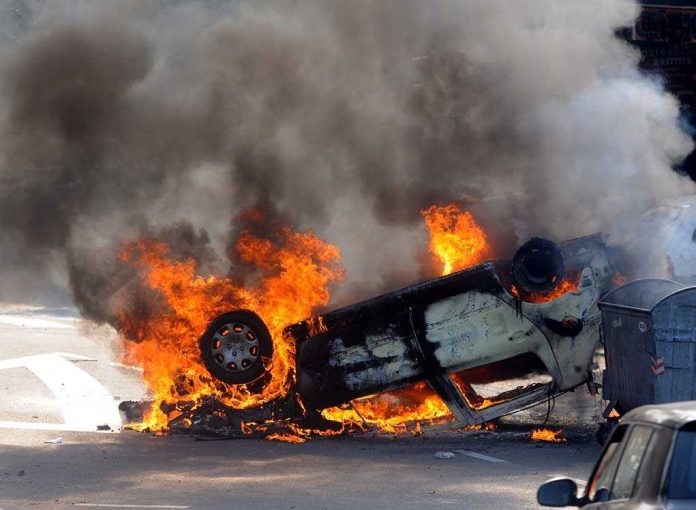
The central lesson of this incident is not that cars can burn—everyone knows they can—but that a roadside vehicle fire can become a wildfire in seconds when it happens in dry fuel, on a wind-exposed corridor, with nothing to stop the ignition from running into brush. In this case, the video-backed chain of events is unusually direct: a vehicle fire and apparent explosion were captured on camera, and officials said that fire became the Round Valley Wildfire, which burned about 30 acres.[1][2]
Intro Header
- The fire’s spread was fast, but the evidence for the vehicle-to-wildfire link is stronger than the usual social-media speculation around dramatic car fires.
- What remains unsettled is not whether the wildfire followed the vehicle incident, but what caused the vehicle fire in the first place.
- Arizona’s dry highway corridors are a known ignition environment; vehicle-related wildfires are not an outlier there.
- The useful question is mechanism, not spectacle: how a vehicle fire escapes containment and turns into a brush fire.
Why a vehicle fire can become a brush fire so quickly
Vehicle fires usually begin as mechanical, electrical, or fuel-system failures; the U.S. Fire Administration notes that mechanical and electrical issues, along with crashes, are common causes of vehicle fires.[6] Once a vehicle is burning on the shoulder of a highway, the fire does not need to be large to become dangerous. Tires, wiring insulation, fluids, plastics, and hot components can all contribute heat, embers, and radiant ignition. In a dry roadside environment, that is often enough to light grass or brush before a response crew can fully arrest the spread.[7][8]
That is why the visual drama of an explosion is less important than the physical setting. A burning vehicle on its own is usually a contained event; a burning vehicle beside cured vegetation is not. Arizona’s wildfire-prevention guidance explicitly lists vehicles driving or parking over dry vegetation as a recurring ignition source, alongside other human-caused causes such as dragging trailer chains and flat tires striking pavement.[8] The Round Valley incident fits that regional pattern. It is the combination of heat, roadside fuels, and rapid fire spread that turns an otherwise ordinary vehicle fire into a brush fire with acreage attached.
What the video and official reporting actually establish
The strongest part of the record is the timeline. FOX 10 Phoenix reported that “a vehicle on fire caused the Round Valley Wildfire near Fountain Hills” and that hotshot crews stopped the forward progress after it burned about 30 acres.[2] New York Post’s account likewise said a driver captured the moment a vehicle erupted in a fireball and that the explosion sparked the Round Valley Fire, temporarily shutting down both directions of State Route 87.[1] Those are not vague impressions; they are direct descriptions of a specific incident, on a specific road, on a specific afternoon.
The Arizona Department of Transportation’s statement, as relayed in the coverage, matters because it anchors the event in official traffic and closure reporting rather than pure eyewitness speculation.[2] That does not settle every forensic question, but it does settle the basic public fact pattern: a vehicle fire occurred, it was associated with an apparent explosion, and the resulting blaze became a 30-acre wildfire that forced a highway closure. The geographic detail also matters. State Route 87 has a history of vehicle-related roadside ignitions, so the incident is not an abstract anomaly; it happened on a corridor where dry vegetation and highway traffic regularly collide.[8][13]
What remains unknown: the cause of the vehicle fire itself
The evidentiary gap is narrow but important. The reports confirm that the vehicle fire caused the wildfire; they do not identify why the vehicle caught fire in the first place.[1][2] That distinction gets blurred constantly in public conversation. A fire can be real, causal, and documented without the root mechanical failure being immediately known. FOX 10 explicitly noted there was no word on what caused the car fire, and no immediate information on whether anyone was hurt.[2] In other words, the wildfire causation is established; the ignition origin inside the vehicle is not.
That uncertainty is exactly where rumor tends to breed. A dramatic fireball invites instant theories about batteries, fuel tanks, fraud, sabotage, or hidden defects. But the available record does not support choosing among those possibilities yet. The video shows the outside sequence, not the internal failure mode. It cannot distinguish thermal runaway in a lithium-ion pack from a conventional fuel-system failure, an overheated component, or another source of ignition. Absent a formal investigation, the honest position is simple: the vehicle caused the wildfire, but the vehicle’s own failure mechanism remains undetermined.[2][6][7]
Why Arizona highways are especially vulnerable
Arizona is not just a place where wildfires happen; it is a place where human activity repeatedly supplies the ignition. State wildfire-prevention guidance identifies vehicles as a major category of person-caused wildfire, alongside dragged chains, sparks from rims, cigarettes, and equipment use in dry vegetation.[8] ADOT has also pointed to prior SR 87 incidents where chains or trailers started brush fires in the same general area.[13] That history matters because it changes how we interpret the Round Valley fire: not as a freak accident outside the expected risk landscape, but as a textbook example of how transport corridors double as ignition corridors.
This is the deeper reason the story resonated. People tend to imagine wildfire as something that comes from lightning or a distant hillside. In places like central Arizona, the more common threat is banal and local: a vehicle, a hot component, a patch of grass, and a few seconds of exposure. Once the flame reaches fine fuels, wind and slope do the rest. That is why emergency managers care so much about roadside fuel management, shoulder conditions, and rapid containment. The first fire may be automotive. The second is ecological.
How to read the broader vehicle-fire debate without losing the facts
There is a lot of noise around vehicle fires in general, especially because lithium-ion battery failures in electric and hybrid vehicles have become a prominent subject in media coverage. But general anxiety about EV fires does not help explain this specific incident unless the vehicle type is known, and it is not established here.[6][7] That is the discipline many discussions miss: category-level risk is not the same as case-level proof. A public narrative about “vehicle fire crisis” can coexist with a much simpler explanation for one event—an ordinary car fire that ignited dry brush and escaped containment.
That distinction should shape how the incident is remembered. The Round Valley fire is best understood as a roadside ignition event with a clear downstream consequence, not as evidence for whichever theory is loudest in the moment. The video is compelling because it shows how quickly a fire can escape a vehicle and consume surrounding vegetation; the official reporting is compelling because it confirms that this is exactly what happened.[1][2] What it does not yet do is answer the engineering question of why the vehicle failed. For that, investigators would need wreckage analysis, witness detail, and ideally a formal fire report.
Sources:
[1] YouTube – Terrifying vehicle explosion appears to spark large wildfire. See …
[2] Web – Car explosion caught on camera, sparking the Round Valley Fire
[6] Web – Vehicle Fires: how they start, spread, and how to prevent them
[7] Web – Vehicle Fire Safety – USFA.FEMA.gov
[8] YouTube – Inside the LA Firestorm – The REAL Story | Full Documentary
[13] Web – So many wildfires in Arizona are caused by vehicles. The fire that …