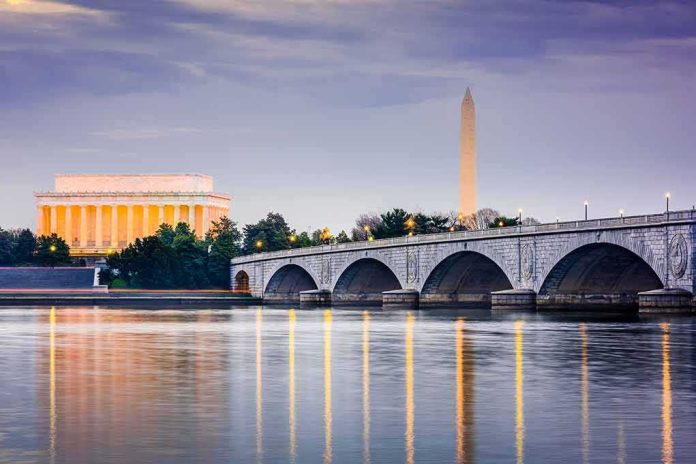
The real story here is not whether a dramatic punishment can be announced; it is whether the underlying conduct is actually vandalism, or something much more ordinary and bureaucratic: a renovation gone wrong, followed by a scramble to assign blame.
Key Points
- The public dispute centers on the Lincoln Memorial Reflecting Pool’s newly altered surface and who, if anyone, caused the damage.
- Trump’s harsh rhetoric fits a long-standing federal-monument law-and-order frame, including the idea that damaging federal property can trigger severe penalties.
- The available reporting is stronger on uncertainty than on vandalism: multiple outlets say the cause of the peeling material is unknown.[9][10]
- The most consequential fact is that visible deterioration appeared shortly after a costly renovation, which makes a workmanship or materials failure at least as plausible as intentional sabotage.[1][2]
What the dispute is really about
The Lincoln Memorial Reflecting Pool has become a case study in how quickly a public monument can be pulled into a larger argument about competence, stewardship, and political narrative. Trump’s side presents the peeling surface as vandalism and treats the response as a criminal matter severe enough to justify years in prison; the counter-record is much narrower and more restrained, saying only that there is visible damage and that its cause is not established.[19][20] That distinction matters. Damage is not the same as vandalism, and a federal penalty is not self-executing simply because a high-profile figure wants one.
On the evidence available, the strongest fact is the simplest one: the pool was recently renovated, filled, and then observed to have blue material peeling away from the bottom.[1][9][10] That sequence points first to a project problem. It may involve paint, sealant, liner material, surface preparation, or some interaction with the algae treatment described in reporting, but the core point is that the public record does not clearly establish a malicious act.[2][9][10] In any serious analysis, uncertainty at the level of causation is decisive.
Why the 10-year language sounds familiar
The reported threat of a 10-year prison sentence is not a random flourish. Trump has previously used the protection of monuments as a law-and-order theme, and the federal statute governing willful injury to government property can indeed carry up to 10 years’ imprisonment.[19] That legal ceiling, however, is only relevant if prosecutors can prove the elements of a willful property crime. The existence of a maximum penalty does not prove a crime occurred, and it does not convert a disputed maintenance failure into a federal vandalism case.
This is why the rhetoric travels farther than the facts. Monument controversies are emotionally potent because they involve visible symbols in public space, where the line between damage, neglect, protest, and sabotage can become a political weapon before investigators finish sorting out the evidence.[20][25] Trump’s framing works especially well in that environment: it casts him as a defender of national heritage while shifting attention away from the obvious question of whether the renovation itself was sound.
The renovation itself is the central context
The pool’s recent history is essential. Reporting indicates the project cost more than $14 million, far above the earlier estimate, and the work was supposed to refresh a prominent federal landscape feature, not create a new controversy over peeling material.[1] The same body of reporting also notes that the pool had already been rebuilt in 2012 with sustainable water-conservation features, underscoring that this is not a neglected, decades-abandoned basin; it is an actively managed public asset.[5] When a surface fails soon after intervention, the burden falls on the intervention, not on conjecture about vandals.
There is also a technical reason to be skeptical of the vandalism claim. Algae management, chemical treatment, surface coatings, and water-filled concrete structures are unforgiving combinations; if the preparation, adhesion, or chemical compatibility is wrong, failure can show up quickly. That is why several reports stressed that the detaching blue material could be paint or sealant and that the cause remained uncertain.[10][9] In plain terms, the visible symptom is real, but the mechanism is still an open question.
How to read the competing claims
The pro-vandalism case rests on assertion and atmosphere. It points to an arrest reported by media, then leaps from an alleged interaction with the pool surface to a broad claim that the pool was intentionally damaged. But the contemporaneous reporting summarized in the research package does not show a clean evidentiary chain proving that the peeling material was caused by a deliberate act. Indeed, PBS/AP reporting said Trump offered no evidence for his accusation and that investigators were still sorting the matter out.[20] That is the difference between accusation and proof.
The anti-vandalism case is more disciplined. It does not need to establish the exact engineering failure to be persuasive; it only needs to show that the public record does not support certainty about sabotage. Multiple outlets say the cause of the detachment was unknown, and the timing—days after painting and refilling—makes a renovation-related explanation highly plausible.[9][10] In a dispute like this, the more modest account is usually the stronger one because it matches what is actually known.
Trump’s claiming the Lincoln Memorial Reflecting Pool was vandalized shortly after a nearly $15 million renovation he pushed for the nation’s 250th anniversary. The pool turned fluorescent green with algae and showed blue paint or liner peeling off right after it was refilled… pic.twitter.com/KFWEDOOnFF
— Patricia 🇺🇸 (@1109Patricia) June 21, 2026
Why this matters beyond one reflecting pool
Federal monuments are not just objects; they are political stage sets. When visible deterioration appears at a place like the Lincoln Memorial Reflecting Pool, competing narratives rush in because the site symbolizes national memory, public competence, and institutional authority all at once. That is why a surface defect can instantly become a morality play about lawlessness or mismanagement. The factual problem is much smaller than the symbolic one, but the symbolic one is what drives the rhetoric.
For readers trying to make sense of this kind of episode, the right discipline is to separate three questions that are often blurred together: what is visibly happening, what caused it, and what legal category best fits it. Here, the first question is answered plainly enough—something is peeling or detaching from the pool’s newly renovated surface.[9][10] The second is unresolved. The third, therefore, cannot responsibly be settled by political declaration alone.
Sources:
[1] Web – JUST IN: President Trump threatens a 10-year prison sentence after …
[2] Web – Trump Finishes $14M Reflecting Pool Renovation Here’s the Before …
[5] Web – NEW: Trump spent $14 million to repaint the Reflecting Pool. This is …
[9] Web – : bit.ly/4ont18z Trump’s $14 million renovation to the … – Facebook
[10] Web – Paint Peels Off Lincoln Memorial Reflecting Pool Just Days … – …
[19] Web – Nation Experiencing Pattern Of Vandalism To Black Monuments
[20] Web – Executive Order on Protecting American Monuments, Memorials …
[25] Web – Trump signs executive order to punish vandalism against federal …