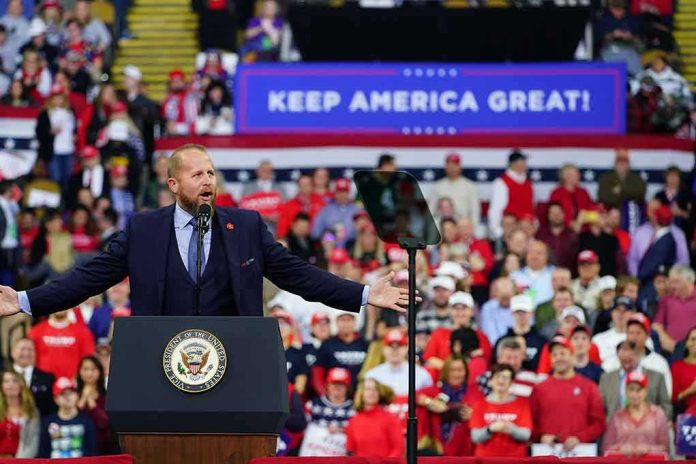
A $1.7 billion “weaponization” fund sounds like payback for patriots, but the paper trail so far looks more like a political Rorschach test than a finished rescue plan.
Story Snapshot
- Trump allies promote a $1.7 billion fund for “weaponization” victims, including January 6 defendants.
- News reporting describes it as a proposed settlement tied to dropping a $10 billion Internal Revenue Service lawsuit, not a finalized program.
- The idea borrows language from real federal victim-compensation funds, but lacks the same statutory backbone and safeguards.
- Whether it becomes relief for the wronged or a partisan slush fund will hinge on law, transparency, and who defines “victim.”
What The $1.7 Billion Fund Is Supposed To Be
Supporters online describe President Trump announcing a $1.7 billion “weaponization” fund to compensate Americans targeted by the Biden Department of Justice, explicitly including January 6 defendants. That description echoes earlier Trump rhetoric about creating victim-compensation funds using seized assets to pay people hurt by crime or government abuse.[1] The pitch taps into a deeply felt sense on the right that federal law enforcement has been selectively weaponized against conservatives, pro-lifers, and Trump-world figures.
However, the clearest on-the-record reporting from major outlets paints this fund as part of settlement talks, not a signed, operating program. According to that reporting, Trump was expected to drop a $10 billion lawsuit against the Internal Revenue Service over a 2019 tax-return leak in exchange for creating a $1.7 billion compensation mechanism for people claiming harm from Biden-era “weaponization” of the legal system. That is a dramatic concept, but “expected” and “talks” are not the same as enacted law or wired money.
How It Would Work On Paper, And Why Critics Call It A Slush Fund
Reports describe a five-member commission with authority to distribute roughly $1.7 billion in taxpayer money to claimants who say they were targeted under Biden, including about 1,600 people charged in connection with the January 6 Capitol attack and potentially Trump-associated entities.[1] Trump would reportedly have power to remove commissioners without cause, and the body would not need to disclose detailed procedures or a public list of recipients.[1] Critics, including watchdog groups, argue that such unchecked discretion resembles a presidentially controlled slush fund, not a neutral victim program.[3]
From a conservative rule-of-law perspective, that criticism lands for a simple reason: if one man can quietly decide who is a victim and how much they get, using taxpayer dollars, the door swings wide open for favoritism. Liberals call it corruption; a principled conservative should call it bad process. Even if you believe federal agencies abused power under Biden, the remedy should mirror how America usually compensates victims: through clear statutes, transparent rules, and independent review, not backroom discretion.
How Real Federal Victim Funds Actually Look
Compare the proposed “weaponization” fund with the September 11th Victim Compensation Fund. Congress passed a law, the Never Forget the Heroes Act, which President Trump signed, permanently authorizing that fund and appropriating “such funds as may be necessary” to pay all approved claims.[2] The fund operates under detailed regulations, eligibility standards, and published procedures. Families may disagree with individual awards, but no one can fairly say the money is handed out according to a President’s personal favorites list.
The Department of Justice’s Office for Victims of Crime is another example. The office administers the Crime Victims Fund, a long-standing pool that supports services for people harmed by violent crime. Dollars flow through formula-based grants and competitive awards, not through ad hoc decisions about who counts as a “friend” of the administration. When the Trump Justice Department tried to tie some Victims of Crime Act grants to immigration-enforcement cooperation, a coalition of states sued and the administration backed down.[3] That fight shows what happens when Washington appears to politicize victim funding: courts and states push back hard.
Weaponization, Alleged Victims, And The Eligibility Problem
The heartburn around the $1.7 billion idea is not only the money; it is the definition of “victim.” The reporting suggests eligibility could extend to January 6 defendants and others who claim they were harmed by Biden-era prosecutions or investigations.[1] Yet nothing in the supplied record shows courts formally declaring these people wrongfully prosecuted or affirming that Department of Justice line attorneys acted with partisan intent. Without such findings, “weaponization victim” becomes a political label, not a legal status, which is a shaky foundation for taxpayer-funded payouts.
President Trump Announces Massive $1.7 Billion “Weaponization” Fund for Americans Targeted by Biden DOJ, Including J6ershttps://t.co/Jrfxf78p0S
— Real News Central (@RealNewsCntrl) May 15, 2026
Supporters will argue that when the system is corrupt, you will rarely get the nice, clean judicial ruling that admits it; you need political action to make victims whole. That instinct lines up with a healthy skepticism of bureaucracies that many conservatives share. But if you short-circuit process entirely, you just swap one perceived abuse for another. The left weaponized prosecutions; the right answers by weaponizing compensation. That is not restorative justice; it is alternating spoils.
Where Principle And Power Collide Next
Americans over 40 have seen this movie before: Washington uses real suffering as the backdrop for power plays. The $1.7 billion “weaponization” fund, as currently described, sits uncomfortably between legitimate grievance and opportunistic design. On one hand, federal victim compensation is a legitimate, established tool when government or criminals cause harm.[2] On the other, shifting billions from the Treasury Department’s Judgment Fund into a largely opaque body answerable to one politician invites abuse claims that will make Benghazi and Fast and Furious look tame by comparison.[1]
The path forward that respects conservative values looks different. If Biden-era agencies truly targeted citizens for politics, Congress should investigate, hold public hearings, and, if warranted, legislate a narrow, rule-bound fund for demonstrably wronged individuals, subject to independent review and strict transparency. That is harder than blasting out viral posts about a $1.7 billion rescue of “our people,” but it is how you turn outrage into lasting reform rather than just the next chapter in America’s endless payback saga.
Sources:
[1] Web – President Donald Trump stalls on promise to create a fund for …
[2] Web – September 11th Victim Compensation Fund to End Award …
[3] Web – Trump Administration Abandons Unlawful Conditions on Victims of …