
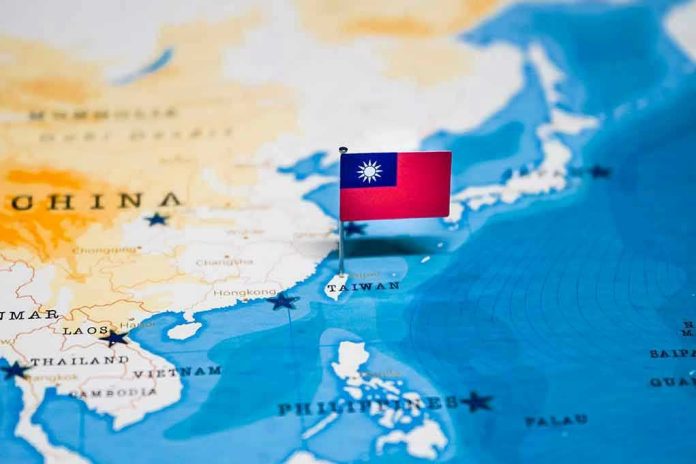
When a sitting American president openly puts Taiwan’s weapons on the bargaining table with China, it signals how far Washington’s security promises can be pulled into backroom deals most citizens will never see.
Story Snapshot
- President Donald Trump says he will discuss United States arms sales to Taiwan directly with Chinese President Xi Jinping during their Beijing summit.
- Chinese officials publicly warn Washington to stop military ties with Taiwan, calling the island an internal Chinese matter.
- Reports indicate a senior United States official insists there is no change in Taiwan policy, but no detailed arms package is confirmed.
- Taiwan has approved a major special defense budget, banking on continued United States weapons deliveries as China ramps up pressure.
Trump Puts Taiwan Weapons on the Summit Agenda
President Donald Trump told reporters ahead of his Beijing trip that he would talk with Chinese leader Xi Jinping about continuing United States arms sales to Taiwan, confirming the issue is formally on the summit agenda.[1] Trump acknowledged that Xi “would like us not to” sell weapons to the island but said he would still have that discussion.[1] Broadcast reports from Beijing describe a packed schedule focused on the Iran war, trade disputes, technology tensions, and United States arms sales to Taiwan.[4]
Television coverage shows Trump arriving in Beijing and being greeted with full ceremonial honors before heading into talks that both sides portray as “high stakes.”[4] United States outlets report that Taiwan arms sales sit alongside tariff talks and artificial intelligence cooperation in the negotiating mix, raising concern that security commitments could be treated like another chip in a sprawling deal.[4] For Americans already skeptical of globalism and elite diplomacy, that transactional framing deepens distrust in Washington’s priorities.
China Draws a Public Red Line on Taiwan
Chinese government spokespeople responded before the summit by repeating a familiar but firm warning: Beijing “firmly opposes” United States weapons sales and any military ties with Taiwan, which it calls an internal Chinese matter. State-linked coverage frames the issue as a sovereignty violation, not just a policy disagreement, insisting foreign countries must stop “interfering” in what Beijing views as a domestic question. Trump’s own remarks, acknowledging Xi’s objection, effectively confirm an active Chinese protest campaign.[1][3]
Chinese opposition underscores why Taiwan routinely becomes a flashpoint whenever Washington and Beijing meet, regardless of which party occupies the White House. For Americans on both left and right, this episode highlights how sensitive decisions about war and peace can be shaped by quiet pressure from another authoritarian government that does not answer to United States voters. Yet citizens receive only clipped soundbites rather than detailed explanations of what, exactly, is being bargained over in their name.
United States Policy Signals Versus Missing Paper Trail
Reports from outlets focused on China policy say a senior United States official has stressed there is “no change” in Washington’s Taiwan policy despite Chinese pressure, suggesting Trump’s rhetoric does not automatically equal a policy reversal.[2][3] That continuity likely refers to long-standing commitments under United States law to provide Taiwan with defensive weapons and to resist coercion that jeopardizes the island’s security. However, the available public record shows no new presidential directive, State Department memo, or Pentagon release spelling out specific arms packages tied to this summit.
Media coverage so far documents intent to discuss the issue rather than any signed agreement or canceled sale.[1][4] No source in the set identifies which weapons systems, dollar amounts, or delivery timelines are truly on the table.[1][2][4] That information gap matters for a public already convinced that “the deep state” and permanent bureaucracy make life‑or‑death decisions behind closed doors. When the government asks citizens to trust its Taiwan commitments while withholding basic details, it feeds the sense that elites expect blind faith instead of informed consent.
Taiwan’s Defense Push and Global Jitters
Coverage from Taipei shows Taiwan’s parliament approving a roughly twenty-five billion dollar special defense budget that relies heavily on United States arms purchases.[2][3] Legislators argue over how much to spend on foreign systems versus indigenous programs, but both sides frame the urgency around deterring a potential Chinese attack.[3] Taiwan’s president warns that any gap or delay in the planned buildup will weaken the island’s overall defense posture and increase shared security risks for its people.[3]
Taiwan watches Trump-Xi summit nervously, hoping island does not become “the surprise” in Beijing. Trump plans to discuss future US arms sales to Taiwan directly with Xi, raising fresh anxiety in Taipei over one of the most sensitive meetings in years. https://t.co/pw24pwQdK4
— Will Ripley (@willripleyCNN) May 14, 2026
Global markets and regional governments are watching the Trump–Xi meeting closely, worried that Taiwan’s security could be folded into broader “grand bargains” on trade, energy, and technology.[4] Reports note that Trump himself highlights Taiwan’s geography, pointing out it sits about sixty-seven miles from China but thousands of miles from the United States, framing arms sales as a strategic calculation rather than an automatic promise.[1] For many Americans who already feel abandoned by both parties, that kind of distance math reinforces a fear that far‑off deals may once again override hard‑won principles.
Sources:
[1] YouTube – Trump Says He’ll Talk About Selling Arms to Taiwan at Xi Summit
[2] Web – Ahead of Trump-Xi summit, China warns on US arms sales to Taiwan
[3] YouTube – Trump in China to discuss Iran war, trade and arms sales …
[4] YouTube – Trump arrives in Beijing for talks with China’s Xi on Iran …