
U.S. military forces have fired on and disabled multiple Iranian-flagged oil tankers in the Gulf of Oman over a five-day period, raising questions about the legality of the blockade and whether enforcement actions risk destabilizing a fragile ceasefire.
Story Snapshot
- U.S. Central Command (CENTCOM) disabled three Iranian-flagged vessels—M/T Hasna, M/T Sea Star III, and M/T Sevda—between May 6 and May 8, 2026, by firing precision munitions at smokestacks and rudders.
- CENTCOM reports over 50 commercial vessels have been redirected and multiple disabled since the blockade began, with crews issued multiple warnings before use of force.
- The blockade’s international legal authority remains undisclosed; no UN Security Council resolutions, declarations of war, or neutral state notifications have been publicly released.
- Iranian state media frames U.S. actions as unprovoked aggression, while Iran has seized vessels and conducted retaliatory strikes, creating a tit-for-tat escalation despite ceasefire agreements.
Precision Fire and Blockade Enforcement
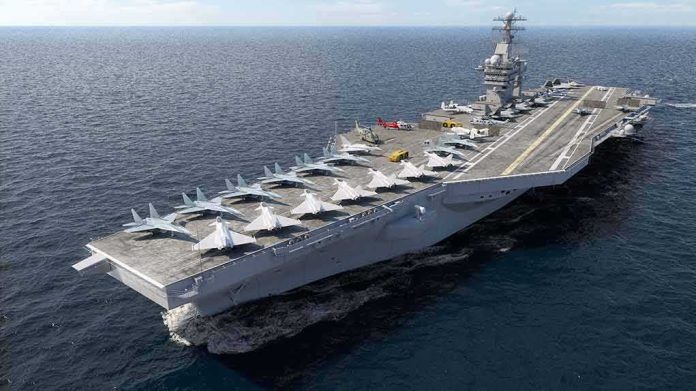
On May 6, 2026, an F/A-18 Super Hornet from USS Abraham Lincoln (CVN 72) fired 20mm cannon rounds into the rudder of the Iranian-flagged M/T Hasna after the vessel’s crew failed to comply with repeated warnings over several hours [1]. Two days later, on May 8, a Navy F/A-18 Super Hornet from USS George H.W. Bush (CVN 77) disabled both M/T Sea Star III and M/T Sevda by firing precision munitions into their smokestacks as both vessels attempted to enter Iranian ports [1]. CENTCOM stated all three vessels ceased transiting to Iran following the disabling actions.
Scope of Blockade Enforcement Operations
CENTCOM enforcement actions extend beyond the three disabled tankers. According to military officials, over 50 commercial vessels have been redirected to ensure compliance with the blockade, and multiple additional vessels have been disabled [1]. An earlier incident on April 19, 2026, involved USS Spruance (DDG 111), which fired 5-inch rounds from its MK 45 gun into the engine room of M/V Touska after the vessel’s crew refused to comply with warnings over a six-hour period [3]. U.S. Marines from the 31st Marine Expeditionary Unit boarded the containership M/V Blue Star III in late April, searched it, and released it after determining its voyage would not include an Iranian port call [4].
Unanswered Questions on Blockade Authority
While CENTCOM press releases assert that vessels violated “the ongoing U.S. blockade,” no public documentation has been released establishing the blockade’s international legal foundation under the United Nations Convention on the Law of the Sea (UNCLOS) or other maritime law frameworks [1][3]. No UN Security Council resolutions, declarations of war, or formal notifications to neutral states have been disclosed. The vessels are described as “Iranian-flagged” and “unladen,” but cargo manifests, ownership records, or independent verification from maritime registries have not been provided to corroborate the claims [1]. No crew statements, depositions, or post-incident forensic reports confirming receipt of warnings or explaining non-compliance have been released.
Escalation Amid Ceasefire Tensions
The U.S. enforcement actions occur against a backdrop of rising tensions despite a ceasefire agreement. Iranian state media has accused the United States of firing first on Iranian-flagged tankers and has reported that Iranian forces responded with retaliatory strikes. Iran has also seized vessels in the Sea of Oman, creating a cycle of mutual accusations and counter-strikes [6]. Iranian officials have demanded that the U.S. lift the blockade before opening negotiations on the Strait of Hormuz, positioning American enforcement as an obstacle to peace. Saudi Arabia has reportedly barred the United States from using the kingdom’s airspace for “Project Freedom,” signaling hesitancy among key Gulf partners to support the blockade operations.
The Broader Pattern of Maritime Disputes
Naval blockade and interdiction disputes in contested chokepoints have a long history of generating competing legal and political narratives. Enforcing powers claim lawful blockade authority while challengers frame interceptions as unlawful aggression or piracy. The Persian Gulf has been a focal point for such friction; documented U.S.-Iran maritime incidents have escalated from warning shots to disabling fire and boardings over decades. Whether the current blockade enforcement strengthens or undermines the ceasefire remains contested, with both Washington and Tehran accusing the other of violating the agreement and threatening further escalation.
Sources:
[1] U.S. Disables 2 More Vessels Violating Blockade in Gulf of Oman
[3] U.S. Forces Disable Vessel Attempting to Enter Iranian Port, Violate …