
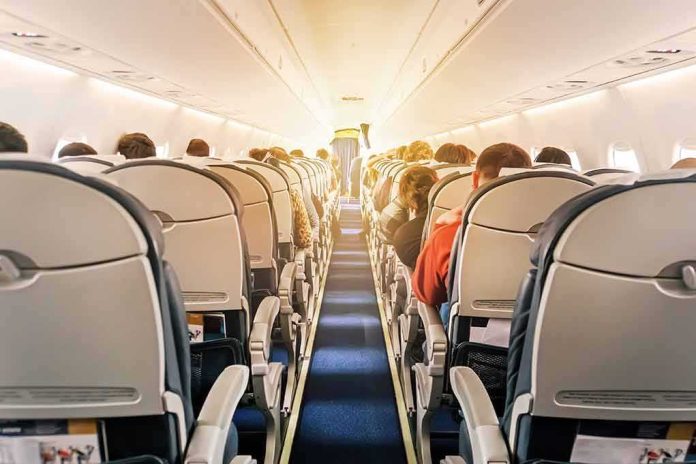
An airplane cabin at 35,000 feet is one of the few remaining spaces where a stranger’s bad night becomes everyone’s problem, with no door to close and nowhere to walk away to — which is exactly what played out aboard American Airlines Flight 1779 on September 11, when a passenger’s alleged intoxicated conduct forced a flight crew into emergency protocol and a law enforcement meeting on the tarmac.
Key Points
- Katy Inzer, 46, of Edgewater, Maryland, is accused of removing her pants and masturbating roughly 20 minutes into American Airlines Flight 1779 from Baltimore to Miami on September 11.
- A Miami-Dade Sheriff’s Office incident report says a fellow passenger alerted a flight attendant, and deputies who met the aircraft on landing noted signs of intoxication, including a strong odor of alcohol and bloodshot eyes.
- A witness told police he heard “strange loud moaning sounds” and saw Inzer partially undressed with her legs pressed against the cabin window.
- Because the alleged conduct occurred mid-flight, the matter was referred to the FBI, which holds jurisdiction over crimes committed aboard aircraft in U.S. airspace.
- The incident fits a documented, years-long pattern of unruly-passenger cases that airlines and the FAA track closely, even as overall rates have fallen sharply since their 2021 peak.
What Happened Aboard Flight 1779
The flight departed Baltimore/Washington International Thurgood Marshall Airport bound for Miami International Airport on the evening of September 11, operating as an Airbus A319. According to a Miami-Dade Sheriff’s Office incident report cited across multiple news organizations, a 61-year-old male passenger approached a flight attendant about twenty minutes after takeoff and reported that the woman seated in 9D had “remove(d) her pants and began to actively masturbate while making inappropriate sounds.” A separate witness account obtained by TMZ describes a husband and wife seated nearby hearing “strange loud moaning sounds,” with the husband turning to see a partially undressed Inzer touching herself with her legs pressed against the window.
The lead flight attendant reportedly confirmed to cockpit crew that the passenger had become fully undressed, a detail relayed to American Airlines’ ground operations team through the Aircraft Communications Addressing and Reporting System — the short, pre-formatted digital messaging link crews use to notify dispatch of in-flight developments without broadcasting over radio frequencies monitored by other aircraft. That triggered American’s Integrated Operations Center to arrange for law enforcement to meet the aircraft on arrival, a standard escalation path for onboard incidents that fall short of justifying a diversion but still require ground intervention. The aircraft did not divert and completed its scheduled route to Miami.
How Law Enforcement and the Airline Responded on Landing
Miami-Dade Sheriff’s deputies met Flight 1779 at the gate and questioned Inzer after passengers deplaned. The incident report describes deputies observing a “strong odor of alcoholic beverage” and bloodshot eyes, standard field indicators officers use to document suspected impairment before any formal testing occurs. Because the alleged conduct took place while the aircraft was in flight — placing it under federal rather than purely local jurisdiction — the Sheriff’s Office forwarded the matter to the FBI, consistent with the bureau’s established role in prosecuting crimes committed aboard commercial aircraft.
Separate reporting indicates Inzer told officers she had consumed “several drinks” during a two-hour ground delay in Baltimore before boarding, and that she had no memory of the flight itself, believing she had been asleep. That account, if accurate, would help explain the deputies’ field observations without resolving the underlying allegation, since recollection and intoxication are distinct from the conduct witnesses described to crew and to each other in real time.
A Pattern the Industry Already Tracks Closely
Incidents like this one do not occur in a vacuum; they occur against a backdrop the Federal Aviation Administration has spent four years trying to measure and suppress. Unruly-passenger reports spiked during the pandemic, peaking near 6,000 cases in 2021 — a 492 percent jump from roughly 1,000 reports the year before — driven overwhelmingly by mask-related confrontations. The rate has since fallen more than 80 percent from that 2021 high, and the FAA has referred over 310 of the most serious cases to the FBI for criminal prosecution since late 2021. Alcohol remains a consistently cited factor in disruptive-passenger incidents internationally, implicated in a meaningful share of reported cases even as overall volume declines.
Sexual misconduct cases occupy a narrower, more legally fraught corner of that broader category. A passenger who masturbated on a 2016 Delta flight from Myrtle Beach to Detroit was later convicted of simple assault and indecent exposure after a lawsuit sought $10 million in damages, establishing that courts treat such conduct as criminal exposure rather than a mere civility violation. More recently, passengers on United Airlines flights have separately reported being seated next to men masturbating in view of them, with one traveler receiving only a $100 flight credit against a $400 fare and no indication the offending passenger faced consequences before deplaning — episodes that have drawn renewed criticism of how inconsistently airlines intervene once a flight attendant is alerted mid-air.
😱 Mile High Club💦On American Airlines ✈️ Flight 1779 featuring Katy Inzer. A Maryland woman is reportedly under FBI review following an alleged sexual incident aboard a flight from Baltimore to Miami. The 46-year-old of Edgewater masturmabated & moaned prompting complaints 🤣🤷 pic.twitter.com/lZ9aYDzk4m
— Cassandra Pluto ⚑☭ (@cassandra_pluto) October 6, 2026
What the Allegation Means Going Forward
The Flight 1779 case is, at this stage, an allegation documented in a police incident report and corroborated by witness statements to officers — not a finalized criminal disposition, and no court filing detailing formal charges has surfaced publicly. What is firmly established is the sequence of events as relayed by the flight crew, the responding deputies, and the passengers seated nearest Inzer, all of which point to the same underlying narrative independent of one another’s phrasing. For American Airlines and its peers, the episode reinforces why crews train to de-escalate and document rather than confront, and why FBI referral — not merely local citation — is the default response whenever alleged sexual misconduct occurs above U.S. airspace. For passengers, it is a reminder that a sealed aluminum tube at cruising altitude offers crew only limited tools, and law enforcement only the ground, to resolve what happens in between.
Sources:
thegatewaypundit.com, breitbart.com, newsbreak.com, express.co.uk, tmz.com