

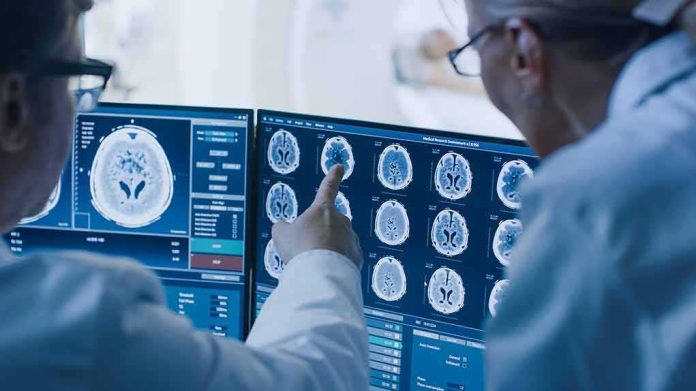
The headline promise isn’t “mind reading”; the durable significance is that researchers can now reconstruct, with surprising structural and semantic fidelity, what a person is looking at from noninvasive brain scans—an engineering milestone that clarifies how far decoding perception has come and what practical limits still govern it.
The Short Version
- Brain-IT, developed at the Weizmann Institute, reconstructs images a person is viewing from fMRI activity with markedly improved semantic and structural accuracy over prior methods.
- The system marries a brain-to-latent encoder with a modern image generator, using a specialized transformer to align noisy voxel patterns with visual features.
- It advances a mature line of work in fMRI-based visual reconstruction; the achievement is real, but it decodes perception under experimental constraints—not private thoughts or memories.
- Progress hinges on data quality, individualized calibration, and the physics of fMRI; those same limits shape near-term applications and privacy debates.
What Brain-IT Actually Does: Decoding Perception, Not Reading Minds
Brain-IT is an image reconstruction pipeline: a participant views natural images in an MRI scanner; the system reads the resulting fMRI activity from visual cortex; a learned mapping converts that multivoxel pattern into a compact representation suited for a generative image model; and the generator synthesizes an image that matches the scene’s layout and meaning—the difference between “a red jacket on snow” and “a dog on grass”—more faithfully than prior approaches. In peer-reviewed venue terms, the work has been accepted to ICLR, a leading machine learning conference, and its authors report superior reconstructions by both objective metrics and human judgments of semantic match.
This capability doesn’t extract arbitrary thoughts. fMRI detects blood-oxygen-level dependent (BOLD) changes—a sluggish proxy for neural activity—within voxels measuring millions of neurons; the readout is too coarse and too slow for inner monologue or fleeting imagery. Within that constraint, however, the visual cortex encodes rich structure about what the eyes see; modern generative models are finally good enough to meet the brain halfway and render a plausible picture from those signals.
How It Works: From Voxel Patterns to Images
The technical crux is alignment: bridging noisy, individual-specific brain measurements and the “language” of images used by today’s generators. Brain-IT tackles this with a Brain-Interaction Transformer—an architecture designed to model relationships across tens of thousands of voxels, distill them into a semantically meaningful latent code, and interface with a diffusion-style image generator. In practice, that means: (1) learn a subject-specific encoder that maps fMRI activity to a multimodal latent space where semantic categories and spatial contours are disentangled, and (2) condition a generator on that code so it draws images that match both “what it is” and “where it is” in the scene.
This bidirectional framing matters. Because the model can also predict expected brain activity given an image, researchers can probe which visual features drive which cortical patterns—an experimental lever that deepens our understanding of human vision as much as it improves pictures. Surveys of the field emphasize that most effective pipelines decode into the latent spaces of pretrained vision or generative networks and then render images from there; direct pixel-wise inversion from fMRI alone remains intractable given signal quality and sample sizes.
Where This Fits in the Field: A Real Advance on a Mature Path
Image reconstruction from brain activity is no longer an outlier; it’s a defined subfield with recurring constraints. Reviews catalog the standard bottlenecks: limited paired datasets, inter-subject variability that requires individualized training, fMRI’s low temporal resolution, and noise that blurs fine detail. The most successful methods leverage deep networks to decode high-level features—edges, textures, object identity—then rely on powerful generators to “fill in” photorealism while staying tethered to the decoded semantics and structure.
Against that landscape, Brain-IT’s claim to novelty is credible: better alignment of semantic and structural channels yields reconstructions that look less like generic “best guesses” and more like the specific image the participant saw, as judged by standard metrics and visual inspection. That is exactly the kind of incremental but meaningful step that moves a mature field forward without changing its fundamental limits.
Boundaries and Misconceptions: What It Cannot Do (Yet)
Popular headlines often blur “reconstructing what you’re looking at” with “reading your thoughts.” Technically and ethically, the distinction is nonnegotiable. Today’s reconstructions depend on: (a) explicit cooperation—subjects spend hours in a scanner to collect training data that tie their idiosyncratic cortical patterns to known images; (b) the presence of an external visual stimulus, not a spontaneous memory; and (c) relatively controlled laboratory conditions that minimize motion and maintain attention. Without that calibration and context, performance collapses. With it, systems can recover meaningful scene content—but not inner speech or unconstrained daydreams.
fMRI’s physics are the primary limiter. BOLD signals lag neural spikes by seconds and average over large tissue volumes; fine spatial details and rapid dynamics are smeared or lost. State-of-the-art diffusion models can plausibly “restore” details that the brain activity suggests at a coarse level, but those are educated inferences, not hidden truths pulled directly from cortex. Scholarly analyses of mind-reading claims repeatedly find that public narratives overreach the operational scope of the methods; Brain-IT marks real progress within those boundaries.
Why It Matters: Scientific Payoffs, Practical Uses, and Privacy
Scientifically, improved reconstruction is a probe into the brain’s representational geometry—how populations of neurons encode edges, textures, objects, and scenes—and a powerful testbed for comparing biological and artificial vision. Practically, noninvasive decoding of perceived images is a stepping stone toward communication aids for people who cannot speak, richer diagnostics for disorders that affect perception and attention, and better human–computer interfaces that adapt to a user’s visual state. Surveys and position pieces converge on this dual promise: neuroscience insight and patient-facing tools, tempered by the reality that noninvasive signals are data-poor and subject-specific.
Ethically, the center of gravity is cognitive privacy. Even within laboratory limits, the prospect of reconstructing perceptual content raises questions about consent, data governance, and potential misuse. The field’s own reviewers caution against “mind reading” framings precisely because they can desensitize the public to real risks while misunderstanding current capability. The responsible path forward is clear: explicit consent, strict control of neural data, transparent model behavior, and legal guardrails that treat neural recordings as sensitive biometric information. Those safeguards are prudent now—even as the technology remains stimulus-bound and cooperation-dependent—because capabilities tend to ratchet forward rather than retreat.
What To Watch Next: Signals of Genuine Progress
Three developments would signal the next inflection. First, better encoders that generalize across people with minimal calibration, narrowing the gap between individualized “cognitive fingerprints” and out-of-the-box decoders. Second, hybrid sensing that pairs fMRI’s spatial acuity with modalities offering faster temporal resolution, reducing ambiguity in the latent codes. Third, tighter integration between brain-aligned feature spaces and generative models—less post hoc “cleanup,” more biologically grounded synthesis—so that reconstructions remain faithful when scenes get complex and dynamic. Progress along these lines would translate to clearer science and more usable tools, without erasing the ethical obligations that come with reading the visual mind.
Sources:
feedpress.me, arxiv.org, ixbt.com, popularmechanics.com, nypost.com, thejc.com, frontiersin.org, ar5iv.labs.arxiv.org