

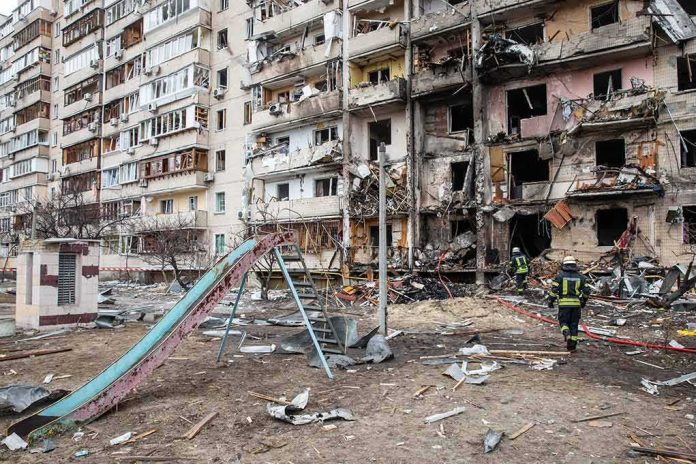
Russia’s use of one‑way attack drones against Kyiv and the surrounding Kyiv Oblast, including the Boryspil district where the capital’s main airport sits, has matured into a routinized campaign: massed salvos that force Ukraine’s air defenses to fight nightly while fragments, strays, and penetrations still injure civilians, set warehouses ablaze, and periodically kill bystanders.
At a Glance
- Documented Russian drone strikes have repeatedly targeted Kyiv and the Kyiv region, with Boryspil suffering casualties and damage alongside frequent air-defense engagements.
- Ukrainian intercept rates are often high, yet fragments and leakers still cause fires and injuries; several waves damaged residential buildings and logistics facilities.
- The activity fits a broader Russian pattern of near-daily Shahed‑type drone salvos designed to saturate defenses and pressure urban life and infrastructure.
- The operational center of gravity is shifting toward larger, more frequent strikes that compress warning time and expand damage risk across multiple districts.
What Happened: Kyiv and Boryspil Under Repeated Drone Fire
Open-source reporting and official statements from Ukrainian authorities converge on a clear picture: Russia has conducted recurring overnight and mixed-time-window drone attacks against Kyiv and surrounding areas, with Boryspil—home to key logistics nodes and the international airport—frequently affected. Reuters detailed an overnight strike in which explosions echoed across the capital for roughly two hours; Ukraine’s air force reported destroying dozens of inbound drones, yet four people were still injured in the capital from debris and blast effects. In subsequent waves, authorities recorded fatalities and more than a dozen injuries in Boryspil—casualties linked to strikes on a residential building and other sites, according to the regional governor.
These were not isolated episodes. Local and international outlets have documented fires and structural damage across multiple nights: a rail worker killed at a crossing in Boryspil district; burning warehouses; damaged homes, garages, and vehicles; and emergency responses that stretched through the night as fragments and falling wreckage ignited secondary blazes. On other nights, officials emphasized that there were no civilian casualties—an outcome they attributed to both successful intercepts and public compliance with shelter guidance, as air-defense batteries engaged targets over the region.
How the Campaign Works: Saturation, Fragment Risk, and Operational Aims
Russia’s preferred instrument in these episodes is the Shahed‑type one‑way attack drone: inexpensive, long‑range, individually slow but operationally potent in swarms. By launching dozens at once, sometimes layered with cruise or ballistic missiles, Russia attempts to saturate Ukrainian tracking, cueing, and interceptor inventories. Even with good shoot-down rates, two dynamics work in Moscow’s favor. First, any “leaker” can still strike a target. Second, mid‑air kills over urban areas shower fragments—warhead remnants, engine blocks, and wing sections—onto neighborhoods below, producing a steady drumbeat of fires, injuries, and property damage, as Kyiv residents have repeatedly experienced.
The operational logic is coercive pressure via persistence. Analysts at CSIS describe a sharp escalation in launch volume beginning in late 2024, with weekly Shahed sorties jumping from roughly 130 to over 1,000 within six months; by 2025, large, mixed salvos had become normalized, with average wave sizes approaching 300 and intervals between major strikes compressing to a few days. Interception remains the Ukrainian strength, but volume tilts the cost curve and forces defenders to expend high‑value munitions to defeat low‑cost attackers—exactly the asymmetry Russia is trying to impose.
Why Boryspil Matters: Logistics, Symbolism, and Civilian Exposure
Boryspil’s prominence in the strike record is not accidental. It anchors international aviation infrastructure and sits amid vital logistics corridors; even when the airport itself is not directly targeted, the broader district hosts warehouses, rail crossings, and industrial sites. Reported incidents include strikes and debris impacts that killed or injured civilians and damaged residential buildings and storage facilities, sparking fires that required extended emergency response. From Moscow’s perspective, repeated pressure around Boryspil signals reach and complicates Ukraine’s wartime distribution of goods—pharmaceutical and other warehousing has been hit—without having to penetrate deeply protected point targets every time.
Civilians bear the brunt of this geography. Air-defense success often pushes intercept points outward from the urban core, but debris fields do not respect district boundaries. That is why the Kyiv City Military Administration and regional authorities keep repeating the same instructions on sheltering and refraining from filming air defenses in action; the risk profile during active engagements is not theoretical, as injuries from falling fragments and secondary fires attest.
Scale and Pattern: From Episodic Raids to a System of Pressure
Across months, the strikes cohere into a system rather than a set of incidents. Multiple independent assessments chart the migration from sporadic waves in 2022 toward routinized salvos by 2025–2026—larger, more frequent, and more complex in routing and altitude, with decoys to split radar attention. One CSIS analysis documented record single‑day Shahed deployments in the hundreds, underscoring how quantity alone can strain defenders and emergency services across multiple oblasts at once. Another CSIS review quantified the overall missile and drone volume since late 2022, with more than 14,700 one‑way attack drones reported launched through 2024—evidence that the Shahed is a strategic, not tactical, choice for Russia.
That scale helps explain the lived experience in Kyiv: sirens at unconventional hours, successive nights of alerts around the start and midpoint of months, and the alternation between casualty‑free nights and deadly ones as fragments fall differently and a handful of drones slip through. For residents, the oscillation is psychological attrition; for planners, it is resource attrition—manpower on alert, radar uptime, interceptor inventories, fire brigades and grid repair crews on call, every night.
Air Defense, Effectiveness, and Limits
Ukraine’s defenders have honed a layered response: radar and electro‑optical detection, radio‑electronic warfare to degrade guidance, mobile gun and MANPADS teams for terminal defense, and higher‑end interceptors for missiles mixed into the wave. In many reported cases, the air force reports downing the majority of inbound drones—dozens in a night—yet injury counts in Kyiv and Boryspil still surface afterward because “successful defense” in a drone‑saturation environment means preventing catastrophic hits, not preventing all damage. Cost asymmetry endures: an interceptor may cost orders of magnitude more than a single Shahed, but the cost of not firing—allowing a leaker to hit a residential block, a substation, or a distribution warehouse—can be higher still. Analysts evaluating cost‑effectiveness therefore look beyond unit prices to replacement cycles, domestic production capacity, and the value preserved by defense of critical nodes.
The limits are structural. Unless Russia’s stockpiles, production, or political will falter, saturation can be sustained at a tempo that forces Ukraine to rotate systems and crews while juggling protection of the capital with coverage of ports, power infrastructure, and front‑line logistics. This is why even nights officially labeled “no civilian casualties” matter: the system is still working on Ukraine’s decision cycles and supply lines.
⚔️ KYIV, UKRAINE: Russian aerial strikes targeted the capital and Boryspil International Airport on September 5. Sustained drone attacks caused infrastructure damage to warehouses and residential buildings across multiple regions.#Kyiv #Ukraine #AerialStrike #ThreatIntel… pic.twitter.com/oF4s8xE03M
— Threatwhere (@threatwhere) September 7, 2026
What It Means Going Forward
The evidence on Kyiv and Boryspil points to a durable reality rather than a transient flare‑up. Russia has institutionalized the drone salvo as a strategic instrument—cheap, scalable, and politically useful for signaling reach into the heart of Ukraine. Ukraine has institutionalized the counter: layered air defense, rapid public warnings, disciplined civil response, and swift repair. Between those poles lies the human cost that turns up in casualty ledgers and fire reports after each wave. As long as Russia sustains volume, Kyiv’s nights will continue to toggle between “everything intercepted” and “something slipped through”—and Boryspil, with its mix of symbolism and logistics, will remain in the crosshairs.
Sources:
thegatewaypundit.com, aljazeera.com, reuters.com, newsukraine.rbc.ua, pravda.com.ua, unn.ua, english.aawsat.com, censor.net, ukrinform.net, isis-online.org, csis.org, businessinsider.com, airwars.org