

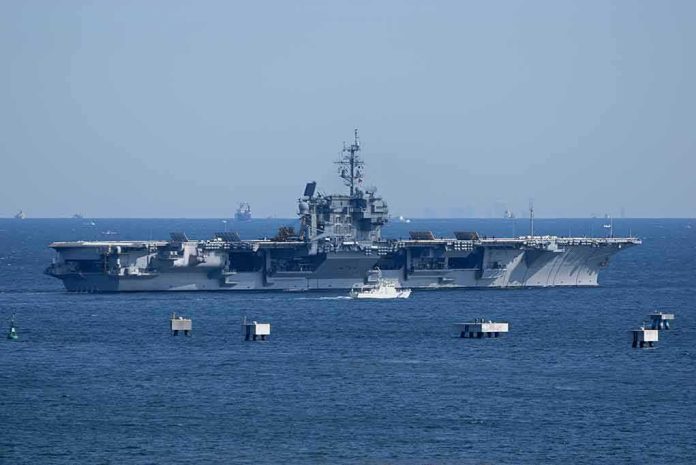
In the Strait of Hormuz, claims of “imminent threat” are not abstractions; they are the switch that determines whether the world’s most consequential shipping lane stays open or slides toward wider war.
At a Glance
- U.S. Central Command says it struck Iranian IRGC launchers on Larak Island to preempt sea-mining aimed at the Strait of Hormuz, describing “limited, precise action.”
- Independent outlets align on the U.S. rationale: prevent a near-term threat to civilian mariners, commercial shipping, and global trade flows.
- Tehran condemns the strike as an illegal violation of sovereignty, reports casualties, and frames its missile response against U.S. sites as lawful self-defense.
- This fits a recurring pattern in Hormuz: rapid action, sparse public evidence, and dueling legal narratives over anticipatory self-defense in a chokepoint that moves oil markets.
What Happened and Why It Matters for Global Shipping
According to U.S. Central Command (CENTCOM), American forces conducted a limited, precision strike on Iran’s Larak Island after observing Islamic Revolutionary Guard Corps personnel preparing to “launch rockets and deploy sea mines into the Strait of Hormuz.” The official rationale is straightforward and weighty: remove an imminent hazard to civilian mariners and the free flow of commerce through the world’s most sensitive energy corridor. Multiple major outlets reported that framing consistently, with CENTCOM’s phrasing carried intact.
The United States presented the action as the first known direct strike inside Iran in several weeks, signaling both restraint and readiness amid a persistent, low-burn confrontation. Shortly after, Iran answered with missile fire at U.S.-linked targets in the region, underscoring that this was not a one-sided raid but another turn in a tit-for-tat cycle. The exchange risks more than military theater; roughly a fifth of seaborne oil and liquefied natural gas regularly transits Hormuz, and any credible mine-laying there would raise insurance premia, reroute ships, and immediately reverberate through energy markets.
The Mechanism of Threat: Sea Mines, Launchers, and “Imminence”
Sea mines are the cheapest strategic lever in the Gulf. Even rumored emplacement near Hormuz’s narrow shipping channels can push ship operators to delay or divert. The U.S. account centers on launchers and “rockets with sea mines” being readied for deployment; some reports paraphrase the systems as missile or anti-ship cruise missile launchers, an inconsistency that matters because the legal basis for anticipatory self-defense often turns on the specific capability and how close it is to use. What remains public is a CENTCOM statement and unnamed U.S. officials briefing reporters—no imagery or declassified ISR package has been released that would let outside analysts confirm a mine-laying operation in progress. That evidentiary gap is common in real time; it also fuels skepticism.
Could rockets emplace mines? Analysts note Iran has experimented with “standoff” methods to seed hazards in constrained waters, though traditional mine warfare often relies on surface craft, small boats, or sub-surface delivery. The U.S. claim is operationally specific—launchers preparing to deploy mines toward a critical lane—yet remains uncorroborated in public with sensor feeds. In practice, commanders weigh classified indicators, pattern-of-life data, and rules of engagement that define imminence in minutes and meters, not press-ready graphics. Without a declassification, the public is asked to credit the threat assessment on authority.
Competing Legal Narratives: Anticipatory Self-Defense vs. Sovereignty
Washington’s logic is familiar: in a chokepoint where both civilian safety and alliance credibility ride on uninterrupted passage, stopping a live attempt to mine shipping lanes is a lawful, necessary, and proportionate act of self-defense. Tehran’s answer is equally predictable and categorical: a strike on its territory violates sovereignty and the UN Charter; reported casualties and damage intensify the charge. Iran’s UN mission and Foreign Ministry cast subsequent missile attacks on U.S. sites as “defensive and proportionate” responses. In this legal duel, each side invokes self-defense while accusing the other of aggression—a posture amplified by the speed of events and the absence of jointly accepted fact-finding.
International lawyers will recognize the hinge: how narrowly or broadly a state defines imminence, what evidence it can credibly point to, and whether force was necessary and proportionate to avert the alleged attack. Absent public release of targeting packets or battle damage assessments, outside adjudication defaults to trust in national assessments—or, conversely, to skepticism of them. The Strait’s strategic gravity ensures that neither narrative is only academic; the prevailing account shapes coalition behavior and market expectations in real time.
Pattern, Not One-Off: Hormuz as a Narrative and Coercion Battlefield
This episode slots into a longer pattern: rapid military decisions justified by anticipatory self-defense claims, followed by retaliatory fire and dueling statements, all before independent forensics can surface. Hormuz magnifies that rhythm. States, insurers, and shippers price risk immediately; they cannot wait for a declassified ISR clip. As a result, the first mover in the information space often enjoys a practical advantage—if allies, markets, and mariners accept that a threat was imminent and thwarted, the intent behind force looks protective rather than escalatory. That incentive pushes both Washington and Tehran to frame early and hard.
For policymakers, this is not merely about deterring an adversary; it is about preserving freedom of navigation as an operational fact. Mine warfare is asymmetric by design. The credible threat of renewed emplacement can slow traffic without a single hull breach. Denial and deception around coastal launchers, mixed with civilian cover and familiar waterways, complicate attribution and compress decision windows. The United States therefore leans on persistent ISR, standing ROE, and forward-deployed maritime forces to respond inside that window—accepting that public transparency will lag operational necessity.
Iran fired roughly a dozen missiles and drones today at US forces and partner bases in Jordan, Kuwait, Bahrain, and Iraq's Kurdistan region, retaliating for a fresh round of CENTCOM strikes on IRGC air defense sites, radar systems, maritime assets, and mine laying capability near…
— Marneen (@marneen) September 2, 2026
Where the Evidence Is Strong—and Where It Is Thin
The factual backbone that stands up well: CENTCOM went on record about a limited strike to preempt a sea-mining threat; major outlets independently carried the same core rationale; and Iran responded with missile fire, confirming an exchange rather than a unilateral U.S. action. Those points are consistent across sources. What remains thin in the public domain is the granular proof of imminence—imagery of rigged mines, telemetry of launch preparation, or a declassified rules-of-engagement memo. The terminology drift across reports (rockets, missiles, anti-ship systems) further blurs the technical picture, though it does not by itself negate the U.S. claim.
Implications: Shipping, Alliances, and the Next Decision Window
For shipowners and insurers, the operational question is binary: is there an active mine hazard inside or abeam of the convoy lanes? Naval mine countermeasures and air-sea patrol patterns adapt quickly after such strikes, but even transient uncertainty widens spreads and alters routing. For allies hosting U.S. forces within Iranian missile and drone range, the cycle of strike and counter-strike tightens domestic risk calculations—and with them, basing and overflight politics. Strategically, both sides are testing thresholds: how close to the lanes Iran can posture assets without drawing fire, and how far the United States will go to maintain a credible preemption standard without sliding into broader war.
The cleanest path to reducing ambiguity is also the least likely in real time: selective declassification of strike intelligence or third-party satellite analysis that can verify equipment, posture, and timing; conversely, credible Iranian forensic data could challenge the imminence claim if it showed non-operational status at the moment of impact. Short of that, this contest will continue to be decided, operationally and narratively, inside compressed windows—where commanders weigh classified indicators, lawyers parse imminence, and tankers wait for the all clear.
Sources:
tass.com, cnn.com, english.news.cn, aljazeera.com, bbc.com, kayhanlife.com, yahoo.com