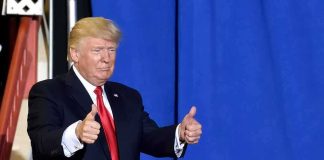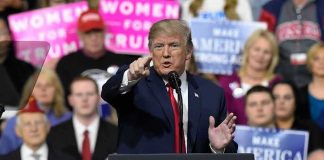
The collision between verified Iranian plots to assassinate Donald Trump and Trump’s own vow to pound Iran with repeated military strikes has turned a long-running hostility into a personalized, open-ended war built around the security of one man and the survival of one regime.
Key Points
- U.S. and allied intelligence, Justice Department charges, and court testimony now document multiple Iran-linked plots to kill Donald Trump, making him an unusually explicit foreign-state target.
- Trump has responded by portraying the Iranian leadership as “stone cold crazy,” framing massive U.S. airstrikes and overt regime-change goals as necessary self‑defense and global security policy.
- Independent fact‑checks and nuclear monitoring bodies dispute key elements of Trump’s threat narrative, especially claims of an imminent Iranian nuclear weapon or missiles able to hit the U.S. homeland.
- The confrontation sits inside a broader global surge in assassination threats and political violence, where foreign plots and domestic attacks increasingly blur together.
From Soleimani’s Killing to an Explicit Assassination Feud
The current standoff cannot be understood without the decision Trump took in January 2020: ordering the drone strike that killed General Qasem Soleimani, the architect of Iran’s regional operations. That strike crossed a psychological line for Iran’s leadership; senior figures publicly vowed revenge and began speaking not only of striking U.S. forces, but of killing Trump personally.
Over subsequent years, U.S. and allied intelligence services have repeatedly detected plots linked to Iran’s security apparatus that target Trump directly. Reporting by CNN, the New York Times, CBS News and others describes human-source intelligence on a murder-for-hire scheme, escalated Secret Service protection, and specific operational planning attributed to Iranian actors. Time Magazine’s reconstruction of one plot notes that a go-between was effectively authorized to offer up to $1 million for Trump’s assassination, and ties that scheme to publicly declared Iranian vows of revenge for Soleimani.
The Justice Department has moved beyond intelligence into criminal process. A federal complaint and subsequent charges name Iranian officials and alleged agents in the United States as participants in a plot to kill Trump before the 2024 election, placing the case alongside other documented attempts against U.S. presidents in a long historical list. In Brooklyn, a Pakistani businessman has testified under oath that he was recruited and coerced by Iran’s Revolutionary Guard Corps to join an assassination plan, describing explicit threats to his family.
Seen together, these cases make clear that Iranian actors have not merely fantasized about killing a U.S. president; they have organized concrete operations, tested access, and hired intermediaries. Trump’s insistence that he is Iran’s “number one target,” a phrase he has repeated in interviews and aboard Air Force One, is not just rhetorical flourish but grounded in documented hostile activity.
Trump’s Language: “Stone Cold Crazy” and a Personalized War
Trump has chosen to respond by elevating the confrontation from a strategic rivalry to a moral and psychological crusade. In speeches, interviews, and posts on his social platform, he has described Iran’s rulers as “stone cold crazy,” “sick people,” and “crazy bastards,” language that strips away the usual diplomatic veneer and portrays the regime as irredeemably irrational.
That rhetoric sits alongside policy steps that formally recast Iran as a threat requiring extraordinary measures. A recent White House fact sheet highlights an executive order that renews the national emergency with respect to Iran and creates mechanisms to impose tariffs on countries doing business with Tehran, characterized as necessary to protect American security and the U.S. economy. In prime-time addresses and video statements, Trump has framed ongoing U.S. airstrikes as a “massive and ongoing effort” not only to neutralize threats to U.S. forces, allies, and global shipping, but to make sure “they will never possess a nuclear weapon” and ultimately to remove the clerical regime from power.
On the operational side, that framing has translated into some of the largest U.S.–Israeli air campaigns in the region’s modern history. Israel has acknowledged an operation involving roughly 200 fighter jets striking about 500 targets in western and central Iran, including air defenses and missile launchers; Trump has announced “major combat operations” in tandem, casting the effort as a joint bid to dismantle the Islamic Republic’s military core. U.S. Central Command has detailed strikes on over 170 targets in recent waves alone, ranging from coastal surveillance to naval infrastructure, all justified in part as measures to keep the Strait of Hormuz open.
Trump’s own words tighten the linkage between personal security and national policy. Asked what should happen if Iran ever succeeded in assassinating him, he has said he left instructions for the United States to launch massive strikes on Iran in response, and in public remarks he has promised a disproportionate retaliation ratio—“every time they hit us, we’re going to hit them 20.” The message is unmistakable: harm the man, and the full weight of U.S. military power will fall on the regime.
Regime Change as Economic Cure: Aspirations and Reality
Beyond self-defense, Trump has asserted that removing Iran’s current leadership is necessary to restore the country economically. This argument builds on a familiar critique: that decades of revolutionary rule, sanctions, and foreign adventurism have hollowed out Iran’s economy and condemned its population to mismanagement and isolation. The administration’s public framing of the war—emphasizing destruction of missile industries, naval forces, and nuclear capabilities—is often paired with promises that a different political order in Tehran would unlock prosperity.
Analytically, this is a sweeping claim. Iran’s economy is indeed constrained by sanctions, corruption, and the costs of regional proxy conflicts. But serious research on the regime’s internal politics and international position shows a leadership deeply focused on survival and sovereignty. Iran’s core demands in negotiations over the war have been consistent: regime survival, credible guarantees against future U.S. or Israeli attacks, meaningful sanctions relief, and retention of deterrent capabilities—the very capacities Trump seeks to destroy. In other words, the regime’s economic and security priorities are inseparable from its insistence on remaining in power.
Experts at institutions such as Chatham House and legal analysts of Iran’s constitutional system describe a complex hybrid structure in which a Supreme Leader, backed by security organs, balances domestic legitimacy crises with regional strategy and appeals to resistance against Western pressure. That structure has proven remarkably durable in the face of previous external shocks, including extensive sanctions and covert operations. As recent BBC analysis concludes, despite Trump’s claims that Iran’s armed forces and enrichment program have been “decimated,” the same regime remains firmly in place, still able to negotiate, mobilize, and fight.
For readers who remember earlier promises of quick regime change in Iraq or Libya, the parallel is hard to ignore. Airstrikes can degrade specific capabilities; they do not automatically produce a stable, pro‑Western government, let alone a rapid economic turnaround.
Where Trump’s Threat Narrative Collides with the Evidence
When Trump describes the Iranian leadership as “stone cold crazy” and insists that U.S. strikes are compelled by imminent existential threats, he is making two distinct claims: one about behavior, the other about capability. The first—willingness to sponsor assassination plots—is amply documented. The second—imminent nuclear or missile danger to the U.S. homeland—is not.
A detailed New York Times fact‑check of Trump’s justifications for attacking Iran finds no public evidence that Iran was preparing a preemptive assault on the United States. Defense Intelligence Agency reporting and statements from the head of the International Atomic Energy Agency indicate that, while Iran has missiles capable of striking regional targets and U.S. bases in the Middle East, it does not possess intercontinental ballistic missiles able to reach the continental United States, nor has the IAEA seen clear signs of a decision to build nuclear weapons.
U.S. strikes on Iranian nuclear facilities last year did seriously degrade capabilities and likely delayed elements of the program by roughly two years, according to Pentagon assessments; but they did not “completely obliterate” Iran’s nuclear infrastructure, as Trump has claimed. Arms control experts argue that talk of Iran being on the brink of “weaponizing” its nuclear material is designed to justify further U.S. attacks rather than reflecting an intelligence consensus.
This gap between rhetoric and evidence matters. It is one thing to argue, credibly, that a state sponsoring assassination plots against a U.S. president and attacking regional bases demands firm response. It is another to anchor a large-scale, open-ended war—and a regime-change strategy—in threats that intelligence services and international watchdogs do not corroborate. For an older audience that has watched multiple wars sold on worst‑case scenarios, the distinction is critical.
Assassination Plots in an Era of Rising Political Violence
The Iran–Trump feud is not occurring in isolation. Data on political violence and threats against public officials show a sharp rise over the past decade, in the United States and globally. A research review of public figure threats finds that many would‑be attackers are mentally ill and experiencing downward spirals in their lives, and that direct threats are often a poor predictor compared with observable “approach” behaviors. A live dataset of assassination attempts on U.S. politicians identifies nearly thirty serious incidents since the 1960s, with the pace accelerating in the 2020s.
Studies of terrorism and political assassinations indicate that violence against politicians is most likely in systems combining restricted political competition with high polarization and fragmentation—conditions that describe both Iran’s internal environment and, increasingly, parts of the American landscape. In the U.S., political violence has in recent years come disproportionately from the extremist right, according to terrorism databases and FBI statistics, even as foreign-directed plots like Iran’s run in parallel.
Against that backdrop, Trump’s profane and incendiary language toward Iran operates in a charged domestic climate. Scholars writing in venues like The Conversation have warned that such rhetoric—the promise to send Iran “back to the Stone Ages,” for example—illustrates a broader “unhinged language of war” that can lower inhibitions, both among state actors and among volatile individuals inclined toward violence.
The assassination attempts and plots against Trump, whether domestic or foreign-sponsored, have already fed into a sense among many Americans that political life has crossed into a more dangerous era. Each new plot, such as the Iranian schemes detailed in court filings and intelligence briefings, layers onto domestic shootings at rallies and golf courses, reinforcing a perception that political leadership has become physically hazardous in ways unfamiliar since the mid‑20th century.
Watch: Trump Calls Iranian Regime 'Stone Cold Crazy', Vows More Strikeshttps://t.co/gr0i9Y1hss
— RedState (@RedState) July 13, 2026
Strategic Costs and Open Questions Going Forward
Strategically, Trump’s insistence that the Iranian regime is “stone cold crazy” and must be battered until it collapses raises three enduring questions.
First, can airstrikes and economic isolation alone produce regime change in a system as entrenched as Iran’s? Officials from Israel and Arab states, interviewed by Reuters, are skeptical; they doubt that bombing commanders and security institutions, even in carefully targeted campaigns, will be enough to uproot the clerical establishment. Iran’s own negotiation stance, centered on regime survival and deterrent preservation, suggests that external pressure will be met with internal tightening, not capitulation.
Second, how does tying U.S. war policy to the security of one president shape escalation dynamics? Trump’s stated desire to retaliate at ratios like “20 to 1” and his talk of automatic strikes if he is killed compress decision-making into a narrow, emotionally charged channel. That may deter some actions; it also risks locking the United States into cycles of tit‑for‑tat that are hard to unwind, especially if Iran’s leadership calculates that domestic nationalist sentiment can absorb punishment.
Third, what does this confrontation do to broader norms around assassination and political violence? When a head of state publicly centers his war aims around personal protection and the destruction of a foreign regime, it blurs lines between national interest and individual vendetta. Iran’s documented assassination plots already cross established legal and moral boundaries; sustained war fought largely in response to such plots tests the resilience of those boundaries from the other side.
For now, the evidence is clear on two points. Iran’s security apparatus has repeatedly pursued ways to kill Donald Trump. And Trump, in turn, has made the Iranian regime the focal point of an unusually personalized war, built on a narrative of imminent, existential threat that is only partially supported by the underlying intelligence. How long that feedback loop can continue without either decisive change in Iran or a recalibration in Washington remains one of the most consequential strategic questions of this era.
Sources:
redstate.com, cnn.com, theguardian.com, time.com, youtube.com, nytimes.com, cbsnews.com, unitedagainstnucleariran.com, justsecurity.org, unwatch.org, chathamhouse.org, common.usembassy.gov, pubmed.ncbi.nlm.nih.gov, thomasrenard.eu, en.wikipedia.org, ctc.westpoint.edu, thehindu.com, foreignpolicy.com, newsweek.com, cato.org